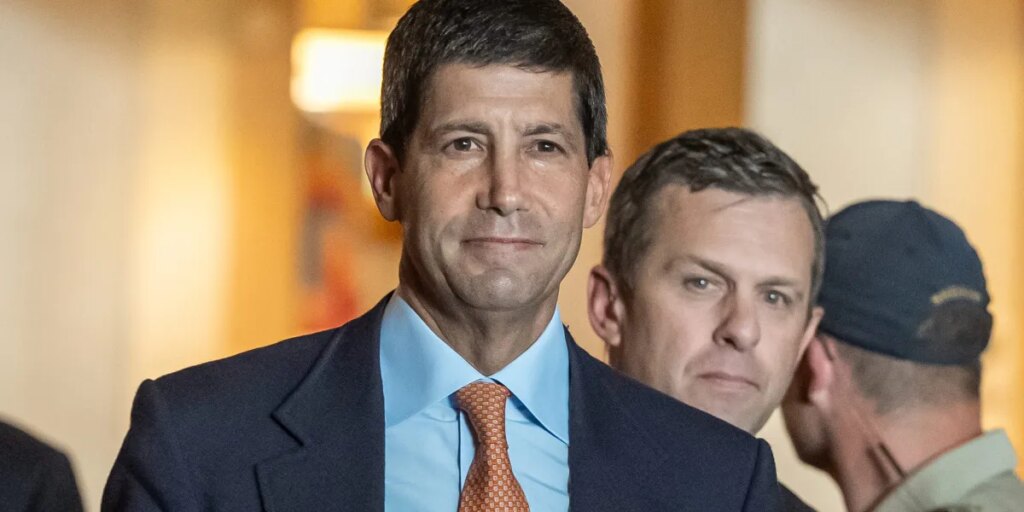
Wall Street hadn’t heard a peep out of Federal Reserve chairman Kevin Warsh for a month, until he walked on stage for his keynote speech at Jackson Hole today. Warsh’s speech at the Fed’s annual gathering came with added scrutiny this year: Not only was it Warsh’s first as chairman, but he has also caused analysts some discomfort with his pullback from giving now-familiar forward guidance (in which the central bank indicated the general direction of travel for the base interest rate). On forward guidance, Warsh stuck to his guns, saying: “You might know about my longtime discomfort with early pronouncements of future policy decisions … Forward guidance as a regular practice was adopted by my colleagues—and me—during the global financial crisis. It was essential at the time, and we introduced it with much fanfare.”
“But as with other legacies of crises past, I believe the practice has outstayed its welcome. In normal times, the role of forward guidance should be limited and circumscribed; otherwise, it risks creating ambiguity in the name of clarity. Oversharing policy deliberations and overcommitting to future decisions can lead markets, businesses, and households astray, and I believe when policymakers make quasi-commitments on interest rates throughout the cycle, we inhibit our own freedom to make the right calls when it’s time to decide.”
His tone was firm: “We should not indulge a regime in which market participants are looking primarily to the Fed for their next trade.”
And while Warsh has repeated his commitment to the Fed’s dual mandate of inflation at 2% and maximum employment, neither he nor his central bank staffers are living under a rock: Bond yields tracked higher following Warsh’s July press conference, as markets digested a Fed on hold and the suggestion that markets may be doing some of the legwork for financial tightening that they had come to expect from the Fed.
But more alarmingly—for some corners of the street—were the questions hanging over the established frameworks the Fed uses to make decisions about the base rate. Analysts questioned if these frameworks might be subject to change, searching for answers on how policymakers were thinking, even if they didn’t know what action it might prompt.
Here, Warsh shared insights. While his outlook on the economy wasn’t necessarily rosy, it nevertheless described the balance of priorities within the Fed.
Price stability is front of mind, he suggested, in the balance of risks in the Fed’s mandate. He said: “But on the price-stability side of our mandate, the numbers are more concerning. The Fed’s preferred measure of inflation, the 12-month change in the PCE price index, stands at 3.7%, while the six-month change is 4.1%.
“None of these measures are perfect, but they all tell a similar story: Inflation is running above our 2% target. So the Fed’s predominant focus right now should be on prices.”
The employment side of the Fed’s mandate is doing “well,” he said, courtesy of a robust consumer and a “rematching” of employers and employees after the COVID pandemic. He added: “As of now, I believe the labor markets are broadly consistent with full employment, but on the price stability side of our mandate, the numbers are more concerning.”
With speculation swirling as to how actively the Fed will commit to its mandate, Warsh moved to nix concerns: “There is one signal nobody can miss: The responsibility for 65 months of sustained, elevated inflation sits squarely with the central bank. And that is where it belongs … I stand here today committed to a discipline, not to a decision. My Fed colleagues and I are hardly the first to hold these positions in a time of great consequence. We are determined to redeem the time by doing our very best work.
“We take our responsibility seriously, with humility and with resolve. So much depends on choices we make. Sound monetary policy helps households and businesses to prosper. When carried out effectively, it broadens and deepens the momentum of our economy . . . and helps to secure America’s leadership in the world. And I know that our country needs us to think carefully and act wisely.”
Warsh’s latest speech (at the time of writing) seems to have sidestepped any sharp reaction from markets: the price of gold—a safe-haven asset relied upon during times of volatility—dropped by approximately 1% during Warsh’s speech. The VIX volatility index also declined 1%, while longer-dated Treasuries also lowered. The CME FedWatch index, which tracks Fed fund futures, shows 57% of traders believe the Fed’s next rate move on September will be a hike of 0.25%, to the 3.75% level.
Early reaction from analysts suggests Warsh learned from the pushback earlier this summer. Eric Winograd, chief U.S. economist at AllianceBernstein, wrote that while the Fed chairman’s speech was light on details of central bank transformation, it did “correct a couple of mistakes he made at his last press conference, reinforcing that PCE is the target measure for inflation and that interest rates are the Fed’s primary tool.
“Those corrections make the speech hawkish compared to his last remarks and should offer some relief to the back end of the yield curve, where some worries about Warsh’s willingness to act with rates to bring inflation down contributed to rising yields.”
‘The productivity pixie’
One thing some Wall Street analysts—unusually—didn’t want to hear too much about was AI. As UBS’s Paul Donovan quipped ahead of the speech: “The worst case would be a reiteration of Warsh’s belief in the productivity pixie, and platitudes about future higher growth. Technology’s impact on macroeconomic productivity is uncertain, and risks of a ‘brain drain’ from the U.S. and lower immigration also affect growth.”
The boomerang central banker hit on the topic early, but with questions rather than expectations as to how it might shape the Fed’s mandate. Warsh said: “We recognize that AI is a new variable—potentially a new factor of production—that will have consequences for both the economy and the conduct of monetary policy. It opens some major lines of inquiry: Will the application of AI cause a significant, sustained rise in productivity across the economy? And if so, when?”
“Among the other yet-unknowns is the resulting market structure. It’s not obvious where the returns on capital will land or on what timescale.”
He added: “We will be thinking through these matters with the help of a task force on productivity and jobs. My early check-ins with the leaders of that task force, and the four others, have been encouraging.”
The post Kevin Warsh finally threw Wall Street some crumbs on what he’s thinking: ‘There is one signal nobody can miss: 65 months of elevated inflation’ appeared first on Fortune.