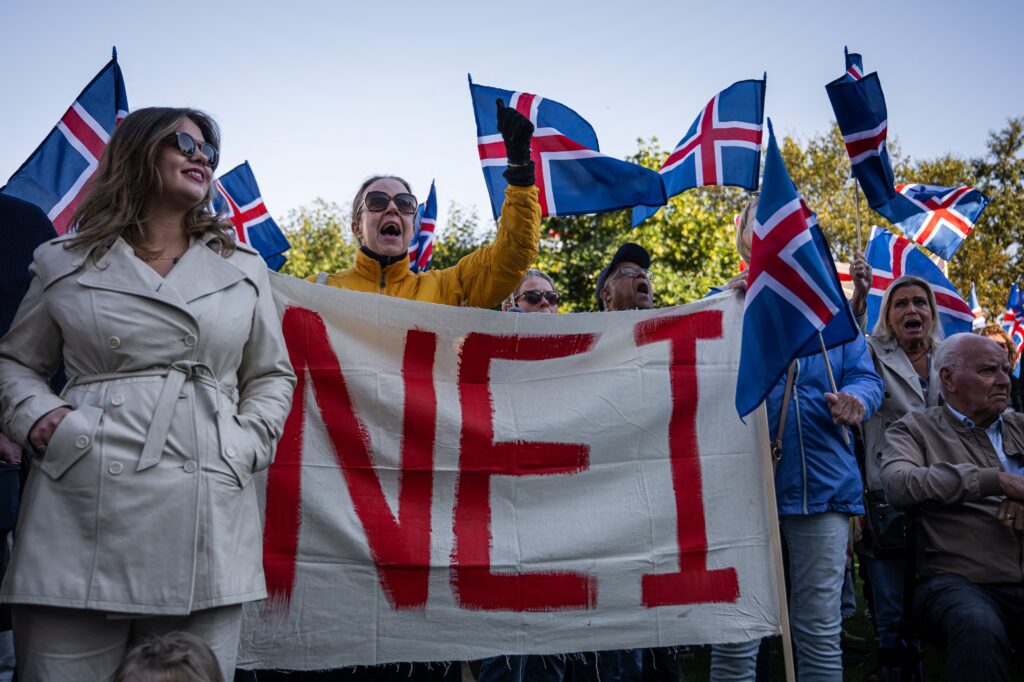
BRUSSELS ― Rattled by President Donald Trump’s territorial claims in the Arctic, the people of Iceland will vote Saturday on whether to restart talks on joining the European Union.
Iceland quit its E.U. bid more than a decade ago, after years of negotiations collapsed over fishing restrictions. Several factors, including rising prices and security concerns, have rekindled Icelandic interest in joining the bloc of 27 nations.
A major push, however, came this year from Trump’s fixation with seizing Greenland, Iceland’s neighbor in the North Atlantic.
Trump triggered a crisis at NATO when he insisted in January that the United States needed to take Greenland, which he called a “piece of ice.” Greenland is an autonomous territory of Denmark, a NATO member.
In public remarks, Trump mistakenly referred several times to Greenland as Iceland. Though evidently a gaffe, its repetition nonetheless stoked unease in Iceland about which island he wanted to grab.
“The international system we have lived with since the end of World War II is shaking,” Iceland’s Foreign Minister Thorgerdur Katrin Gunnarsdottir wrote in a recent report, stressing the value of cooperating with European allies.
A “weakened” relationship between Europe and the U.S. calls “for a new assessment,” Thorgerdur Katrin wrote. A referendum on E.U. talks, she said, would give the nation “a choice about where it wants to go” and “how it wants to secure its interests for the future.”
While Iceland, a nation of some 400,000 people just south of the Arctic Circle, is not an E.U. member, it is a member of NATO and also part of the E.U.’s common economic market under an agreement that includes Norway and Liechtenstein.
Proponents of reopening negotiations say the rift with the U.S. over Greenland, and global tensions over Arctic routes and resources, should push Iceland deeper into the E.U. fold.
Opponents argue that the bloc could infringe on Iceland’s decision-making, especially in the country’s key industries: fishing and farming.
Dagur B. Eggertsson, an Icelandic lawmaker and key figure in the pro-E.U. camp, said the goal was “strengthening our place within Europe at a time of growing uncertainty” about alliances that are crucial to smaller nations.
This “has increased the urgency of the European question for Iceland,” he told The Washington Post.
Dagur, a former mayor of Reykjavik, the capital, said the argument for E.U. membership is not to replace NATO or Iceland’s defense agreement with the U.S., but about “adding another layer of security.”
“When it comes to tariffs, trade wars and economic coercion, the E.U. is already a superpower,” he added. “It has the weight of the single market, an extensive network of trade agreements and the ability to defend its members collectively when economic pressure is applied.”
Joining the E.U. is an arduous process that entails years of negotiations with the bloc’s executive arm and requires enacting changes to align national laws and policies with E.U. requirements.
A candidate country must be judged to be in compliance with E.U. standards in more than 30 areas, from customs and agricultural regulations to anti-corruption measures and judicial independence.
Nations typically eyed economic benefits as an incentive to join the E.U., which was founded in 1993 to promote free trade across the continent. The E.U.’s single market is designed for seamless movement of people, goods, services and capital.
Today, the E.U. also pitches itself as a guarantor of stability and security at a time of mounting doubt about U.S. military commitments and fears of spillover from Russia’s war in Ukraine. Despite pledges to strengthen defense, the E.U. is not a military superpower and its 27 member countries are in a protracted, divisive debate about whether to expand at all.
The ballot will ask voters one yes-or-no question: Should Iceland resume membership talks with the E.U.?
In 2016, Britain held a referendum that similarly asked a binary question: Should the United Kingdom remain a member of the European Union or leave the European Union?
“Leave” won by a slight margin and the result was Brexit, Britain’s painful departure from the E.U., which has led to a decade of economic decline and stagnation.
Advocates of a larger E.U. say that achieving a successful outcome for Iceland could unlock the stalled bids of other countries. If the “No” camp wins, it could dampen efforts to build momentum around the idea of expansion.
Marta Kos, the E.U.’s commissioner for enlargement, says admitting new members would create “a Europe capable of securing its own interests” at a time of renewed rivalry among global powers.
In a world “where dependencies are weaponized … becoming stronger together is our biggest asset,” Kos said in a speech this week.
European leaders, grappling with a looming U.S. military drawdown, have vowed to take charge of their defenses. Kos told The Post she sees expanding the bloc as part of the efforts to ensure long-term security.
“Iceland’s decision would undoubtedly strengthen the case for the E.U. to welcome new members,” she added. Kos said she expected negotiations on Iceland’s membership to take one to two years, potentially leading to entry in 2028.
Nearly all the E.U.’s neighbors are seeking membership or closer ties, reflecting rising interest in the E.U., she said.
But the accession efforts of several nations, including Serbia, Kosovo and North Macedonia, have stalled for political and administrative reasons.
Many of the bloc’s members, from Germany to Bulgaria, have expressed reluctance about admitting others to the club, because of worries about the impact on the E.U.’s common budget, its foreign policy decisions and its power balance.
Montenegro is a front-runner in negotiations, while Albania is moving along its checklist. This summer, Ukraine and Moldova formally opened membership negotiations after Hungary dropped a long-standing veto against Kyiv.
Iceland, which has a stable economy, has fewer barriers to entry than most other candidates. In addition to being a member of the Common Market, it is also part of Europe’s visa-free travel zone.
In Saturday ballot’s, citizens will vote solely on resuming negotiations, not on actual membership. Ultimately, a deal would require Iceland to hold a second referendum, as well as receive approval from all 27 current E.U. member states.
“I think the European Union needs a successful case because it hasn’t had one ever since 2013,” when Croatia was the last country to join, said Nina Vujanovic, a fellow at the Brussels-based Bruegel research institute.
Since Russia’s 2022 invasion of Ukraine, seeking E.U. membership has gained an added “security dimension,” Vujanovic said, signaling that a nation is part of Europe’s democratic orbit and aligning its identity as European.
“For a country like Ukraine, entering the E.U. and its institutions means stability and security,” she said. “For Iceland, it is also a security question,” given threats in the Arctic.
Trump’s tariffs and rhetoric on annexation have triggered bursts of patriotism in Canada, Greenland and across Europe. This has pushed nations like Iceland but also Britain, the only country to leave the E.U., closer to Brussels.
Tinatin Akhvlediani, head of the E.U. Enlargement Program at the Centre for European Policy Studies, said a “Yes” from Iceland would help “make the case that the European Union and its membership are very attractive.”
It would highlight that “it’s not only candidate countries which are poor, which have security threats, which are bigger or have ongoing military conflicts,” Akhvlediani added. “These are also prosperous economies, stable democracies … that still want to be part of the European Union.”
The post Iceland eyes hookup with European Union after Trump’s grab for Greenland appeared first on Washington Post.