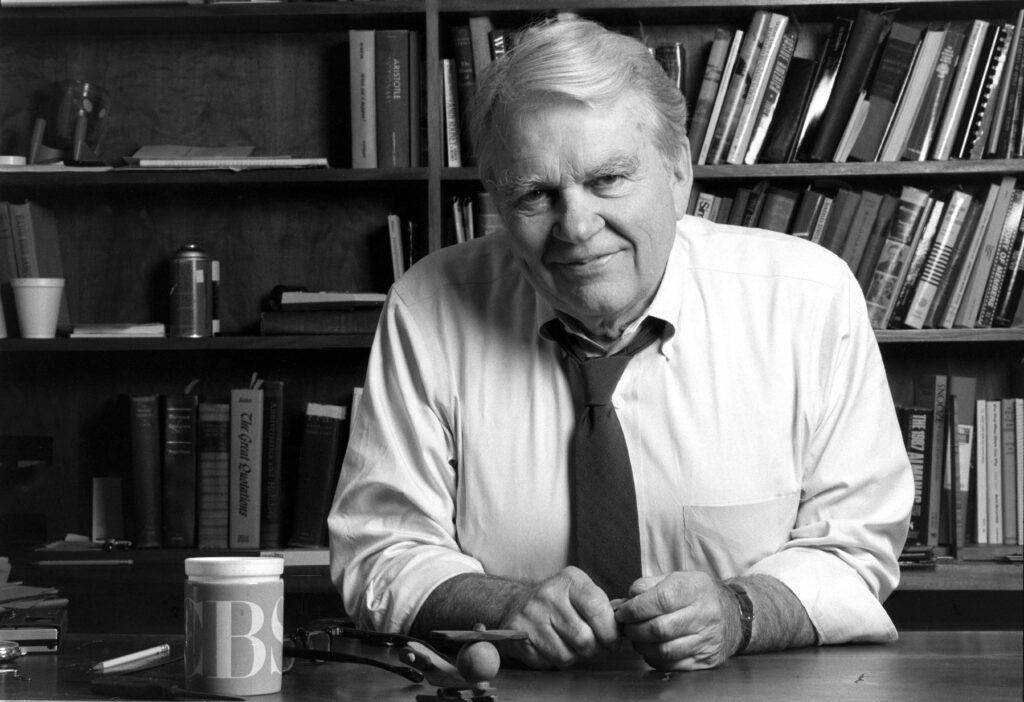
Last week, the media website Breaker reported that embattled “60 Minutes” executive producer Nick Bilton, empowered by equally embattled CBS editor in chief Bari Weiss, wants to bring a long-lost segment back to the show: “A Few Minutes With.” The segment, featuring Andy Rooney, ran for more than 33 years until Rooney’s retirement in 2011 at 92. Bilton and Weiss are reportedly eyeing comedians (who, not coincidentally, tend to share Weiss’s woke-skeptical worldview) such as Jerry Seinfeld (he turned it down) and John Cleese. With the show slated to return, much revamped and missing staples like Scott Pelley, on Sept. 13, they had better find someone fast.
If they’re going to replace Rooney, it’s probably worth remembering who he really was.
Contrary to how it may have seemed at the time, Andy Rooney was not, in fact, born delivering commentaries to camera on Sunday nights. As we learn from “Andy Rooney: A Lucky Life,” a terrific, soon-to-be-released biography by Paul Grondahl, Rooney was an old-school journalist first and foremost.
He started his career covering World War II for Stars and Stripes alongside his lifelong best friend, Walter Cronkite. (Cronkite famously described a bombing over Germany as an “assignment to hell,” a phrase Rooney for years mocked as too purple.) Rooney stood out, even then, for his lack of concern about decorum or likability. The only goal was the purest journalistic one: Tell the truth.
Covering the war for Stars and Stripes — a publication renowned for its independence (and currently under assault by Defense Secretary Pete Hegseth) from the government that funded it — Rooney skewered sacred cows such as Ernest Hemingway (“you could tell he was having the time of his life playing war”) and, especially, George Patton, whom he called “a foulmouthed boor who got too many American soldiers killed for the sake of enhancing his own reputation.” Patton wrote an angry letter to Stars and Stripes about that kind of coverage, to no effect. Rooney would eventually win the Bronze Star Medal for his work.
After the war, Rooney wrote for newspapers and, eventually, television: He won his first Emmy for CBS in 1968, quit two years later when CBS refused to run a segment called “An Essay on War,” went on PBS to recite it (his first-ever appearance reading his own piece in front of a television camera) and was hired back by CBS a couple of years later. The “60 Minutes” gig happened because audiences hated a point-counterpoint segment (witheringly mocked by Dan Aykroyd and Jane Curtin on “Saturday Night Live”). They gave Rooney the last 2½ minutes and got an instant hit in return.
Rooney went at the peculiarities and indignities of American life with the same clear-eyed relentlessness that he went at Patton with. His commentaries were often about light subjects — why cereal boxes were only half full, why electronic devices broke almost immediately — but they were based in an everyman perspective that was, more than anything, about the consumer standing up to corporate mistreatment. Grondahl writes: “He stood up for the little guy, railed against big business, spit in the eye of charlatans, exposed phoniness, skewered pomposity, groused about everyday annoyances, and stuck to a bedrock philosophy sometimes mistaken for churlishness.” That’s who Rooney was: He was always trying to be a truth-teller.
This could get him into trouble. A quote from Pelley in the book is exactly right: “Andy understood that popularity has nothing whatever to do with journalism,” he says. “He always had the courage of his convictions and he didn’t give a damn what anyone thought about what he wrote.” Pelley’s right about popularity having nothing to do with journalism, but Rooney’s perspective could be blinkered, whether it was mocking Kurt Cobain days after his suicide or, most notoriously, comments about Black parents and same-sex marriage that prompted CBS to suspend him. But he was also willing to change and, more important, to learn, saying on air that he didn’t want to be “someone who had made life a little more difficult. … I felt terrible about that.” Rooney would make strong statements, but they were never hot takes, and, like any good journalist, he tried to fix the holes in his thinking.
He was also, in the purest sense, a dogged working writer: In his career, he wrote an estimated 2,000 syndicated newspaper columns and some 1,000 television commentaries, all from a desk he built by hand and dragged into the “60 Minutes” office by himself. He rarely missed a show. He died about a month after leaving the show, nearly fulfilling the writer’s dream of doing what you love so much and for so long that, in the end, you just conk out at your desk.
The idea of the new “60 Minutes” having a Rooneyesque segment isn’t bad. But Rooney wasn’t popular, or beloved, because he just reacted to whatever dumb controversy happened to be making headlines. He was popular and beloved because he was trusted. And he was trusted because he took core journalistic principles and used them the way they’re supposed to be used: by sticking up for the little guy.
He was, at his core, one of us. Any replacement would do well to remember one of Rooney’s best quotes: “I just try to put down on paper some of the thoughts that have crossed my mind because I’m average enough so they’ve probably crossed the reader’s too. I’m satisfied trying to quantify the obvious.” In this age of disinformation, chaos and grift, I can think of no more noble calling. Here’s hoping his replacement hears it too, because we’ve never needed it more.
The post CBS wants a new Andy Rooney. It should study the original first. appeared first on Washington Post.