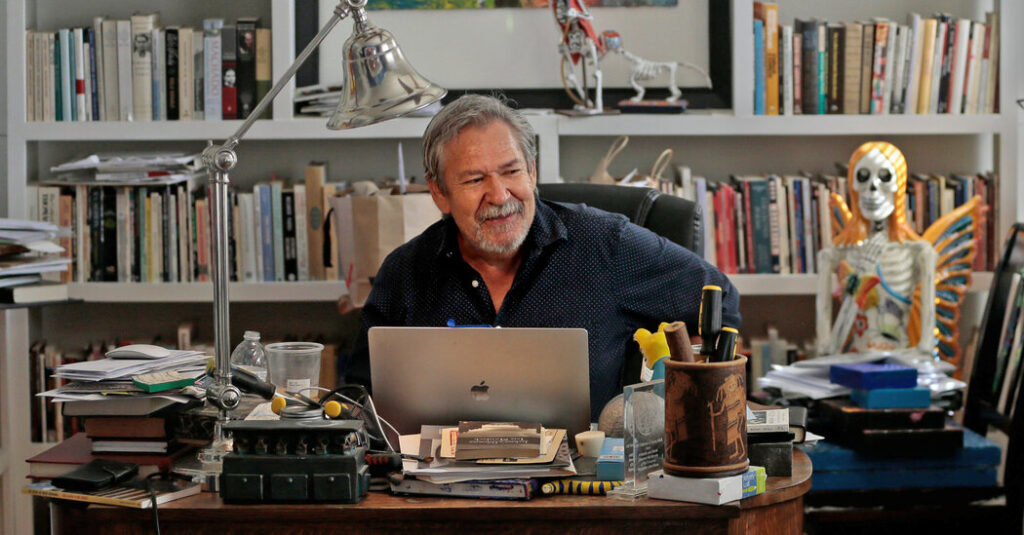
Benjamin Alire Sáenz, the first Latino novelist to win the PEN/Faulkner Award, and who examined — in poetry and prose — identity, belonging and sexuality along the physical, psychic and cultural border between the United States and Mexico, died on July 28 in El Paso. He was 71.
The death, in a hospital, was of complications from a lung disorder, his sister, Gloria Woods, said.
Mr. Sáenz (pronounced “signs”) experienced the fluidity of borders in all aspects of his life: in his travels between El Paso and Ciudad Juárez, Mexico, its sister city across the Rio Grande; in the duality of the English and Spanish languages; in the themes he explored as a writer of children’s, young adult and literary fiction; and in his complicated life as a one-time Catholic priest who, upon leaving the clergy, married and divorced, then publicly acknowledged at age 54 that he was gay.
Mr. Sáenz occupied “that liminal space; I would call it living in between,” his friend Daniel Chacón, the chairman of the creative writing department at the University of Texas, El Paso, said in an interview.
Writing, Mr. Sáenz often said, provided him with healing salvation from the double trauma of sexual abuse as a boy and substance abuse as an adult. It also brought him clarity, direction and hope during his journey toward self-discovery.
“I write all my books to save my life, I think,” he told Texas Monthly in 2013.
Born on a small farm in New Mexico, he lived most of his professional life roughly 50 miles to the south, in El Paso, where he completed his education and found his voice and a sense of acceptance.
In El Paso, he witnessed and experienced the discrimination and racism directed at Mexican Americans, who make up more than 80 percent of the city’s population. It was also a community, he described in a 2023 TEDx talk, that was “too hard-working, too forgiving and too generous to live in anger and rage.”
“I believe that a writer’s job is to bear witness, and I want to bear witness that the border is not just a [expletive] metaphor, that we are people,” he told Con Safos magazine in 2017.
Most of his two-dozen plus books took place along the U.S.-Mexican border. The two most highly regarded were published in 2012: “Everything Begins and Ends at the Kentucky Club,” a story collection that won the 2013 PEN/Faulkner Award, and “Aristotle and Dante Discover the Secrets of the Universe,” which Time magazine in 2021 named one of the 100 best young adult novels ever written. A film version was released in 2022.
The Kentucky Club is a real-life, prohibition-era bar in Juárez, a few blocks south of the border. Mr. Sáenz’s story collection illuminated the lives of marginalized people trapped in the pain of violence and the self-destructiveness of drugs, and those who were searching for grace amid their despair.
“We, on the border, want to live,” he told The Los Angeles Review of Books in 2013. “I write stories of survival. The teller has survived to tell the tale. I am one of those survivors.”
In one story, “The Hurting Game,” Michael, the narrator, discusses his inability to form an intimate bond with a friend, an anxiety that Mr. Sáenz said he himself experienced after being abused. “Some people knew how to love and some people didn’t,” Michael says. “Tom was the former. I was the latter. I didn’t know which one of us had it worse.”
In its first week of publication, “Aristotle and Dante” sold a disappointing 11 copies, Mr. Sáenz said in 2022 on the “Latino USA” public radio show.
Thanks to strong reviews and an audiobook narrated by the “Hamilton” playwright and songwriter Lin-Manuel Miranda, sales of “Aristotle and Dante” eventually surged past one million copies. The book was translated into at least two dozen languages, becoming his best-known and most commercially successful work.
“Aristotle and Dante” unfurls with Ari realizing that he is in love with his friend, Dante, and eventually overcoming his fear of acknowledging his feelings, a catharsis that Mr. Sáenz said he, too, needed to experience in order to write both “Kentucky Club” and “Aristotle and Dante.”
In 1994, he married Patricia Macias, a family court judge in El Paso. The marriage ended in divorce in 2008 during a turbulent and decisive period in which he entered treatment for drug and alcohol abuse, resolved while in therapy that he was gay, and stopped blaming himself for being sexually abused.
“We feel like we’re always a fraud,” Mr. Sáenz said of abuse victims on “Latino USA.” His therapist guided him toward restoration, he said, in part by asking who wrote his books. He said he did, of course — to which his therapist responded reassuringly, “You’re not an impostor.”
Benjamin Alire Sáenz was born on Aug. 16, 1954, in the agricultural community of Old Picacho, N.M., and grew up on a farm in Mesilla, near Las Cruces, to Juan and Eloisa (Alire) Sáenz. The fourth of seven children, he said on “Latino USA” that the only thing he had of his own was a toothbrush.
At the age of 5 or 6, he began experiencing sexual abuse from a family member. He never publicly identified the perpetrator and did not comment on how long the abuse continued.
The violence, he said in the TEDx talk, left him “afraid and confused” and searching for “a world that was kinder” than the one he knew. It led him to discover that better world in books. He said he would subsequently lie in the cotton fields outside his home, seeing the shapes of elephants and palm trees in the clouds, and concocting stories in his mind.
He grew up in a Catholic family, and his first calling was the priesthood. He received a bachelor’s degree in 1977 from St. Thomas Seminary in Denver, studied theology at the University of Louvain in Belgium and was ordained in 1981.
He left the clergy after three years, explaining in interviews years later that he found it lacking in what he hoped would be its mission of championing social justice and the poor. He also sensed both his sexual awakening and a desire to become a writer, and cited his inability to remain a spokesman for a Catholic Church amid sexual-abuse scandals.
“Too painful,” he told El Paso Inc. magazine in 2021.
He entered the University of Texas, El Paso, received a master’s degree in creative writing in 1987, then wrote his first book of poetry, “Calendar of Dust,” while on a fellowship at Stanford University. It won an American Book Award in 1992. But El Paso beckoned and, against the advice of his Stanford colleagues, he returned to the border city.
“I have never felt truly American, but I have always felt home in El Paso,” Mr. Sáenz said in his TEDx talk.
In addition to his sister, he is survived by two brothers, Ricardo and Joe Sáenz.
In 2010, Poets & Writers, a nonprofit literary organization, named Mr. Sáenz one of the world’s 50 most inspiring authors. In 2021, he published “Aristotle and Dante Dive Into the Waters of the World,” a best-selling sequel to his original book and that addressed the AIDS epidemic.
Mr. Sáenz completed a final novel before his death, “When the World Was Happy,” which is scheduled to publish in September and is loosely based on the death in 1990 of his 13-year-old niece, Amy Hauser, during a mass shooting at a bowling alley in Las Cruces.
“Our roots of love are deep. Our pain is deep,” Ms. Woods, the sister of Mr. Sáenz and mother of Ms. Hauser, said of the family in a text message. “Our love for one another is deeper than our pain.”
The post Benjamin Alire Sáenz, First Latino Writer to Win PEN/Faulkner, Dies at 71 appeared first on New York Times.