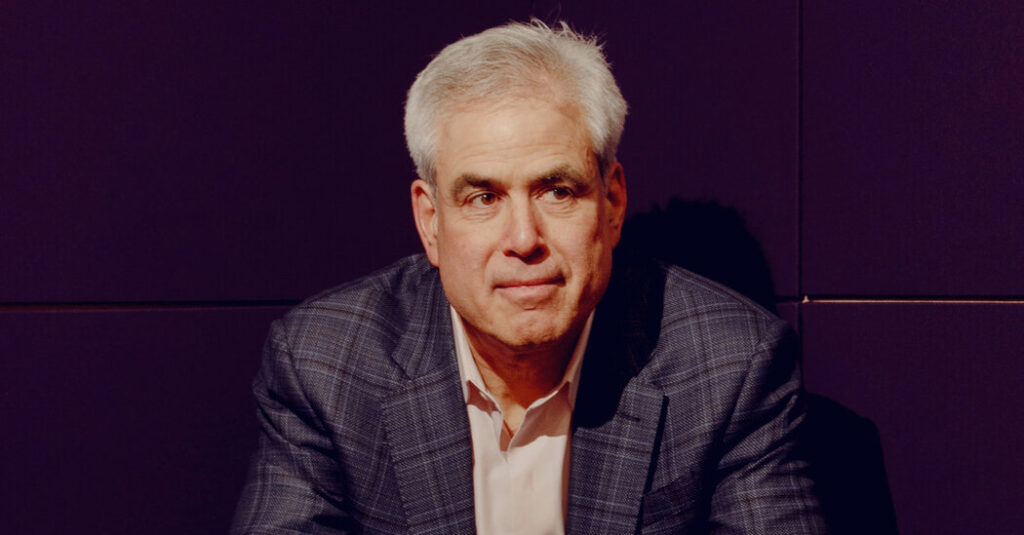
The day the social media giant Meta agreed to as much as a $17.1 billion settlement over claims it had endangered children, the social psychologist Jonathan Haidt was on deadline. He was supposed to hand in revisions for the second edition of his book blasting social media companies for endangering children. He got a two day extension.
Mr. Haidt’s 2024 book, “The Anxious Generation,” was a runaway best seller that provided a reference text for a coalition forming to shield children from big tech, a loose collective of protective parents, fed-up teenagers, aspiring presidential candidates and celebrities in search of a non-radioactive social cause. (Not that many people are proud to say kids should spend more time on Instagram reels.)
On Wednesday, as Meta agreed to its landmark settlement, Mr. Haidt was doing a victory lap. In an interview, he described the moment in the sweeping terms of the founders he has challenged, prophesying with a tech titan’s sunny conviction.
“We’re putting the cat back in the bag,” Mr. Haidt said. “We’re going through a historic turning point from techno optimism to techno skepticism.”
The book has, in fact, spurred people to action. Gov. Sarah Huckabee Sanders of Arkansas sent copies of it to the 49 other governors. Mr. Haidt discussed it with Gov. Kathy Hochul of New York and Gov. Spencer Cox in Utah, along with Meghan Markle, Oprah Winfrey, Jessica Seinfeld and Katie Couric. Ever industrious, the author turned the book into a campaign and forthcoming documentary.
As Mr. Haidt was working on the book, a coalition of states were coming together to sue Meta for the harm it was causing children. The attorneys general and plaintiffs say that Meta’s algorithms trap its users in the infinite scroll, hours of time spent staring at half-naked influencers or malnourished celebrities, images that breed body dysmorphia, anxiety and depression. Mr. Haidt met with some of the attorneys general on Zoom, briefing them on his research.
The allegations in the suit are shocking. They are also, for anyone who has ever stared at a screen, shockingly mundane. To many people, the suits might read like their own time diaries, mirrors of the hours plenty of people spend scrolling, liking, replaying, reposting, like Marionettes kicking their limbs knowing some invisible overlord holds the strings. And for anyone who has read “The Anxious Generation,” the claims were familiar. (Some social scientists noted that the book sometimes seemed to blame social media for trends that its rise coincided with; Mr. Haidt said there are now three meta analyses that show a benefit from reducing social media use.)
That Meta has to pay up to $17.1 billion is not only financially significant but also a clear admission that the company’s defense is weak, Mr. Haidt notes. (The company invoked its protections under Section 230, which shields companies from liability for what their users post.) The company lost its first personal injury suit in March, but this week’s hefty sum of settlement translates that decision from legalese and social capital into cash.
“This is the biggest victory that there’s ever been for the reformers,” Mr. Haidt said.
Mr. Haidt teaches a course on “Flourishing” at New York University, and some of his young students there actually don’t share his soaring optimism on the big tech battles. Zofia Fernandini, 23, who took his course in 2023, said she feels as though some of the tech reckoning is arriving too late for those in her generation, which has already spent years feeling their brains toasted by the hours of endless scroll.
“People are only seeing some of the damages when it’s too late — it’s already made so much of an impact on our generation’s life,” she said. Trying to sum up the amount of money a social media company ought to pay her for the toll on her own frayed attention, Ms. Fernandini paused and then lowballed: “Maybe $50,000?”
It’s true that while the movement to challenge big tech is often compared with the suits against big tobacco in the 1990s, the results aren’t likely to be as straightforward. As lawyers and scientists went after cigarette companies, the rate of Americans who smoked plunged from 42 percent to under 10 percent. But Americans today are not quitting phones and social media en masse. There’s a complicated effort underway to find safeguards — constraints on beauty filters, nighttime blocks, age controls, two-hour time limitations.
Few are pretending the American addiction to social media is over. There is only so much that can be done to rein in Meta, because its hold on our lives is so totalizing. (“It’s a little bit more as if someone had added nicotine to the water supply,” said Jaron Lanier, a prominent tech critic.) This battle is less David versus Goliath, and more David versus God. Even Adam Mosseri, the head of Instagram, testified in the trial that the problems the plaintiffs described had “no silver bullets.”
Mr. Haidt doesn’t entirely agree. Characteristically sanguine, he feels that the settlement Meta agreed to is only a fragment of the social changes that are likely to occur. “We’re now seeing the dark side of digital technologies in a way that makes it possible for a cultural rejection, a cultural awakening that we can’t live this way,” he said.
And for people of any age who have found themselves glued to screens, failing to wrench their attention back, the settlement brought a moment of release. The fixation on children’s tech addiction and attention is also, for some adults, a way of grieving their own. If you can’t log off, at least maybe your kids can. After two hours.
“Two years ago, when I would do an interview with a journalist, they would almost always start off with, ‘I see this in my own kids,’” Mr. Haidt reflected. “Beginning sometime in 2025, what would generally happen is the journalists would start off by saying, ‘I see this in myself.’”
The post A $17.1 Billion Vote of Confidence That Jonathan Haidt Was Right appeared first on New York Times.