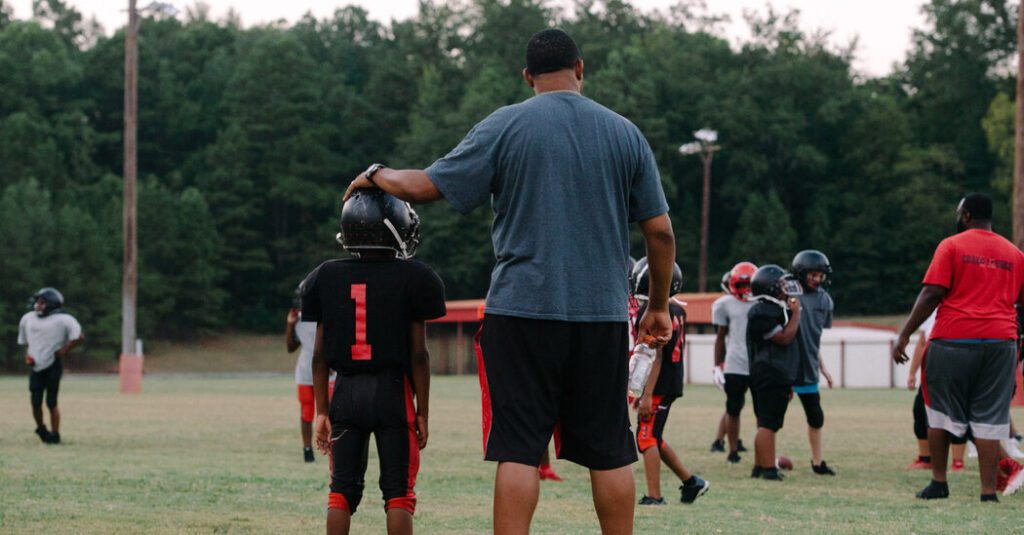
Two things are true: Football has a hold on American culture, and tackle football is not good for brains. Navigating that contradiction can be especially tricky for parents of children who play the game.
Twenty years into the era of C.T.E. awareness, parents know enough to be worried but perhaps not enough to avoid the risks entirely.
Some lean into the positives of the game — among them, the joy and excitement it brings to families, the sense of community it builds, the multigenerational traditions it holds, and the lessons about teamwork and work ethic — and hope that, fingers crossed, C.T.E. is not looming inside the brain.
It’s a risk-reward calculation, one that the children might not be old enough to consider.
C.T.E., or chronic traumatic encephalopathy, is a progressive neurological disease caused by repeated hits to the head. That means it is largely preventable.
But it cannot be definitively diagnosed until death. Scientists are not sure why some people who play decades of football do not get it, while some teenagers do.
That uncertainty can be justification for the status quo. But new research shows that one in four ex-N.F.L. players who died over a recent six-year period had C.T.E. Scientists think the number is substantially higher, since most of those former players never had their brains examined.
What is a parent to do with that information? If not playing at all is not an option, here is some guidance that has broad support from medical professionals.
Flag over tackle
A key factor for C.T.E. is the cumulative force of hits over a lifetime, researchers said. While severe concussions can be debilitating, the countless subconcussive impacts — from blocking, tackling and falling — that occur on nearly every play can lead to C.T.E., too. It all adds up.
The more years of repetitive head impacts, the higher the likelihood of C.T.E., scientists have found. That is why it is no longer surprising when a recently deceased former N.F.L. player is diagnosed with C.T.E.
But C.T.E. has also been found in children as young as 15, and there is a growing list of cases involving players in their teens and 20s who never got close to the pros.
One shift in football that brain researchers would love to see: Delay the start of tackle football. Consider flag football and lower-contact versions of other sports, too.
Practice tactics
Limit contact in practice. Most players practice far more than they play games. The Ivy League banned full-contact practices years ago. The N.F.L. and its players’ union have agreed to limit full-contact practices, too, as a measure to reduce injuries, including to the head. Two-a-days, at any level, are largely a relic.
Coaching philosophy
Be wary of any “play through it” mentality from coaches, parents and others. Brain injuries are not easily identified by onlookers, unlike a broken bone or a torn ligament. Peer pressure and a toughness mentality might keep young players from speaking up. Parents and coaches should.
If there are concerns, consult with independent doctors not affiliated with the team.
What if my son is knocked unconscious?
If a player sustains a blow to the head that knocks him out, however briefly, he should be removed from the game and receive independent medical care before returning to the field, experts say.
Teenage players and younger are especially at risk of what doctors call second-impact syndrome: brain swelling that occurs if someone experiences one head injury shortly after another. If damage from the first blow hasn’t yet healed, a chain of metabolic events can be triggered: Cerebral blood flow increases, arteries swell past capacity and pressure builds inside the brain, sometimes leading to coma and death.
Product claims
Be wary of products purported to reduce risk. Researchers said that no helmet or helmet cover, mouth guard, neck equipment, supplement or medication has proved to reduce C.T.E. risk, despite any marketing claims.
The post Your Child Plays Football. How Can You Minimize Risk of C.T.E.? appeared first on New York Times.