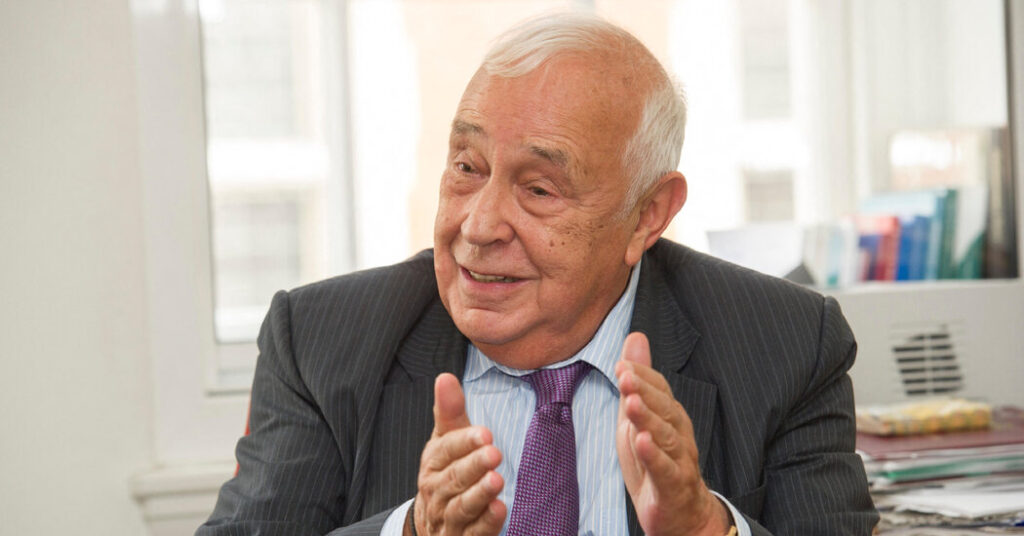
Robert Skidelsky, a British economic historian and political maverick whose monumental three-volume biography of John Maynard Keynes restored the economist to the center of public debate after decades in which free-market ideas had eclipsed him, died on April 15. He was 86.
His death was confirmed by the University of Warwick, where Mr. Skidelsky began teaching in 1978 and became an emeritus professor of political economy in 2006. No further details were provided.
Born in Japanese-controlled Manchuria to a family of Russian origin, interned as a child during World War II and educated at Oxford, Mr. Skidelsky ranged widely across the worlds of scholarship, journalism, politics, think tanks and business, and over the years was affiliated with several political parties.
His independence could come across as principled, contrarian or simply exasperating, depending on the observer and the issue. His first major biography, a sympathetic 1975 study of Oswald Mosley, the leader of Britain’s prewar fascist movement, nearly destroyed his academic career. Decades later, he was criticized for his ties to Russian companies and wealthy Russians and for arguing that Western policies, including NATO’s expansion, had contributed to Russia’s hostility toward Ukraine.
But his reputation rested overwhelmingly on his biography of Keynes. Published in three volumes from 1983 to 2000, it was widely regarded as the definitive account of the economist’s life and one of the most important intellectual biographies of its time.
Mr. Skidelsky began the project just as Keynes, who played a key role in designing the postwar international financial system, was falling out of favor. The inflation and stagnation of the 1970s had discredited Keynesian management, which called for active government intervention in the economy, in the eyes of many economists and political leaders. Margaret Thatcher, the prime minister of Britain, and President Ronald Reagan in the United States promoted deregulation, privatization, lower taxes and faith in the self-correcting power of markets.
Against that intellectual tide, Mr. Skidelsky presented Keynes not merely as the patron saint of government spending but also as a worldly, cultivated and often audacious thinker who understood that markets were governed by uncertainty, confidence and human psychology as much as by mathematical rules.
He also drew a richly textured portrait of Keynes’s private world: his friendships with the artists and writers of the Bloomsbury Group; his many love affairs with men; and his marriage to the Russian ballerina Lydia Lopokova, which led him to disavow gay liaisons.
“No one can properly write about Keynes without technical mastery of economics,” the historian Arthur M. Schlesinger Jr. wrote in The New York Times in 1994. Mr. Skidelsky, he added, “wonderfully adds a sturdy, skeptical sense of political reality, a discriminating appreciation of literature and the arts, sensitive insights into the individual psyche and an incisive and often witty style.”
Sylvia Nasar, reviewing the final volume, “Fighting for Freedom, 1937-46,” in The Times in 2002, wrote that Mr. Skidelsky had “rescued Keynes from the economists and placed him in the world of history where he properly belongs.”
Robert Jacob Alexander Skidelsky was born on April 25, 1939, in Harbin, in the Japanese puppet state of Manchukuo, now part of northeastern China. His father, Boris Skidelsky, was Jewish, and his mother, Galia Sapelkin, was Christian. Robert was raised in the Church of England and later described himself as half Jewish.
His paternal family had deep roots in Russia and Manchuria. His grandfather had helped construct the final stretch of the Trans-Siberian Railway to Vladivostok. The family company, L.S. Skidelsky, leased one of the largest private coal mines in Manchuria.
Boris Skidelsky fled during the Russian Revolution and became a British citizen before going to Manchuria, where he met his future wife, also from a Russian émigré family. The family’s fortune, however, was devastated by the stock market crash of 1929.
After Britain and Japan went to war in December 1941, the Skidelskys were interned, first in Manchuria and then in Japan. They were released after several months, in an exchange for Japanese citizens held by Britain, and traveled to England, where Robert’s earliest memories included sheltering under a table during the frequent German bombings.
He attended Brighton College and then enrolled at Jesus College, at the University of Oxford, in 1958 to study history. He later did graduate research at Nuffield College, Oxford. His Ph.D. thesis became his first book, “Politicians and the Slump: The Labour Government of 1929-31,” published in 1967.
The book established the subject that would preoccupy him for the rest of his career: why democratic governments so often failed to respond boldly enough to economic crises.
After writing a study of progressive education, Mr. Skidelsky turned to Mr. Mosley. Once a rising political figure who had served in Parliament as both a Conservative and Labour member, Mr. Mosley responded to the Depression by proposing an aggressively interventionist economic program. After his proposals were rejected, he founded the British Union of Fascists, modeled in part on Benito Mussolini’s movement in Italy, and became an admirer of Adolf Hitler.
Mr. Skidelsky was initially drawn to Mr. Mosley’s economic thinking — particularly his contention that orthodox politicians had no adequate answer to mass unemployment — and believed that the passage of time had made a reassessment possible. He knew Mr. Mosley’s son, the novelist Nicholas Mosley, and assisted the elder Mosley with his memoirs. He also moved in the social orbit of Mr. Mosley and his wife, Diana Mitford, who had been interned during the war because of their fascist sympathies and lived for many years in France.
“The role of biographer, as I conceive it, is not that of prosecutor,” Mr. Skidelsky wrote in his introduction. “It is somewhere between that of counsel for the defense and judge.”
To many critics, however, the book minimized Mr. Mosley’s antisemitism and included passages that appeared to blame Jews for the hostility directed at them. In one passage, Mr. Skidelsky wrote that Jews “must take a large share of the blame for what subsequently happened.” Some passages were removed or softened in later editions, but he never made a broad public recantation of the book’s underlying approach.
Some reviews praised the biography’s research and narrative power, but the controversy had severe consequences. Mr. Skidelsky, who had taught since 1970 at the Johns Hopkins School of Advanced International Studies in Washington, was denied tenure. Efforts to secure a permanent appointment at Oxford also failed.
He returned to Britain and spent two years at the Polytechnic of North London, a bruising comedown for an ambitious Oxford scholar. In 1978, he was appointed professor of international studies at the University of Warwick. He later became professor of political economy there and remained at Warwick until his retirement in 2006.
He threw himself into the Keynes biography, a project that eventually consumed two decades. He and his family lived for years at Tilton House, Keynes’s former country home in Sussex, and Mr. Skidelsky wrote at Keynes’s desk.
The success of the biography brought him election to the British Academy — Britain’s leading scholarly institution for the humanities and social sciences — and, in 1991, a life peerage as Baron Skidelsky of Tilton.
His party affiliations traced an unconventional political journey. He belonged to Labour until 1981, when he joined David Owen and other moderates in founding the Social Democratic Party. After that party dissolved in 1988, he accepted his peerage under the Conservative government and joined the Conservative Party in 1992.
Following Labour’s election victory in 1997, he served briefly as a Conservative spokesman in the House of Lords on culture and then treasury affairs. William Hague, the Conservative leader, dismissed him in 1999 after Mr. Skidelsky publicly opposed NATO’s bombing of Yugoslavia that stopped the ethnic cleansing of ethnic Albanians and other human rights abuses by Serbian forces. Mr. Skidelsky left the party in 2001 and sat after that as a cross-bench peer.
His migrations among parties became a standing joke. Fellow peers would stop him in the corridors of the House of Lords and ask, “Which party are you in today, Robert?”
The global financial crisis of 2008 returned both Keynes and his biographer to the foreground. Policymakers who had trusted markets to police themselves suddenly turned to bank rescues, public spending and other measures associated with Keynes.
In “Keynes: The Return of the Master,” published in 2009, Mr. Skidelsky argued that the crisis had exposed the central failure of free-market orthodoxy: its inability to account adequately for uncertainty and financial panic. He later condemned the austerity policies adopted in Britain and elsewhere, contending that cutting public expenditure during a weak recovery would prolong stagnation.
Russia remained both an emotional inheritance for him and a source of controversy. Mr. Skidelsky argued that the West had failed to take Russian security concerns seriously and that the expansion of NATO toward Russia’s borders had contributed to confrontation. After Russia’s invasion of Ukraine in 2022, he condemned the invasion but opposed economic sanctions and urged negotiations, arguing that promises of outright Ukrainian victory encouraged a destructive and perhaps unwinnable war.
Those views attracted added scrutiny because of his business connections. He served as a nonexecutive director of Rusnano, a Russian state technology and investment firm, and, later, of Russneft, a privately controlled Russian oil company (not to be confused with Rosneft, the larger, state-controlled producer).
In 2023, the House of Lords suspended him for a month after finding that he had failed to properly declare his relationship with the Center for Global Studies, a think tank he chaired, and benefits he had received through it. The center had been financed in part by Russian businessmen who were later placed under British sanctions.
Mr. Skidelsky’s wife, the former Augusta Hope, whom he married in 1970, survives him, along with their children, Edward, William and Juliet Skidelsky, and six grandchildren.
His final book, “Keynes for Our Times,” was published in June. And in his last speech in the House of Lords, delivered less than a month before he died, he once again invoked Keynes, this time on youth unemployment, addressing himself to the chancellor of the Exchequer, as the British finance minister is known.
“Look after unemployment, and the budget will look after itself,” Mr. Skidelsky said, quoting the economist whose life had become inseparable from his own. “That may be too bold for our rulers today, but I say to the chancellor that if one wishes to gain anything, then one needs to dare.”
Ash Wu contributed reporting.
The post Robert Skidelsky, Definitive Biographer of Keynes, Dies at 86 appeared first on New York Times.