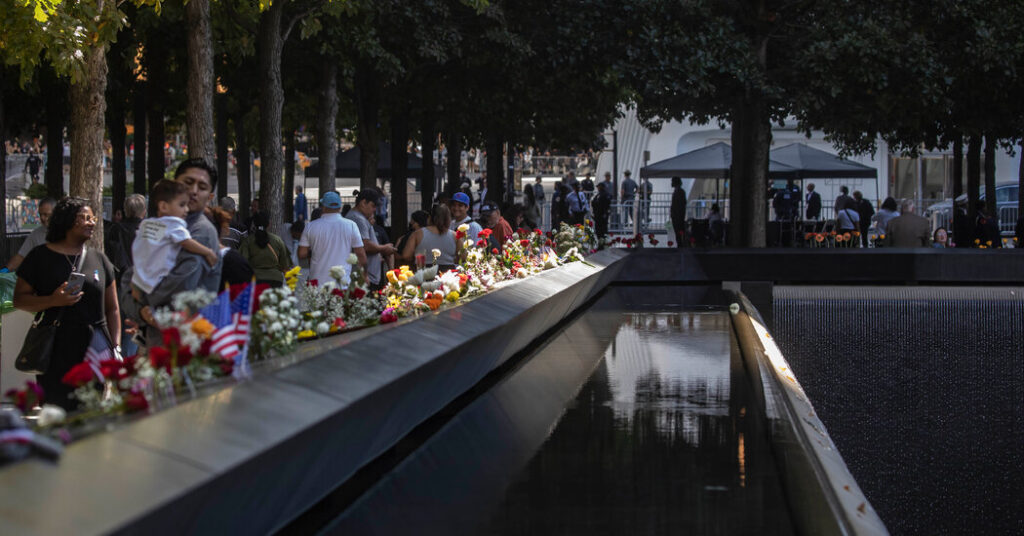
For nearly 25 years, forensic scientists have been testing and retesting bone fragments and other human remains found at the site of the Sept. 11 terrorist attack on the World Trade Center. In that time, they have identified over 1,600 victims.
On Monday, Mayor Zohran Mamdani and the New York City medical examiner’s office announced that they had identified another victim, the first identification in almost 12 months.
But this time, they did so using a new tool — one that combines DNA analysis with detective work from the Police Department, whose officers conducted research into the victim’s family tree.
The medical examiner’s office relied on the Investigative Genetic Genealogy Squad, a group of investigators who receive genetic profiles and seek potential matches for them from public genealogy databases. The investigators then combine those genealogy searches with traditional methods to make identifications.
They have used that process to solve some crime cases that had gone cold, but this was the first time such methods had been used to identify a Sept. 11 victim.
“We’ve had a breakthrough,” Dr. Jason Graham, the city’s chief medical examiner, said. Dr. Graham said he was hopeful that this new tool, known as “forensic investigative genetic genealogy,” could lead to more remains being returned to victims’ families.
The latest identification was the 1,654th that the medical examiner’s office had made since 2001. The victim was identified only as an adult woman because her family did not want her name released, a spokeswoman for the office said.
Mr. Mamdani said the latest identification was “a powerful example of what is possible when we pair cutting-edge technology with an unwavering commitment to those we lost.”
The finding still leaves many people — 40 percent of the 2,753 people who died in the city on Sept. 11 — whose names have not been linked to remains, Dr. Graham said.
“This was the largest mass murder in the history of the United States,” he said. “And it created the most complex identification efforts in our history.”
The remains from the World Trade Center site that are still unidentified were subjected to a variety of forces, including extreme pressure and heat, that have complicated the ability of forensic scientists to sample and study the DNA contained within them, Dr. Graham said.
The last three identifications of Sept. 11 victims in New York came in August 2025. The medical examiner’s office identified one of them as Ryan Fitzgerald of Floral Park, on Long Island, and another as Barbara Keating of Palm Springs, Calif. The third victim was an adult woman whose name was withheld at her family’s request, the office said.
Scientists made the identifications based on advanced DNA analysis of their remains, as well as outreach to their families, the examiner’s office said.
Dr. Graham said on Monday that while the medical examiner’s office would “absolutely” continue to use such traditional DNA analysis, the complementary work of the Investigative Genetic Genealogy Squad provided another avenue of investigation in cases where DNA samples had been “tested and retested over time” but failed to yield results.
The post Forensic Scientists Use ‘Breakthrough’ Method to Identify 9/11 Victim appeared first on New York Times.