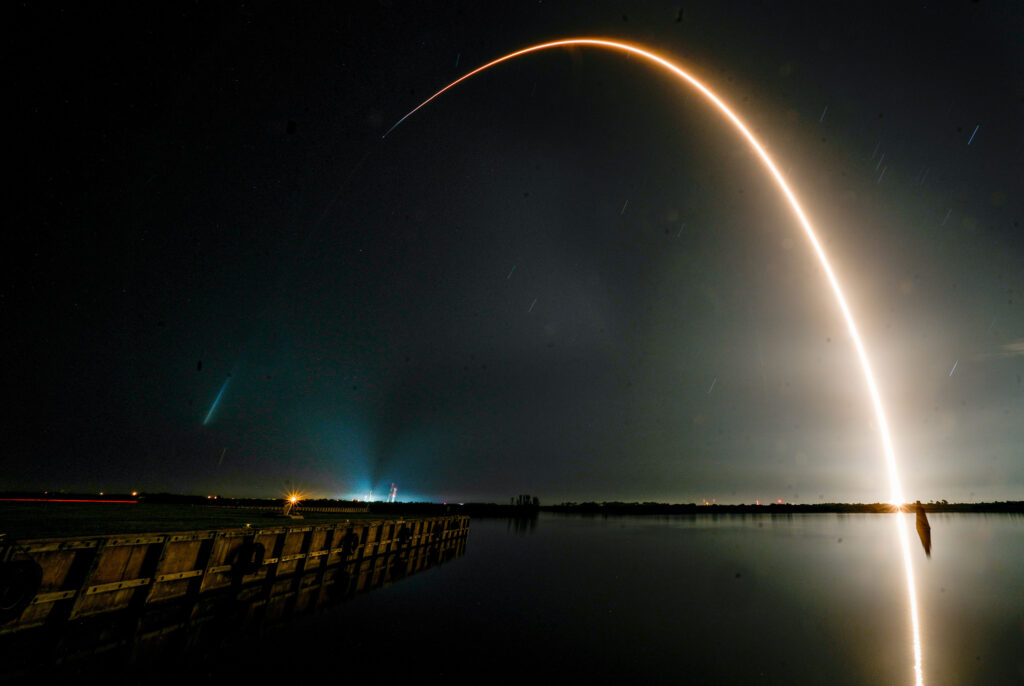
The United States has dominated the commercial space industry for so long that many Americans take it for granted. But that technological edge is starting to dull, with unnerving national security implications.
Two recent developments underscore what’s at stake. A Chinese aerospace company managed to land a rocket booster this month for the first time, an engineering feat that only two American companies has previously managed to pull off: SpaceX and Blue Origin, founded by Post owner Jeff Bezos. This allows for rockets to be reused, dramatically reducing the cost of space launches.
Meanwhile, Russia is quickly deploying low-orbit satellites that can beam internet services to Earth. That system, called Rassvet, will help Russian forces regain communications and targeting abilities over Ukraine that they lost when SpaceX founder Elon Musk cut them off from his Starlink service. Moscow has already launched two satellite packages this year — sooner than anticipated.
With near-peer competitors determined to emulate American success, staying ahead will help ward off future conflict in the final frontier.
To his credit, President Donald Trump signed a memorandum last week seeking to secure America’s lead. He directed federal agencies to prepare U.S. space infrastructure to sustain a goal of more than 1,000 launches and reentries each year by 2030. But that highly ambitious target only underscores the challenge ahead: The Federal Aviation Administration authorized just 205 commercial space operations last fiscal year.
The greatest limiting factor right now is America’s aging launch facilities, which face declining maintenance budgets, as a recent assessment from NASA’s inspector general found. Addressing those constraints can’t be accomplished simply through executive action. Investments from Congress will be required.
Also important is reducing the lengthy — and often duplicative — regulatory reviews that stymie space missions. Fortunately, the FAA proposed such reforms just last month to ease the licensing of commercial space technology.
Competition is part of America’s comparative advantage. The heart of the U.S. space industry has always been the promise that big bets could reap big rewards. SpaceX’s record-setting initial public offering underscored as much. That’s something totalitarian technocrats in Beijing and Moscow could never replicate.
The post China and Russia are nipping at America’s heels in the new space race appeared first on Washington Post.