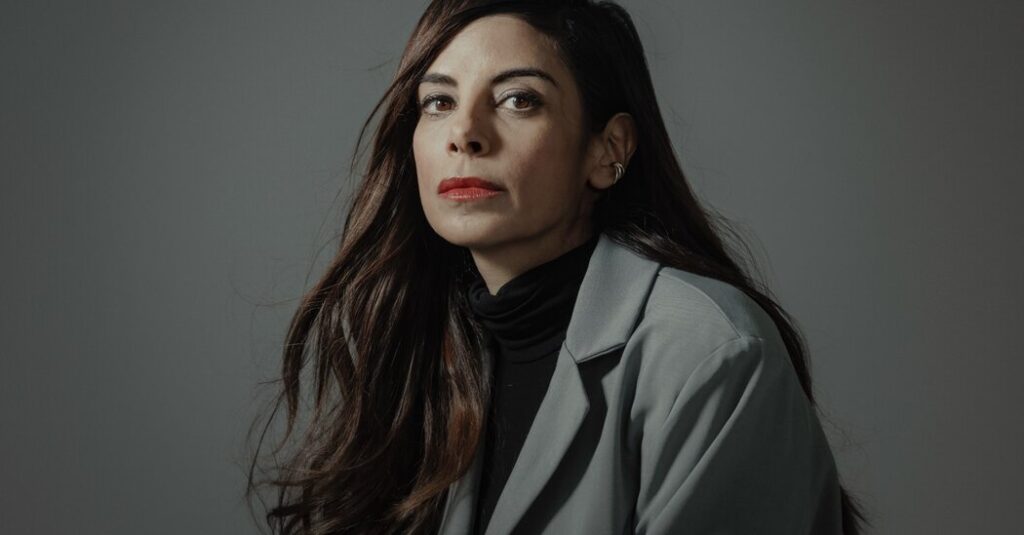
As evening approached on a Thursday in late March, Collien Monica Fernandes, a German actress and television personality, was growing restless. She was having an especially hectic day, shooting an episode of a TV series in a busy marketplace in Phu Quoc, Vietnam. The extras needed wrangling; the set was adjusted and readjusted. As the hours wore on, she checked her phone compulsively — she wanted to be alone in her room by 6 p.m. Finally, at 5:45, with the tropical light dimming, the director called it a wrap. Fernandes tore off her costume, raced to her nearby beachside hotel suite and made sure the digital “Do Not Disturb” sign was on. No one who worked on the show had any idea of what she was about to do.
Fernandes had recently finalized her divorce from another celebrity, an actor and comedian named Christian Ulmen. Ulmen was famous for being a master of cringe humor, or as the Germans call it with more precision, fremdscham (“someone else’s embarrassment”) humor — the kind that comes from watching another person experience an excruciatingly humiliating situation. In his most successful show, “Jerks,” Ulmen played a hapless actor and comedian also named Christian, whose desperate efforts to avoid awkward scenarios only dig him into deeper holes of shame. Escorts, sexual insecurities and fecal preoccupations feature prominently in the show, as do elaborate lies that pile up and eventually collapse beneath the men who lean on them.
Over the course of their 14-year marriage, Fernandes and Ulmen were a high-profile couple in Germany and the media covered their relationship regularly, often presenting it as a modern egalitarian marriage that reflected strong feminist values. After they had a child in 2012, Fernandes started speaking in interviews about the double standards applied to working mothers; she published a series of children’s books challenging traditional gender roles and produced a three-part documentary about the history of feminism. Ulmen, meanwhile, made news by declaring that he was taking a year off after their daughter was born.
At times, the public attention felt uncomfortable or outright invasive. When Fernandes gave birth to their daughter, she said, tabloids knew even before she had left the hospital room. Ulmen was obsessive about preserving their privacy — a journalist who was a friend of Ulmen’s wrote in a magazine profile that Ulmen seriously considered moving when the package delivery man started asking too many friendly questions. More troublingly, Fernandes was subjected to disturbing online harassment that went far beyond the usual comments about a female celebrity’s appearance. For years someone, or multiple people, had been impersonating her on social media, starting online affairs with men and creating and sharing or just recirculating pornography purportedly of her — material that featured other women who resembled her or imagery that might have been A.I.-generated. Others were charging money for the promise of access to her.
Fernandes initially did not devote much energy to the problem — how would she ever find these trolls typing away in some remote corner of the globe? — but in 2021, she learned about a video in which she appeared to be having sex with numerous men. She decided to respond as a journalist, by investigating her digital harassers. She was plagued by these shadowy figures for years and after considerable effort, she believed she had finally found one of them, a man who was conducting sexually explicit online affairs in her name. That March evening, she was ready to expose him.
The action Fernandes was about to take would dominate the news in Germany for weeks, inciting a nationwide movement that many would compare to #MeToo in the United States. Alone in her hotel suite, she prepared a post on Instagram to go up around the same time as the publication of a major news report about her experiences. She announced to her quarter of a million followers that she had filed a criminal complaint in Spain, where she had been living for the past few years, against a man she believed was responsible for digital and psychological abuse. “The perpetrator was (as I now know) quite close the whole time,” she wrote. “His name: Christian Ulmen.”
Fernandes first learned in 2020 that she was being impersonated. Men began reaching out to her team, each with a similar, bizarre request: They wanted to confirm that it was, in fact, the real Collien Fernandes who was flirting with them on social media, who sent them nude photos and videos of herself, who was engaging in phone sex with them. Fernandes started to sense the magnitude of the problem when a lunch with a producer took a strange turn — he was clearly under the impression they were in some kind of online affair. “Suddenly he was showing me photos of me in bikinis — erotic photos,” she says. Fernandes made it clear she would never have sent him those kinds of photos and she had no idea who had.
By then, Fernandes had been married for nearly a decade. She and Ulman met in 2010, when he was 34 — already a well-established director and actor — and she was 28, a presenter on a popular music video channel in Germany. That spring, Fernandes had posed seductively on the cover of the men’s fashion magazine FHM Germany, which named her the sexiest woman in the world. Soon afterward, Ulmen cast her as his wife on a show he was making called “The Snobs,” which was set over 18 holes on a golf course, with Ulmen playing an insufferable, self-made businessman.
Fame had made Fernandes skittish about dating, especially as she felt people underestimated her because of her public image. The tabloids often characterized her as a “party girl,” because she was frequently photographed at celebrity events; but Fernandes considered herself something of a nerd. She was driven, even a workaholic, an obsessive researcher with a critical eye. The network she worked for, she recalls, wanted her to be bubbly, ask inane questions and keep things light, which wasn’t really her sensibility: She had an irreverent edge, and would sometimes go off script on live shows, which could get her into trouble with producers, even if the audience seemed to appreciate it.
Fernandes and Ulmen hit it off on the set of “The Snobs.” On their first date, Fernandes recalls, they talked for nine straight hours. They both started out on camera early, as teenagers, and they found in each other something of a haven. “We could have really deep conversations,” Fernandes told me. Neither had much interest in Germany’s celebrity-circuit nightlife; they preferred to stay home, talking late into the night about the people in their lives, their gripes with the industry or what made a scene funny. “It looks like German television now has a new dream couple,” an entertainment magazine wrote after they went public with their relationship.
Fernandes successfully transitioned out of her younger starlet image, becoming a pundit and journalist, while still acting; Ulmen’s work was widely lauded in the press, even if it sometimes courted controversy. He occasionally appeared in sketches, interviewed celebrities or gave interviews in character as his comic alter ego, a boorish, offensive figure named Uwe Wöllner who was prone to crude sexism. As Wöllner, he hosted a hidden-camera show called “Who Wants to [Expletive] My Girlfriend,” in which women in relationships competed to see which of them could most easily lure other men into going on a date or even having sex (promised but never delivered). Ulmen characterized the work as feminist satire that skewered male sexual desperation, but he sometimes joked about identifying with Wöllner’s adolescent impulses. “I, too, have wondered if it isn’t actually the case that I’m really Uwe Wöllner,” he told a magazine in 2013, “and only pretend to be Christian Ulmen the rest of the time.”
Fernandes also sometimes felt confused by the two versions of Ulmen — the one who presented himself to the public as a feminist and the one she says she saw in her own home. After announcing that he was taking a year of parental leave, Ulmen resumed working. In later years, Ulmen sometimes parented solo while she was on location, but she says he was often resentful and jealous. Seemingly small irritations were enough to provoke his anger, such as the placement of a package in the hallway or her mentioning something in the press that he considered private, like the kind of cookie they preferred. (Ulmen’s lawyer did not respond to multiple requests for comment.)
In the criminal complaint she filed in Spain in December 2025, Fernandes portrayed their domestic life as volatile; she said she never knew when Ulmen might lose control. She alleged physical abuse. In 2023, people near their home in Mallorca heard a woman screaming for help from a window and someone called the police. The officers brought both Fernandes and Ulmen to the station, and Ulmen was held overnight on suspicion of domestic violence. No proceedings were pursued by the authorities, and Ulmen’s lawyer has denied that there was any one-sided violence or threats during that incident.
In legal proceedings over press coverage, Ulmen’s lawyer tried to challenge the reporting of physical violence and threats against Fernandes. Ulmen denied Fernandes’s allegations in an affidavit, according to the lawyer. As in all criminal proceedings, the accused is presumed innocent until proved guilty — a principle that has been emphasized in the German media coverage on the case.
At the time, Fernandes told her sister about alleged abuse (which her sister confirms), but she shared none of it with her friends. She had become deeply private, especially after small details of her life were leaked to the media by people she thought she could trust. She also worried that her friends might not understand why she still had hope for the marriage. “I thought I could fix it,” she told me. “I just needed to find the right therapist to help us come out of those negative patterns.” Her husband was imperfect and impulsive, with some serious anger problems, she always thought. But he was also her best friend.
Because Ulmen often seemed suspicious of her interactions with other men, Fernandes hesitated before telling him about her unsettling lunch with the producer who believed they were having an affair. She told me she was surprised that Ulmen asked no follow-up questions — he didn’t even want to see the exchanges — which, in retrospect, she thinks might have been telling.
A chance booking as a commentator on a news talk show ultimately led Fernandes to the active pursuit of her digital abusers. On the set, Fernandes met a lawyer named Josephine Ballon, a founder of HateAid, a nonprofit dedicated to helping victims of online harassment. Their conversation about Ballon’s work hit home: Fernandes was still disturbed whenever she thought about the explicit video that featured someone who looked like her having sex with many men. She decided to make a documentary about sexual digital abuse. The title was “Deepfake Porn,” a topic the project addressed while also exploring other aspects of online sexual exploitation of women.
Fernandes decided to weave her own story into the documentary, even though she sensed her husband disapproved of that approach. She wanted to try to track down some of the people who were impersonating her online; she especially hoped to unveil the person who seemed to be starting digital affairs on her behalf with people in her social circles.
In researching the documentary, she interviewed a man who had been contacted by one of her impersonators on social media. He explained that the fake Collien had initiated phone sex with him on a Google Hangout, but the voice didn’t sound like Fernandes’s. The impostor Collien had also sent him a pornographic story in which a terrified Fernandes is raped by numerous men. It ends with her collapsed on the floor, covered in semen.
Taking in that story and viewing various images of herself as part of her research, she had an overwhelming sensation of shame. She knew these were not pictures of her, or things she had done, and yet they seemed to represent her. They evoked a torturous trick the mind plays when it’s presented with something horrifyingly self-incriminating that is known to be fake but looks deceptively real.
Fernandes resolved to set a trap for the impersonator. She knew that one of her impersonators was operating through a fake Collien Fernandes account on LinkedIn. She and her producer used the producer’s husband’s LinkedIn account to message the impostor account. The plan was to discuss something innocent — an upcoming birthday party for Fernandes — to see if the impersonator would start talking about sex. They anticipated that the conversation might reveal clues about the person’s identity. Fernandes told me she was so enthusiastic and hopeful about the idea that she mentioned it to Ulmen — but the person behind the account never responded.
In the end, the documentary Fernandes made was unable to identify her impersonators, though it detailed some of her efforts to find them. The film aired in December 2024, not long before Ulmen and Fernandes flew from their home in Mallorca back to Germany to celebrate Christmas with their families. They planned to spend Christmas Day with Ulmen’s family, but Ulmen asked if they could stay at the hotel instead. Fernandes described to me what she says happened next in their hotel room: Ulmen had said he had a stomachache; in fact, he had just read a news item about the documentary, which mentioned that Fernandes went to the German police to file a criminal complaint against her anonymous impersonators, something Ulmen was unaware of. Ulmen asked question after question, growing more and more agitated until he was visibly shaking. Finally, he told her to sit down, because he had to tell her something. Secrets he’d been guarding for close to a decade came out, haltingly, she says: He had been impersonating her online.
That night, Fernandes recalls, Ulmen was in a panic. She suspects he feared that the police would arrest him and that he might spend years in prison. According to Fernandes’s criminal complaint in Spain, Ulmen told her that he had messaged hundreds of men over the course of 10 years, but he would not tell her which men, only that she knew some of them. Fernandes, stunned, made recordings of parts of their conversations, which were included in the complaint. She had so many questions: What did he think would happen if he got caught? Why, of all people, had he impersonated her to start a sexual online affair with their pension insurance salesman? Ulmen tried to answer. He was curious to know who liked her. The whole thing felt like something separate from their true relationship, he tried to explain, more like using porn with some elements of reality. (Asked to comment on Fernandes’s allegations through his attorney, Ulmen did not respond.)
For Fernandes, the digital abuse she believes Ulmen committed was more of a betrayal than even his alleged physical attacks. She could explain away spontaneous violence as a result of anger someone struggles to curb in the moment. But she felt this humiliation was premeditated. It was the difference between someone committing murder in a blind rage, Fernandes says, and someone who plans to “murder women and put them in the fridge and give them to the dog.” She believed her husband had not just used her for his and others’ sexual gratification — he had also erased her as a person, replacing her with a depraved adolescent’s version.
Fernandes later obtained and included in her complaint logs of conversations that she alleges came from Ulmen’s laptop that she captured in video footage on her phone. They were, according to the allegations in the complaint, conversations that Ulmen had with ChatGPT over the days that followed, in which the user inquires, for example, about how to ask men to delete emails, without committing some kind of witness tampering.
Fernandes, meanwhile, fell into a paralyzing depression. She couldn’t fathom how she could return to working and socializing with the men in her life, any of whom might think she was crazy, that she had hit on them, that she had sent them pornography — naked photos with her legs spread, violent rape fantasies. She wasn’t entirely ready to end her marriage, much less publicly accuse Ulmen — and yet if she didn’t reveal that she believed her husband was the impersonator, how could she continue promoting a documentary that demanded justice for herself and all other victims of digital abuse?
Fernandes had not made a decision by the time her family flew back to Mallorca after the holiday. In an email that Ulmen sent to his lawyer, which The New York Times has reviewed, he confessed to his lawyer to conducting sexually explicit digital affairs impersonating Fernandes with about 30 men. He also expressed regret. Fernandes told me that Ulmen heard back from a lawyer a few days later, while they were out grocery shopping. She waited by the car in the parking lot while her husband wandered away to hear his lawyer’s counsel.
A lawyer advising a client in that situation would most likely reassure him that in Germany, disputes between couples, short of those involving physical violence, are considered low priority by prosecutors; they often encourage couples to work out their problems in divorce court or civil court (where damages are much lower than would be true for comparable offenses in the United States). An impersonator who posted degrading images publicly would face a stronger legal challenge than one who circulated them to individuals, as Fernandes was alleging; but either way, in Germany, first-time offenders of nonviolent crimes almost never see prison time. In practice, German law focuses on rehabilitation rather than retribution, says James Q. Whitman, a professor of comparative law and foreign law at Yale Law School.
The more Fernandes learned about how little German law was likely to do to deliver some sense of justice, the more outraged she became — not just about her own specific experience, but about the failings of the law to help so many women who had little recourse when strangers sexually violated them online.
Fernandes had been numb since her conversation with Ulmen on Christmas. But when Ulmen returned from talking to his lawyer, she flew into a rage in the parking lot. “So you’re telling me that it’s possible to digitally abuse me and nothing happens — and you think that’s OK?” Fernandes recalls yelling at him. “Do you realize the situation? That you’re talking to the victim?” She says Ulmen told her to get in the car — that she was acting insane. People were going to recognize them. Fernandes was embarrassing him.
Over the next several months, Fernandes wrestled with whether or not she was ready to leave her marriage. “I’m lying in bed,” she told me, recalling the period following his confession. “I can’t work anymore. I feel bad. I don’t have any motivation. I’m suffering.” Her husband, meanwhile, appeared relatively content, she says.
In June, Fernandes told Ulmen to move out. With time, it became clear to her what she wanted to do, which was bring a criminal case against him — but to bring it in Spain, where the couple had lived for the past two years. and where there was a more comprehensive legal infrastructure to address digital harassment, including a court specifically dedicated to addressing violence against women (which many U.S. states have, but which Germany does not).
The news of an explosive criminal complaint was unlikely to stay under wraps for long. After Max Hoppenstedt Heinrichs, a journalist at Der Spiegel, learned of the complaint, he and a fellow investigative reporter, Juliane Löffler, did extensive research and interviewed Fernandes at length. The article they published on March 19 was titled “You Digitally Raped Me” — a quote from a text Fernandes sent Ulmen when she was still trying to convey to him the gravity of what he had done. The article reported that Ulmen allegedly physically abused his wife, impersonated her online and circulated sexual photos of women who could easily be mistaken for her.
The incendiary Instagram message that Fernandes posted from her hotel room in March was timed to the publication of Der Spiegel’s article. In the post, she decided not to mention the physical violence that she says was part of her marriage, focusing instead on the alleged digital abuse. Germany already had laws on the books to prevent domestic battering, but lagged behind many other countries in how it regulated sexual exploitation and violence online. She wanted to focus attention on the lack of those specific protections She hoped that in calling attention to those gaps in legislation, she might help change the law as well as the culture.
Collien Fernandes’s allegations elicited the kind of widespread rage in Germany that was unleashed in the United States when the Harvey Weinstein story broke. Protests erupted across the country, including one in Hamburg with more than 20,000 people. “The shame has to change sides,” some signs said, referencing a phrase popularized by Gisèle Pelicot, the activist whose shocking public testimony against her husband and dozens of men who raped her while she was drugged had stirred a similar awakening in France. Other signs said, “It’s always a man!” and “Everyone knows a victim, no one knows a perpetrator.” A magazine columnist wrote that her inbox was full of messages from women saying, “How are we supposed to live with men?” and that they planned to stay celibate. Leading politicians rallied around the cause of offering women better protection from digital violence.
The response from fellow German celebrities on social media was swift. Benjamin von Stuckrad-Barre, a widely respected journalist and TV personality who had been a friend of Ulmen’s for close to 30 years, wrote on Instagram that his “solidarity and support” belonged solely to Fernandes. An actress named Inez Bjorg David, who appeared on “Jerks,” posted a copy of the email she had just written to her managers. “I would love it if you removed ‘Jerks’ from my résumé,” she wrote. “It makes me want to throw up and I’m so angry.”
The day the news broke, Stephanie Hubig, the German minister of justice, went public with proposed legislation, long in the works, intended to protect the victims of digital abuse. The legislation would criminalize making or distributing A.I.-modified sexually explicit images without consent, an offense subject to two years’ imprisonment. She also called for technology platforms to disclose information about secretive social media accounts so that violators’ identities could quickly be revealed. Even deepfakes or impersonations that were not sexual in nature but caused reputational harm could be subject to prosecution under the legislation.
Fernandes was gratified that those in Parliament were paying attention, but the timing of the announcement about the legislation contributed to a powerful backlash. Commentators sympathetic to the AfD, Germany’s far-right, populist party, along with anti-establishment actors, privacy rights activists and other critics cast Fernandes, in thousands of posts on X, as colluding with Hubig to try to chip away, for example, at the right to be anonymous online.
Other commentators implied, on social media or in the press, that the madness of the crowd was undermining the presumption of innocence, that women were generalizing too broadly about all men as bad actors (“Throw Out Toxic-Femininity” was the headline of one story about Fernandes in a German magazine). Critics accused Fernandes of having posed practically nude anyway, of being a man-hater, an attention seeker, a bad mother.
It’s not uncommon for individuals who step forward with stories of sexual harassment or domestic violence to face a backlash in Germany, says Löffler, one of the reporters for Der Spiegel who broke the Fernandes story and who has published prominent #MeToo journalism. Until recent years, detailed reporting on accusations of domestic abuse or sexual harassment in Germany were rare, and when it did appear, it often provoked critiques from readers and commentators. “You might get feedback like, ‘Why do I need to hear about this private affair?’” she says. Only in recent years, Löffler explains, has there been more recognition that writing about these issues is an important way to expose abuses of power.
It is not only a cultural norm that has often muffled this sort of reporting in Germany. The German Constitution considers inviolate the right to dignity. That principle is understood there to include privacy and the right of “personality,” which is thought to be, at its core, the right to control one’s own image. Although the German Constitution also ensures the right to free speech, courts in Germany are forever balancing the two concerns, which has had a notable effect on the way that the German media operates. In the United States, a public figure who is trying to win damages against a media outlet must prove that it published false information and also showed “actual malice” in doing so. In Germany, public figures can bring charges of “insult” even if the facts reported are accurate, and courts are frequently asked to weigh in on whether a given piece of journalism is sufficiently important to the public interest to justify exposing the personal details it includes.
Certain details — such as those about sexual leanings or revelations unveiled in therapy — may be deemed so private that no measure of public interest would justify their publication. Courts in Germany are also swifter to file injunctions halting publication than their U.S. counterparts. (The right to privacy in Germany extends so far that mug shots and even the last names of those accused of crimes — including sexual harassment and terrorism — are routinely excluded from news reports, unless there’s a strong public interest.)
The emphasis on privacy has often resulted in a somewhat muted media response to cases in which public figures are accused of sexual misconduct. By contrast, in the United States, the initial #MeToo reporting about Weinstein unleashed unfettered coverage in numerous publications about other harassers or abusers in positions of power, as women stepped forward to share their own stories.
Shortly after Der Spiegel published its story, Ulmen’s lawyer quickly announced that he would be taking legal action against the magazine, accusing it of publishing illegal reporting and making false claims, while also warning away other publications from reporting on Fernandes’s allegations. Ulmen’s lawyer would go on to contest the allegations of physical assault, insist that his client never created or disseminated deepfake videos and challenge the inclusion of the email Ulmen sent to his lawyer.
Even though Der Spiegel never stated in the article that Ulmen had created or distributed deepfake videos of Fernandes, an appellate court ruled in June that the article implied that Ulmen had done so because the story explored the phenomenon of deepfakes. The publication was required to add new language to the article that explicitly stated that there was no evidence that Ulmen made or distributed deepfake videos. Der Spiegel was also ordered to delete two sentences deemed highly personal from Ulmen’s correspondence with his lawyer.
Although Der Spiegel had strong evidence to support its reporting, including audio files, documents, text chats and photos, some news outlets were reluctant to reference Der Spiegel’s reporting on Fernandes’s allegations. In Germany, publishers often fear relying on other publications’ reporting unless they, too, have strong evidence in hand. (In the United States, by contrast, once information about public figures is public, other outlets can reference it, unless they know it’s false.) Much of the coverage defaulted to stories about the legal maneuverings on each side.
Ulmen’s lawyer, in winning small victories in court, was able to sow doubt, in some corners, in Fernandes’ credibility or the accuracy of her story. Reporterfabrik, a nonprofit devoted to media literacy, is scheduled to release a report in late September on how the media narrative about Fernandes played out; in an Instagram post announcing the report, the nonprofit wrote that Ulmen’s lawyer has operated by “disputing trivialities and using the tactic of hyperspecific denials — to desperately create the impression that [Ulmen’s] ex-wife accused him unjustly.” They call the approach “a grotesque web of distractions, half-truths and sham battles, intended to disappear behind a smoke screen of flashbangs.”
The right to control one’s image in Germany has also translated into journalistic norms that are not enforced by law but nonetheless give unusual power to sources. People can often expect to have approval over their quotes before they are published. In March, Ulmen spent five hours talking about his marriage to reporters at Die Zeit, a weekly newspaper. In the end, Ulmen opted to rescind the entirety of the interview. “Mr. Ulmen Would Rather Not After All,” the headline of the story said. (Ulmen’s lawyer later said that the interview was always intended to be a “background briefing.)
That Der Spiegel was as challenged as it was in reporting on Ulmen, can seem paradoxical: Out of legal deference for Ulmen’s right to control his image, the publication was limited in what it could say about his alleged digital usurping of his wife’s image.
Although many of Ulmen’s fans defended him on social media, the allegations and the article in Der Spiegel had immediate professional consequences for him. The German streaming service that carried “Jerks” pulled the show from its site. Producers also chose to shelve a new project, a show called “The Au Pair,” that Ulmen had been working on in the months after his split with Fernandes.
Fernandes was surprised, when journalists who had obtained the scripts ran them by her, to see intimate details that she says he had taken from their family’s personal life and woven into the story lines. In one episode, according to journalists who reported on the scripts, a young man admits to his love interest that he has posted pictures of her on sexualized sites, because it aroused him to see other men’s desire for her. The scene ends with him weeping.
“Shame is a pain that hurts less when you share it,” Ulmen once said in an interview, explaining why the men on “Jerks” so often ended up exposing, inadvertently or not, their most base impulses. In another interview, he is described as never feeling more free than when he plays Wöllner, a figure who does not bother laboring under the burden of hiding his shame. In a 2013 article called “My Friend, the Monster,” a journalist friend of Ulmen’s at the time wrote: “There’s one role that really gets to him: being Christian Ulmen. How does that even work? Nobody tells you.”
I spoke to Fernandes several times over the course of the summer. She was still regularly appearing on TV to push for more significant penalties for digital offenses committed against women, while also trying to manage the anguish that the news inevitably created for members of her family. The criminal complaint she filed in Spain with a special court devoted to violence against women was awaiting a ruling on jurisdiction from a higher court; the original complaint she filed in Germany during her research for the documentary in 2024 had been closed, then reopened following the prominence of the news story, then transferred to a different court, and is still in an investigatory phase. A news release from that court reported that prosecutors were still assessing the material they had with regard to both bodily injury and “allegations of ‘digital violence.’”
When we talked, she often looked to be in a state of shock, something that was rarely visible in the dozens of interviews she gave for German media, in which she invariably projected confidence and poise. She often wore a black blazer, an item of clothing she seems to rely on for added authority, even though it’s so oversized that she appears to be retreating into it. Because she’s more petite than people assume, barely 5-foot-4, she used to be able to move freely without being recognized. More recently, she said, she is approached constantly. “I get hugged a lot in elevators,” she said. “The older women — they want to tell me they went through something once, too.”
The last time we met, in June, we sat on her porch in Mallorca. The Mediterranean seemed to hover in the distance, calm and blue. Fernandes told me that she has a hard time relaxing these days; she has struggled with anxiety, panic attacks and insomnia. Ulmen still lived nearby, and she dreaded running into him at the gas station or the mall or even, possibly, at her own front door. She was overwhelmed by the avalanche of attention, some of it negative. At times she even seemed to feel she had to justify why she decided to speak out. She said she had learned nothing from her husband about which men in her social circles had been contacted by her impersonator. “I had to be able to speak up for myself,” she said.
Despite the backlash, much of the legislation the German justice minister has proposed has wide support and could pass next year. Fernandes is now thinking about returning to Germany. Moving to Mallorca had the effect of largely isolating Fernandes, who, even now, speaks only enough Spanish to get by at the grocery store. She has few close friends who live nearby, and the multimillion-dollar homes closest to her are all protected behind high gates.
Her own house feels oddly empty, with two different rough patches on walls where flat-screen televisions used to be before Ulmen took them to his new home. Holes were still visible where there used to be security cameras. Ulmen had arranged for them to be installed soon after they moved in. One of the cameras in Fernandes’s office faced into the room, rather than out toward where intruders might be approaching. Months after Ulmen moved out, the video feed was still available to him, she worried; she didn’t have the passcode to shut it off. Last winter, a friend who was visiting took one look at the cameras and decided they had to go. “Do you have a ladder?” she asked Fernandes.
The cameras came down.
The post Someone Was Impersonating Her in Online Affairs. She Says It Was Her Husband. appeared first on New York Times.