The high desert is not typically a place you look for a wave. But in the vast expanse between the Sierra Nevada and Utah border, a not-exactly-wide-open race for Congress is testing whether a blue wave, should one come November, is ankle-high or something more akin to a political tsunami.
Nevada’s 2nd District has been represented by just four lawmakers since its creation more than 40 years ago. All those representatives have been Republicans.
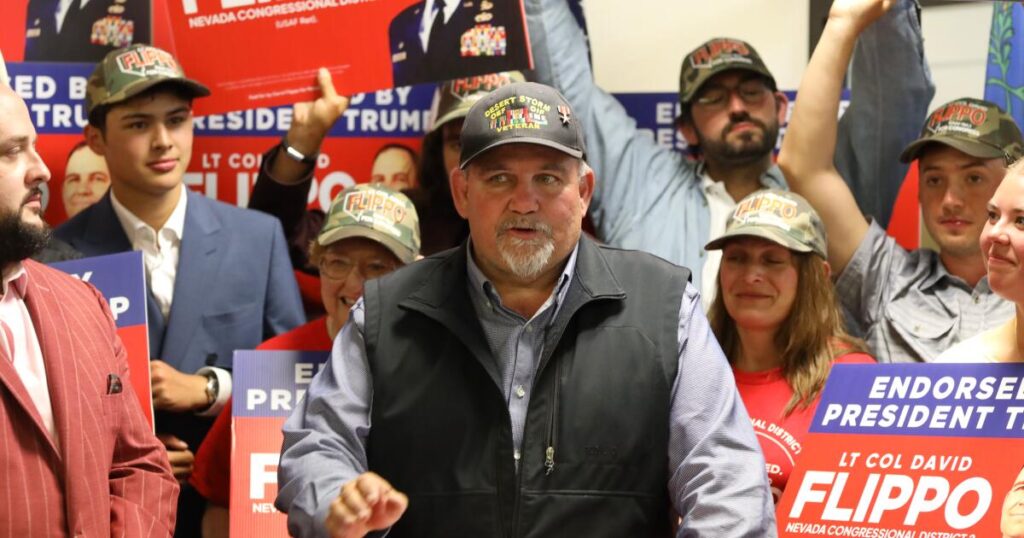
November’s contest should be another shoo-in for the GOP and its nominee, David Flippo. The district, which takes in northern Nevada, is overwhelmingly white and rural, which makes it solidly conservative. In 2024, Donald Trump beat Kamala Harris by a decisive 56% to 42%; only Washoe County, home to Reno, kept things that close. Trump won other portions of the district by 50 percentage points or more.
But inflation, Trump’s sagging approval ratingand other factors — northern resentment toward southern Nevada, where Flippo lived until fairly recently, the refusal of the incumbent to support his party’s nominee — offer Democrats the not-entirely-far-fetched hope of a major upset.
“It will be an interesting summer and fall,” Mark Amodei, who has represented the district for 15 years, wrote on social media after the June primary. “But I believe it’s fair to say that CD-2, for the first time in its history, isn’t a Republican guarantee.”
That’s just about the kindest thing the congressman has had to say about his would-be successor.
All of which make the sprawling district in Nevada’s rough and rocky Great Basin an improbable political bellwether. A win on such forbidding terrain would almost certainly mean a nationwide Democratic gain of 30 or more seats in November; they need to flip just three to take control of the House.
Flippo, 63, a 25-year Air Force veteran and Trump stalwart, arrived in the district from Las Vegas. He ran for Congress there in 2024, losing in the Republican primary. He was preparing for a second try in the Democratic-leaning 4th District when Amodei unexpectedly announced his retirement in February. So Flippo hightailed it north to run in the far more hospitable 2nd District.
He took on the favored candidate of Amodei and others in the GOP establishment, James Settelmeyer, a former minority leader of the state Senate. Backed by a constellation of MAGA celebrities, Flippo waged a fiercely negative campaign, accusing “Tampon Jim” of voting to put menstrual products in boys’ bathrooms and coddling undocumented immigrants, among other distortions. With Trump’s endorsement, Flippo handily defeated Settelmeyer and 11 other primary opponents.
“”Absolutely scurrilous campaign against … one of the nicest guys around,” Amodei said afterward, on the program “Nevada Newsmakers.” “The voters are never wrong. But guess what? Mark Amodei’s not endorsing [Flippo.] I wish him all the best. No way. No, thank you.”
Apart from his exceedingly short-term residency in the district, questions have also been raised about Flippo’s opaque finances. He has lent his campaign more than $1.6 million and failed to provide the personal disclosure information required of federal candidates. There is also no record of Flippo filing the required statement during his 2024 campaign, according to the Washington news outlet NOTUS.
In addition, it reported that Flippo was fired from a job in the financial services industry after his company accused him of violating policies and regulations.
So, a carpetbagger with a sketchy history.
Flippo’s main opponent is Teresa Benitez-Thompson, 48, a longtime Reno resident, former member of the state Assembly and a relatively moderate Democrat. Those credentials also buoy Democratic hopes. The party’s congressional campaign committee has, for the first time in decades, added Nevada’s 2nd District to its target list, though it remains to be seen how much time and money national Democrats commit to the race.
To prevail, Benitez-Thompson would have to defy political gravity, which is to say overcome the reflexive partisanship that has typified politics in this age of deep voter polarization.
In the last two midterm elections, according to the Pew Research Center, more than 90% of Republican and Republican-leaning voters supported GOP candidates for the House. In other words, the kind of crossover voters that Benitez-Thompson needs to win have become rare indeed.
““Trump is a huge liability for Republicans; there is no question that the GOP is going to have huge turnout problems, meaning that in a lot of races, Democrats are going to greatly exceed expectations,” the veteran election handicapper Charlie Cook wrote in a recent midterm analysis. “But converting Republican voters to actually back a Democrat — even for a day — is so much harder now.”
Jon Ralston, one of Nevada’s leading political savants, agreed.
“Some of those rural Nevada voters would rather commit hara-kiri than vote for a Democrat,” Ralston said. (No, Japan’s ancient suicide ritual is not particularly associated with honor or custom in the cow counties, as Nevada’s lightly populated stretches are known. But you get the point.)
“I don’t think it’s impossible,” Ralston, founder and chief executive of the Nevada Independent news site, said of a Democratic upset. “But I remain skeptical.”
Here’s the thing, though, about wave elections— and, to be clear, your friendly political columnist is offering no predictions ahead of November. Like a massive ocean swell, which can bear all kinds of flotsam and jetsam ashore, a political wave that is big enough, broad enough and strong enough can carry all manner of unlikely candidates to victory.
Even in the bone-dry desert.
The post Ripple or blue wave? This race will test Democratic strength in November appeared first on Los Angeles Times.