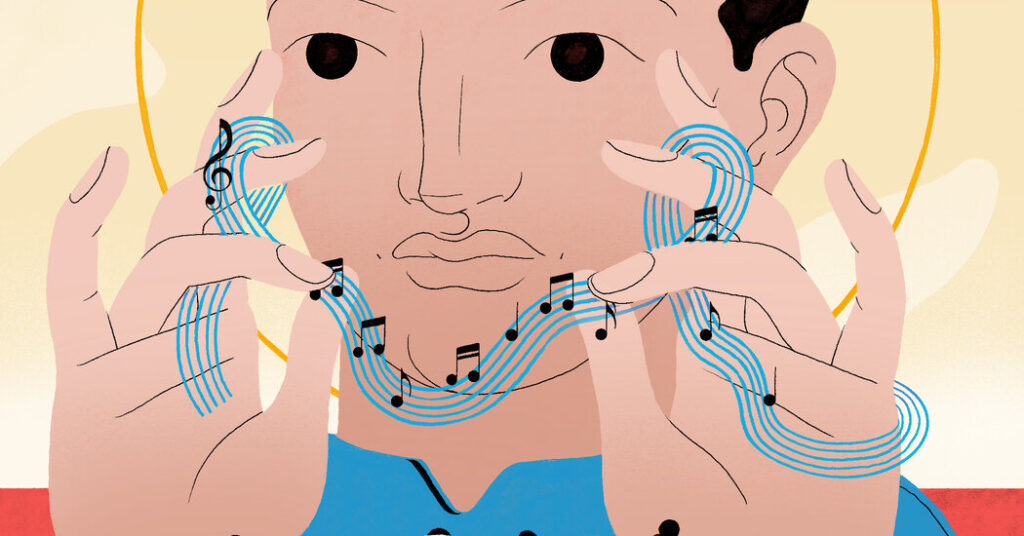
“At this school, your teacher is your God.”
I can remember hearing this more than once while a student at the Curtis Institute of Music, several decades ago, but friends and colleagues who attended other conservatories have confirmed my suspicion that the sentiment was not specific to Curtis. In the music world, gods were everywhere: I’d already heard story after story in which teachers, conductors and soloists were praised as all-knowing and treated as all-powerful. I didn’t give it a second thought, despite having learned in Sunday school that it is dangerous to believe in false idols.
Today, as a grown-up musician myself, I find it to be an astonishing statement. Every one of my musical experiences — whether as a performer, teacher or simply a person trying to come closer to the music I love — leaves me more convinced that deifying teachers is wrong. It encourages deference and passivity, instead of the exploration and commitment that a true musician must spend a lifetime practicing.
All fields have teachers with worshipful acolytes, but it seems to me that musicians have a particular penchant for turning their teachers into deities. Why do we do it? A good teacher can offer invaluable guidance, but not a direct path to excellence and enlightenment, a route some would hope for. That is a myth. Being perpetually curious is hard work. Grappling with an unruly instrument and the infinite subjectivity of music is extremely hard work. This makes students susceptible to would-be gurus who purport to have all the answers and opens them up to different forms of mistreatment.
I recently contacted colleagues at the top of the profession about their experiences with harsh teaching. Stories of (usually at public master classes) humiliation came in quickly: a world-renowned pianist screaming at a student to stop after three notes; a violin teacher calling a student a racial slur; a legendary violinist advising a student to quit music; a venerated teacher comparing a student performance to bird excrement.
I’ve heard multiple teachers say that it is acceptable — even necessary — to beat up (figuratively, I presume) on their students. A celebrated violin teacher once told me that she did not consider it to be a true lesson until the student cried.
This approach should appall us, but we should also take time to consider what it says about our attitudes toward music and learning. You can browbeat a person into obedience; you cannot browbeat them into understanding.
If we want musicians who engage deeply with the music they play, who approach it with imagination and courage and marry instinct to insight, then we should elevate teachers who acknowledge their own fallibility and who help their students learn to think and listen critically. If we want musicians who reduce their work to a set of rules to be followed, we should elevate teachers who think they can do no wrong and demand that their students think the same.
Famous teachers have connections that can open — or close — professional doors for their students. But this cannot fully explain why students and institutions are so in their thrall. There are plenty of powerful people in the music world, and not all of them consider themselves superhuman or abuse their power. We would not be so quick to excuse imperiousness or cruelty if we didn’t believe, erroneously, that certain people held the keys to absolute truth. The problem is not that some people are vicious: The problem is a musical culture so addicted to veneration that they are able to operate with impunity.
And operate they do. Recently, I saw the remarkable documentary “Dear Lara,” which tells the stories of (mostly) women who said they were sexually abused at conservatory. The film makes a convincing and distressing case that the problem is systemic. Apparently, turning (mostly) men into gods can turn them into monsters.
I was lucky: None of my teachers were abusive. In fact, they were inspiring. I doubt that any of them believed for a moment that they knew everything. But I had absorbed that message, endowing them with a mystique they may not have wanted. If you asked me, in my student days, how my week had been, I would have responded by telling you how my lesson had gone. It was only one hour, but it was the hour that mattered.
Even then, though, I had an inkling that there was another approach. I knew on some level that the lesson could do no more than suggest possibilities, and that it would be my job, in all those other student hours, and all the years that would follow, to explore and develop and usually reject them, in the search for something authentic both to me and to the music I was playing. I knew that simply trying to please a teacher was the easy road, which is rarely the right one.
Being a musician means embracing complexity and ambiguity. It means living with all of the many possibilities a great piece of music suggests. This is often uncomfortable. It is human to wish for the complex to be simple, for the subjective to be objective. This wish can be so intense that people sometimes not only overlook poor treatment, they even welcome it. Several students have told me, to my amazement, that they want their teacher to speak to them in a way I can only describe as abusive. This phenomenon may even offer a hint about the appeal of authoritarianism — the bogus simplicity of its message justifying, for some, its inherent cruelty and even the ultimate inability to solve the problems it misdiagnoses.
Music-making should be a spiritual undertaking that requires lifelong devotion. Displacing this devotion onto a human avatar is alluring and wrong. It may make students feel safe, but it leaves them ill-prepared for their life’s work and creates an environment that can expose them to danger. As both a moral and an artistic matter, we must reject this path.
Jonathan Biss is a concert pianist.
The Times is committed to publishing a diversity of letters to the editor. We’d like to hear what you think about this or any of our articles. Here are some tips. And here’s our email: [email protected].
Follow the New York Times Opinion section on Facebook, Instagram, TikTok, Bluesky, WhatsApp and Threads.
The post Push Your Musical Gods Off Their Pedestals appeared first on New York Times.