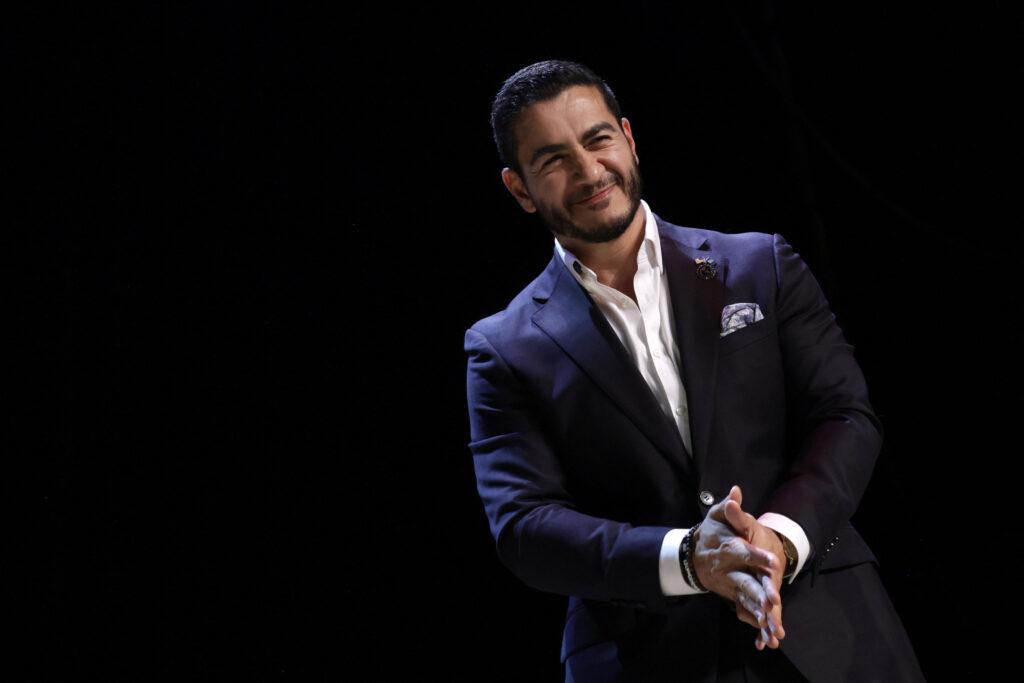
Hours after Abdul El-Sayed won the Democratic Senate nomination in Michigan this month, Sen. Tommy Tuberville (R-Alabama) called the man who could be the first Muslim senator a “TERRORIST” and “RADICAL ISLAMIST” on social media.
Tuberville’s post previewed a deluge of attacks on El-Sayed’s Muslim identity from influential and high-profile conservatives.
By mid-August, 15 days after the primary, religion had become the dominant topic of conservative conversation online about El-Sayed — overtaking mentions of socialism and communism that once dogged the progressive candidate, according to a Washington Post analysis of thousands of right- and left-wing posts and public statements.
Nearly 1 in 3 posts about El-Sayed from right-wing figures mentioned Islam, Muslims or sharia by Aug. 18, according to The Post’s analysis of conservative commentary across social media, newsletters and podcasts.
The fixation on El-Sayed’s faith is part of a growing embrace of open Islamophobia by some Republicans this year, coinciding with a war on Iran and increased hostilities in the Middle East. Politically, those barbs have triggered few penalties within the party. Some Republican lawmakers like Tuberville, whose office declined to comment for this article, have used anti-Muslim messages to mobilize their most ardent supporters.
Islamophobic comments have also been flung at other Muslim Democrats, including New York Mayor Zohran Mamdani and Reps. Rashida Tlaib (Michigan) and Ilhan Omar (Minnesota).
The attacks can cut especially deep in Michigan, which is home to around 240,000 Muslims, one of the largest populations in the country.
Mike Rogers, the Republican Michigan Senate candidate, has focused on casting El-Sayed as an extreme candidate in the hopes of courting independent voters and moderate Democrats. He usually does not highlight El-Sayed’s religion, but his Republican and conservative allies often do.
The Republicans’ Senate campaign arm called El-Sayed “the most radical Senate candidate in America” and referred to him by his full name, Abdulrahman Mohamed El-Sayed, in its debut general election ad against him on Aug. 5, the day after the primary.
When the GOP Senate group later described El-Sayed on X as a “radical socialist,” MAGA and anti-Muslim activist Laura Loomer responded that the post hadn’t gone far enough.
“Please call him a jihadist,” she wrote. “The word socialist has no meaning.”
Loomer told The Post that she felt Republicans needed to be more critical of El-Sayed’s faith, citing his views on Israel’s War on Gaza, which he has described as a genocide.
“These people are being cowards because they are afraid of being called Islamophobic,” she said in an interview.
Loomer, whose polemic posts against El-Sayed appeared frequently in the analysis, said she called President Donald Trump in early August to urge him to call Islamic candidates “jihadists.” Trump did so shortly after in the Oval Office, claiming “jihadists” were being elected when asked about Republican messaging for the midterms.
Before the Democratic primary, right-wing posts about El-Sayed were focused on his political ideology. The contest between El-Sayed, who was endorsed by high-profile progressives including Sen. Bernie Sanders (I-Vermont), and Rep. Haley Stevens, a moderate, was defined by stark differences over issues including Israel, health care and money in politics.
But right-wing posts about El-Sayed surged after the primary election and started to sound different, The Post’s analysis found.
Conservative influencers, politicians and media figures and outlets, who rarely referenced El-Sayed before his win, began mentioning him as or more frequently than their counterparts on the left.
Carl Higbie, a host on the conservative cable network Newsmax, said a vote for El-Sayed is a vote for burqas and mosques. Influencers and politicians frequently tied El-Sayed to Muslim organizations they characterized as extremist or sympathetic to terrorists. And Florida Gov. Ron DeSantis (R) was among the many who associated El-Sayed with sharia law.
The share of conservative anti-El-Sayed posts framed around socialism and communism declined steadily, falling to 23 percent of mentions by the end of the second week after his primary win. Some hit at both ideology and religion by deriding El-Sayed as a “Muslim Socialist” or “Marxist-Islamist.”
References to him as “Abdulrahman Mohamed,” which rarely appeared in prominent right-wing online posts before the primary, multiplied into the hundreds.
“It’s telling that after Abdul won, MAGA’s response was to attack his faith rather than defend Mike Rogers’ record,” Roxie Richner, a spokesperson for El-Sayed, said in a statement.
Rogers’s campaign did not return a request for comment.
Rogers, a former congressman who narrowly lost a Senate race in 2024, has blasted El-Sayed for campaigning with controversial leftist streamer Hasan Piker, who has been criticized across the political spectrum for his comments in 2019 saying “America deserved 9/11″ in the context of U.S. foreign policy before the terrorist attacks. Piker has apologized for the comments, and El-Sayed has called them dumb.
“I spent years hunting terrorists and bringing Osama bin Laden to justice,” Rogers said in a statement the week El-Sayed won the Democratic nomination. “Never in a million years did I think that I would be running against someone who believes America deserved 9/11.”
After the primary, Trump, who campaigned in 2016 on banning Muslim immigrants, called El-Sayed a “communist loser” and “radical left socialist.”
On Aug. 8, Trump posted on his Truth Social platform a photo of himself and first lady Melania Trump from the 2025 inauguration ball beside a photo of El-Sayed with his wife, who wears a hijab.
“Two VERY DIFFERENT America’s,” the graphic read.
In a CNN interview, El-Sayed responded that Trump was right: “One in which your overlords are two people who don’t like each other but joint in the interest of making billions of dollars off of you, or two people who genuinely love each other, enjoyed some pancakes together, want to come together to build the kind of America where they can raise a family, and know that that family is going to have the good things.”
Anti-Muslim rhetoric frames Muslim candidates as “interloper[s] who [have] come in to take something away from them,” said Amy V. Doukoure, lead staff attorney for the Michigan chapter of the Council on American-Islamic Relations, a Muslim American civil rights and advocacy group.
“That kind of divisionary politics, it wins, unfortunately,” Doukoure said.
CAIR’s Michigan office has seen a rise in anti-Muslim rhetoric since El-Sayed won his party’s nomination, Doukoure said. When she spoke to The Post on Thursday, it was the third day in a row that police officers had visited her workplace to investigate death threats the group had received, she said.
El-Sayed has dismissed the fixation on his Muslim identity as an ineffectual attack.
During an appearance on NBC News’s “Meet the Press,” he said the emphasis on his full name echoed how Republicans tried to belittle former president Barack Obama by emphasizing his middle name, Hussein.
In a rally after his primary victory, El-Sayed said he knew the GOP was trying to use his name against him.
“Mike, listen man, if you can’t say the name, it’s Abdulrahman, keep the name out your d— mouth,” El-Sayed said. “I’ll be happy to give you lessons.”
Methodology
The Post analyzed 8,800 social media posts, podcasts and newsletters from high-profile left- and right-wing politicians, commentators and influencers for mentions of Abdul El-Sayed, including common spelling variations such as “El Sayed,” “Elsayed,” “AbdulElSayed,” “Abdulrahman” and “AES.” The posts, collected across a variety of social platforms, were provided by the National Conference on Citizenship, a nonpartisan, civic life nonprofit that catalogues social media and other public posts to aid research into civic discourse; the newsletters were collected directly by The Post. Key word searches were used to identify mentions of “communism” and “socialism”; “Muslim” and “Islam”; and “terrorism” and “Sept. 11.”
The post El-Sayed’s win triggered wave of anti-Muslim rhetoric online, Post analysis shows appeared first on Washington Post.