In a society so heavily dominated by a culture of lookism, it feels impossible to not revel in self-hatred. Reflecting this, there’s a new genre afoot — let’s call it beauty horror.
A subgenre of body horror, beauty horror typically manifests a quasi-satirical gendered narrative in which a character, usually a woman, finds a solution to the evergreen problem of lookism that works for a while but ultimately ends up disfiguring or wholly ruining her. It’s a tale as old as “The Portrait of Dorian Gray” and whose most recognizable recent iterations include Coralie Fargeat’s “The Substance” and Ryan Murphy’s “The Beauty.” But, its signature mix of anxious routine and dread has found its fullest form in the recent works of Asian American women.
Beauty is a discipline, one that requires persistence and consistency — qualities that mirror the stereotypical expectations of the Asian American model minority. This resonance positions Asian American girls and women as the ideal subjects for representing the extremes of self-governed beauty regimens. Not only do Asian American consumers outpace total U.S. customers in facial skin care segments, spending 18% more per year in the beauty market compared to the average buyer, but they also are ubiquitous as influencers, dermatologists and makeup artists hawking product recommendations on Instagram and BeautyTok.
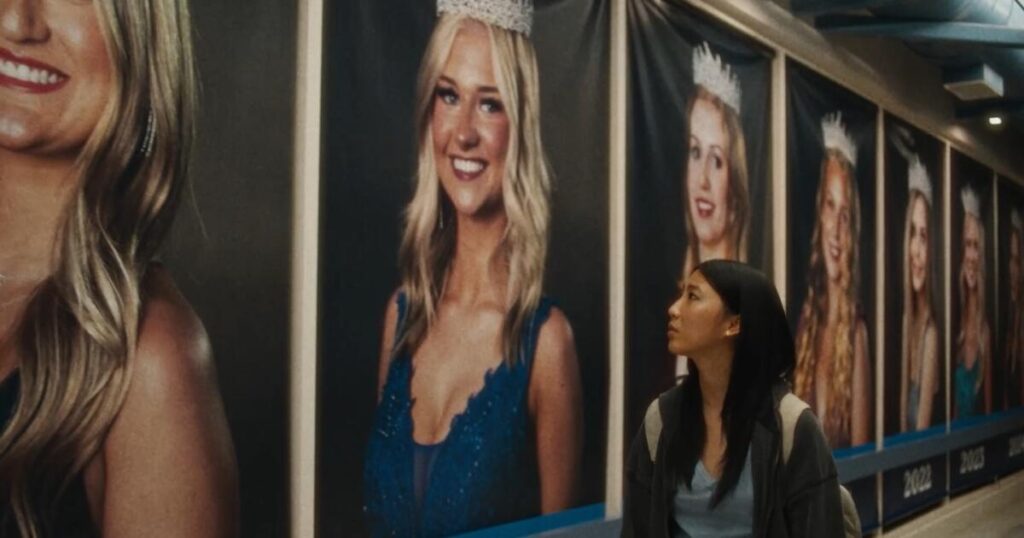
Race is not incidental, but central to understanding beauty horror. Amy Wang’s 2026 film “Slanted” is “The Substance” but with ageism replaced by racism. The film follows Joan Huang (played by Shirley Chen), the teenage daughter of Chinese immigrants who undergoes racial reassignment surgery in hopes of becoming prom queen. In chasing social acceptance, Joan sacrifices her family’s pride, identity and eventually herself, transforming into a perky, cherubic blonde (McKenna Grace).
What “Slanted” gets right is how the pursuit of beauty for Asian Americans often is rooted in the pursuit of whiteness, and how the beauty industry promises perfection if we are willing to take matters into our own hands. However, the film’s proposed remedy — of loving oneself and one’s family — falls short by presenting an individual solution to society’s racism, and thus the film reproduces the same logic of self-improvement that Joan fell prey to in the first place, leading to her racial reassignment.
There’s another Asian American figure woven throughout “Slanted,” though lacking an Asian American face — Dr. Singer (R. Keith Harris), the surgeon who performs Joan’s racial reassignment, was once Indian American. Profiting off racial self-hatred, by the end of the film, his business, Ethnos, is booming with people of color lining up around the corner for his services. Singer’s profit provides an important counterpoint to Joan’s pain, depicting how Asian Americans who fall victim to the impossible pursuit of whiteness also can perpetuate it.
If we care to look, beauty horror can expose us to underlying histories of racial violence in an industry where the fiction doesn’t stray far from reality. Tretinoin, now among the most popular topical acne and anti-wrinkle treatments, was derived from a series of unethical medical experiments whereby its creator, University of Pennsylvania dermatologist Albert Kligman, tested excessively high concentrations of the cream on incarcerated individuals at Philadelphia’s Holmesburg prison, the majority of which were Black men, as documented by scholar Thuy Linh Nguyen Tu. These dosages left behind deep open wounds and chemical burns.
Alongside these trials, Kligman also infected incarcerees with pathogens and chemical agents, including dioxin, a toxic chemical component of Agent Orange, infamously and extensively used during the Vietnam War. Similarly, the origins of Asian blepharoplasty — the double eyelid surgery meant to install a crease and make eyes appear bigger — can be credited to D. Ralph Millard Jr., who served as chief plastic surgeon to the U.S. Marine Corps after the Korean War.
In his medical writings, Millard detailed how he viewed the injuries sustained by victims of the conflict as a “plastic surgeon’s paradise.” Millard also viewed these cosmetic operations as an act of American generosity and goodwill. Through facial reconstruction, whiteness permanently scarred the Asian faces of South Korea.
The future of beauty is no less fraught. Today, the industry’s most extreme iterations can be found in Silicon Valley startup cultureand direct-to-consumer brands. Eshani Surya’s novel “Ravishing” features a young woman named Kashmira who augments her features with a nanotechnology-driven face cream called NuLook that she buys off the internet. Suffering violent side effects, Kashmira ends up in the hospital, only belatedly realizing her estranged brother Nikhil works at the skincare startup.
In Ling Ling Huang’s novel “Natural Beauty,” readers are presented a techno-optimist backstory for the Goop-like beauty company Holistik, where its Chinese American protagonist, Anna, works. Her boss, Holistik top brass Victor Carroll, is also the founder of Avidia Tech, a company whose name sounds suspiciously like Nvidia, the multinational tech firm run by Taiwanese American entrepreneur Jensen Huang that makes GPUs for data science and high-performance computing and that recently partnered with L’oréal on AI-driven cosmeceutical research.
While the character of Victor is not Asian American — that would be too on the nose — we’d be ill-advised to ignore the preponderance of Asian Americans in these burgeoning fields. “Natural Beauty” emphasizes that in the face of billions of dollars, self-love and authenticity can do only so much.
If we focus on the Joans without the Dr. Singers, the Annas without the Victors, the Kashmiras without the Nikhils, we get only half the story. Because as beauty horror tells us, what’s on the outside seeps in, contaminating our selves. The genre’s value isn’t limited to showing the experience of Asian American women; rather, it provides a lens through which to examine beauty’s complex entanglements with whiteness, money and power. We might not like what we see. But we still need to look.
Michelle Wang is a sophomore studying journalism and psychology at Northwestern University. Michelle N. Huang is Assistant Professor of English and Asian American Studies at Northwestern University.
The post ‘Beauty horror’ shows us that race runs more than skin deep appeared first on Los Angeles Times.