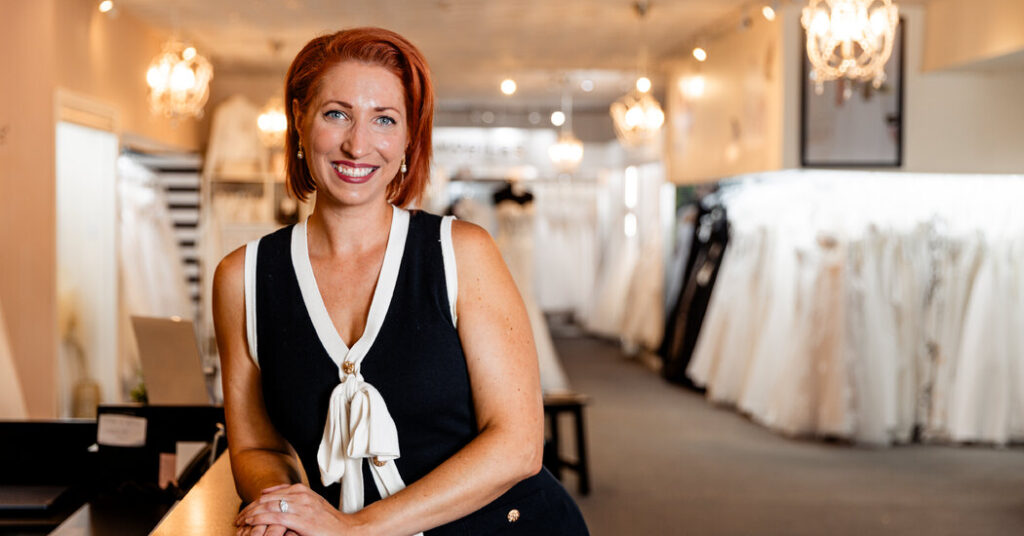
Beth Clark, an owner of Bridal Chateau, an all-inclusive bridal boutique designed for neurodivergent and sensory-sensitive brides, knows firsthand that the bridal shopping experience can be a visual overload.
“A bridal store is naturally going to contain every sensory trigger imaginable,” Clark, 43, said. “There are bright lights, loud music, and mirrors are everywhere. There are multiple appointments going on at once. There’s cross-talking, all paired with dresses that are glitterrific and texturally triggering. That’s overwhelming to someone who is neurodivergent or has sensory sensitivity.”
Bridal Chateau, a third-generation family-run business in Williamsville, N.Y., about a 20-minute drive from Buffalo, is celebrating its 50th anniversary. Clark’s maternal grandmother started the shop in Clark’s childhood home in Depew, N.Y., before moving it to an abandoned carwash they renovated in 1979. By the early 1990s, it had doubled in size.
Clark’s son, Grayson, 11, was the inspiration for the neurodivergent focus and sensory-friendly overhaul; he was diagnosed with A.D.H.D. in 2022 and autism a year later.
Today the 6,500-square-foot store has been transformed into a calming oasis.
“Neurodivergence covers so much these days: anxiety, PTSD, O.C.D., sensory processing, introverts,” she said. “Everything I’ve done to enhance the store is to make sure every bride feels represented.”
The interview was edited and condensed for clarity.
How did your renovation revolution start?
In 2020, Covid shut us down for three months. That gave me time to pause and see how the business was operating. Our first big shift was offering all-inclusive sizing, zero to 40. The response was extremely positive. Then it was, “What else can we do?” Because we carry 500 bridal dresses, three times more than most stores, I decided to focus only on the brides and stopped carrying mother of the bride, bridesmaids or prom options. Then we went from walk-ins to appointments only.
My son’s diagnosis opened my eyes to a lot of things I thought I could change. He used to say, “I’m itchy in my brain.” I thought maybe our brides felt the same.
What environmental changes have you made?
The main space is now wheelchair accessible, and posters show brides of different sizes, colors and disabilities; we want everyone to see themselves getting married. I softened the overhead lighting, lowered the music and removed plug-in fragrances.
The dressing rooms, which were originally next to each other, are now separate, so brides wouldn’t be distracted. The three dressing rooms have adjustable lights and music and are painted in soft tones. One room has a removable mirror for people with body dysmorphia; one room is handicap accessible with bars and a wall-mounted bench. Our dressing rooms have curtains or doors that swing, so it’s easier for people to open.
What is the goal when working with neurodivergent and sensory-sensitive brides?
To strip away as many options as possible, based on the feedback from the bride, so they don’t get overwhelmed. If they do, they freeze, get stuck or shut down. This is supposed to be an enjoyable and fun experience.
What’s your typical process?
Most brides book through our website, which is straightforward, with no friction points, so brides can find information easily. The text is succinct and in black and white to reduce visual overstimulation, with keywords like “neurodivergent friendly” or “we make accommodations.” Our lookbook is purposely easy to navigate, and brides can heart their favorite dresses, which are saved to their profile for us to see.
A stylist will call the bride to ask about their love story, dress inspiration, and if there is anything we can accommodate during the appointment. We use “accommodate” specifically because it gives brides permission to ask for what they need. They might say, “I’m tactile sensitive,” so we know not to bring dresses that are itchy.
How are all your dresses organized?
Our dresses are organized by price point, which we’ve found most important in this economy. When they come in for their appointment, there’s intentional curation. We bring them three different choices at a time, which allows for a visual comparison and to home in on what the bride might want and need without being overly stimulating. Our average is three rounds of three.
For the tactile and sensory sensitive, what kinds of dresses are most successful?
Formal attire is uncomfortable by nature. There’s stiffness, heavy boning, scratchy lace, and rigid waistbands, which can be triggering and create nervous system overload.
Some brides want the feeling of a weighted blanket because that reduces anxiety and makes them feel grounded. Others find that squeezing sensation overstimulating. Muted colors like cremes and blushes with taupe undertones in a classic, soft, one-piece dress, like mikado, jacquard or satin, are successful for us. So is a continuous, gentle sheet lace, like Chantilly, or stretched jersey because it’s lightweight and moves with you. It’s a tighter fit in the bodice with little or no boning.
We also add pockets, a safety measure for putting your hands, a fidget toy, or a squeeze ball inside that makes brides feel more comfortable.
Why are you so passionate about creating this specific environment?
Once you see barriers, you cannot unsee them. I saw those barriers for my son; I’m now recognizing how they happen in my business and with our brides. My business has never just been about the dresses. It’s about “how do I make every bride feel seen?” I work in love. I’m not asking a bride to fit into our world. I’m trying to create a world that’s successful for them.
Why do you think sensory needs are becoming a bigger part of the bridal shopping conversation?
These sensitivities have always been there, but we didn’t know it. Older generations were told not to complain and push through it. Working with Gen Z, there’s more self-awareness. They say what they need. They’re also taking care of themselves more. They are normalizing the conversation. The wedding industry is finally coming around to where we are: client-focused instead of being business-focused, and our client experience is our driving force.
The post A Dress Shopping Experience That’s Not Overwhelming appeared first on New York Times.