When Mandela Barnes dropped out of the Wisconsin governor’s race two weeks before the Democratic primary, he declared, “It has become very clear who our nominee is going to be.”
He meant Francesca Hong, who had a commanding lead in polls — not David Crowley, who ended up narrowly winning the nomination.
Politicians like Mr. Barnes have relied on public and private surveys of voters’ views to guide their decisions for as long as pollsters have sought to measure public opinion. But in this year’s midterm contests, misleading polling has shaped campaign narratives, donor behavior and news coverage like never before.
Polls are traditionally used to measure public opinion, not mold it. But this year, several Democratic campaigns have seized on unreliable polls to push the perception that their candidates are surging to try to solidify support, attract donors and scare off rivals. The rise of prediction markets has also created financial incentives for untrustworthy or even fake political polls at a moment when it has become even more expensive and difficult to conduct high-quality public opinion surveys.
Some Republicans — particularly President Trump — have for years pointed to dubious polling to advance their political goals, but the phenomenon has become far more acute in Democratic primaries this year. In recent weeks, questionable surveys have created confusion and warped perceptions of the results of key primaries for the party.
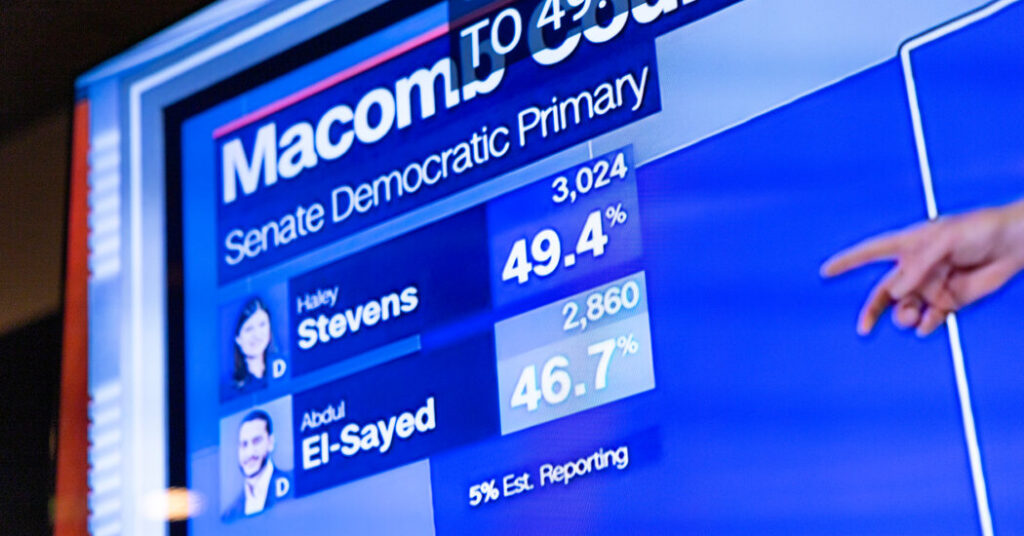
In Michigan’s primary for Senate, polls fueled a widespread belief that Representative Haley Stevens, a moderate Democrat, was a major underdog to Dr. Abdul El-Sayed, a progressive. After she voted on Primary Day, the first question she faced from reporters was about how Dr. El-Sayed built such a large polling lead. She ended up losing by just a percentage point.
In Wisconsin’s primary for governor, polls that consistently showed Ms. Hong ahead by double digits created an air of inevitability around her nomination. When she lost, it was viewed as a stunning upset.
“After seeing the polls, I think everybody would have called me the underdog,” Mr. Crowley said. “During this race, I had to be a little bit recklessly optimistic.”
The polling world has also been rocked by recent revelations of made-up surveys and sketchy practices.
Three purported polls of the Los Angeles mayor’s race, the Wisconsin primary for governor and the Nevada governor’s race turned out to be entirely fake — a “short-term social experiment,” according to the website that released them. The fakery’s discovery, by The Los Angeles Times, came only after Mayor Karen Bass of Los Angeles posted approvingly about one of the polls, which showed her ahead.
Another pollster acknowledged that in a survey of Florida’s primary for governor, it had shifted some respondents’ support from the candidate they had said they backed to another candidate because the initial results “did not align with our read of the race.” (None of the polls above were included in The New York Times’s poll trackers or coverage because they did not meet its basic transparency and professionalism standards.)
All of this is happening at the dawn of the 2028 presidential primary season, when dozens of candidates are likely to be defined in part by polls that cement impressions and set narratives that may not be tethered to political reality.
“Every candidate in 2028 will have their own cooked poll factory,” said Lis Smith, a Democratic strategist who was a senior aide on Pete Buttigieg’s 2020 campaign for president. “Polls now are not just a way of measuring the horse race. It’s a way for candidates and their allies to influence the horse race.”
‘Double Digit Down — It Cannot Be!’
In Michigan, the last eight public polls of Democratic voters found Dr. Abdul El-Sayed leading Ms. Stevens by double digits.
In an interview this past week, Ms. Stevens said she never believed the race was the blowout that the polls predicted. She won key late endorsements from figures including Gov. Gretchen Whitmer of Michigan, a popular Democrat.
But the polling unquestionably shaped how the contest was perceived. Dr. El-Sayed, whose advisers privately predicted a big victory, was so confident that the weekend before the primary, he was pictured hanging out with social media influencers poolside at a party.
Ms. Stevens sent The Times a memo about her experience dealing with polling that did not reflect the reality of the race.
“At first the double digit down polls leading up to the election spooked me and potentially had the ability to paralyze,” she wrote. “But then after chewing on them,” she added, “I came to realize, NO WAY! Double digit down — it cannot be!”
In the interview, she attributed the polling miss to an industry that has largely moved away from expensive “live caller” phone interviews with voters. Instead, most contemporary polling is done online or through texting, mediums likely to include more young people even though the voting electorate skews older. (Live-caller polls can be seriously flawed, too, and it is generally considered best to analyze surveys from a range of pollsters using a mix of methods.)
“Sometimes we miss the plot with all the tweets and all the polls and all the prediction market stuff,” Ms. Stevens said. “In this American democracy, it is still about the people voting, and that remains the purest and most incredible thing, and it likely captures the least amount of our attention.”
The Odds of Confusion: 100 Percent
The biggest new phenomenon influencing how campaigns are viewed is the spread of prediction market data.
The day before Michigan’s primary, Kalshi gave Dr. El-Sayed a 97 percent chance of winning. The morning of Wisconsin’s primary, Polymarket gave Mr. Crowley a 3.6 percent chance of victory.
While betting-market odds are often based on the wisdom of crowds and opaque measurements, they are amplified by powerful companies and reported on by legitimate news organizations that in some cases have financial partnerships with the prediction firms. CNN has such an arrangement with Kalshi and regularly shows the prediction market’s betting odds on television. The Wall Street Journal’s parent company has a partnership with Polymarket to display its odds within Journal content.
Voters and donors now see those numbers, which can be manipulated by all manner of polling and news events, and use them as a proxy for how a candidate is faring.
Sean Clegg, a senior adviser to Gov. Gavin Newsom of California, who is likely to run for president in 2028, said prediction markets had a growing influence on Democratic strategists, donors and primary voters.
“Momentum is everything and poll numbers move prediction markets, which influences strategic voting,” Mr. Clegg said. “The progressive subset of the political class is hyper online, and they are pushing these polling narratives like never before.”
What Can Anyone Do?
The modern polling industrial complex is a Wild West in which numbers often circulate online with little regard to whether they come from reliable sources.
“There is no polling cop,” John Anzalone, a prominent Democratic pollster who worked for former President Joseph R. Biden Jr., said of the proliferation of low-quality surveys that flood the market. The news media, he said, is “going to report on every poll that has a university or college on it,” regardless of its methods. “Bad in,” he said, “bad out.”
Both good and bad polls have real-world consequences, driving decisions about messaging, spending and even whether to stay in a race. This spring, Gov. Janet Mills of Maine suspended her Senate campaign weeks before the Democratic primary, after low polling numbers starved her of money. The decision left Graham Platner to win the nomination without significant opposition. He later dropped out after a rape allegation that he denied.
The first 2028 Democratic presidential primary contest is set to be in South Carolina, where the electorate is dominated by older Black voters — the exact demographic that was most difficult to poll in both Michigan and Wisconsin.
Scott Huffmon, the director of the state’s long-running Winthrop Poll, said that like many other pollsters, he had abandoned live-caller surveys. “We just can’t afford it,” he said.
Polling problems may be less pronounced in the 2028 race, since presidential contests are easier to poll and produce more high-quality surveys. But the looming questions about how to accurately analyze the field in 2028 have left donors struggling with how to decide which candidates are worth the investment.
Few methods besides polling will be able to gauge who has popular support before the primaries begin in January 2028. But usually by the time voting begins, the field has been winnowed as candidates run out of money or perceive themselves to be lacking voter support.
“Given what’s happened over the last two weeks, the inaccurate polling really calls into question whether there’s any empirical value that donors can use to guide their giving,” said Shannon Hunt-Scott, a Democratic megadonor from California. “There’s going to be so many candidates and so many polls of variable quality. People will want to tout them and run around with them. The question is, will they have any real validity? You can’t know.”
Shane Goldmacher contributed reporting.
The post Why Polling Chaos Could Create Big Problems for American Politics appeared first on New York Times.