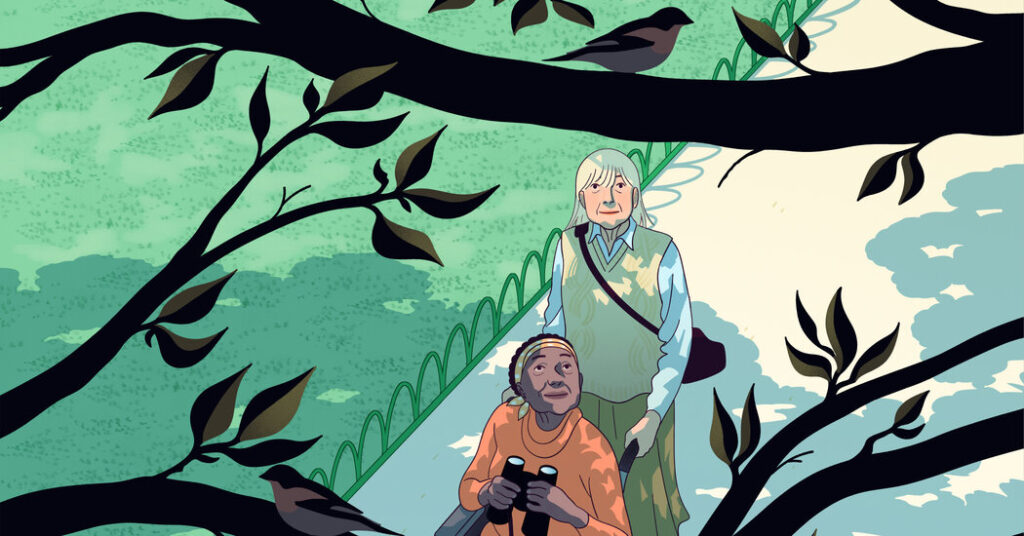
For several years, Nicole Straight and Patricia Wood, who lived across the street in Sausalito, Calif., were neighbors more than friends, exchanging sociable greetings and occasionally having coffee.
Then, last October, Ms. Wood took a fall, broke her neck and spent three months in rehabilitation. When she returned to the house she shares with her niece, she couldn’t walk without assistance. “I still don’t dare go up and down stairs unless someone is with me,” Ms. Wood, 93, said.
That has redefined their neighborly relationship. Ms. Straight, 53, a retired chef, now visits weekly, bringing lattes and cookies, and often leftovers from dinners she has made. Her husband installed a grab bar in Ms. Wood’s bathroom, put up shelves and changed her lightbulbs and smoke detector batteries. The texts fly back and forth.
Ms. Straight calls to say, “I’m going to the grocery store, do you need anything?” Ms. Wood, who no longer drives, provides a shopping list.
“She is a gift from heaven,” said Ms. Wood, a retired insurance executive. “We talk and talk. Sometimes we shed a few tears, but mostly we laugh. I never thought I’d have a new best friend at this time of my life.”
Elder care, typically considered a family obligation, is evolving to adapt to demographic shifts that make reliance on spouses and children less assured.
“The number of older adults who have never married or are divorced has been increasing, so we have more people aging alone,” said Deborah Carr, a sociologist at Boston University who has investigated these trends.
“The proportion who are childless, by choice or not, is also growing,” she added, and families with children have fewer of them than in past generations.
Geographic distances or family estrangements also help fuel the need for other kinds of caregivers — and these roles can be filled by friends or neighbors.
How commonly do friends step into caregiving gaps? A recently published study in JAMA Network Open, led by researchers at the University of Michigan, looked into friends and neighbors serving as caregivers, usually in supplementary roles.
They used data from the National Health and Aging Trends Study, in which more than 2,600 older people with health limitations (average age: 79) identified friends and family members who provided help. Family members were most likely to care for aging relatives, but about 14 percent of participants identified friends (including neighbors) as well. That represents 2.4 million caregiving friends nationally, the authors estimated.
Last year, a national survey by AARP and the National Alliance for Caregiving put the proportion of caregivers supporting non-relatives at 11 percent.
“Friends are among the auxiliary caregivers who have not been acknowledged,” said Karen Fingerman, a gerontologist at the University of Texas at Austin and co-author of a commentary accompanying the study. “We neglect the sacrifices they make.”
The study, believed to be the first nationwide look at caregiving friends, found that they functioned differently from relatives. They’re unlikely to live with the person they’re helping, for example, and rarely serve as the sole caregiver.
“They provide fewer care hours,” said Yee To Ng, a gerontologist and lead author of the study, which found that friends supplied 18 hours of help a month on average compared with about 67 hours from family.
They assist in different ways, too. “Friends are more likely to provide transportation,” Dr. Ng said. Two-thirds of caregiving friends drive their friends around; shopping, helping people go outside, preparing meals and accompanying patients to medical appointments round out the top five tasks.
Sometimes they do more. Czes Ferrino, 82, is widowed and lives alone in Westerly, R.I. She has no disabling health problems, but when her car died recently, her next-door neighbor went with her to several Subaru dealers to find a used replacement. “He walked me through it like a son would for a mother or grandmother,” Ms. Ferrino said.
On the other hand, “there are some tasks friends might not be well equipped to provide or be comfortable with,” Dr. Ng said. Personal care, like bathing and dressing, remains largely the province of family members.
“Those can infringe on people’s self-esteem,” Dr. Ng said. “With family, we accept that when you’re really ill, they step up with intimate activities. It’s embarrassing to have your friends help you use the toilet.”
The researchers also found that respondents who named friends as caregivers were younger than those with only relatives in that role, and more apt to have college degrees. People with higher education levels have larger social networks, Dr. Fingerman said.
Those assisted by friends were also, unsurprisingly, less likely to be married and more apt to live alone — like Ann Greenwater, 84, who lives in a mobile home park in rural Humboldt County, Calif.
She managed independently until a few years ago, when severe back pain rendered her bedridden for nearly three months. Although she’s up and about now, and can handle housekeeping, cooking and personal care, “I’ve never really fully recovered,” Ms. Greenwater said.
She is single, with no family beyond a distant nephew she barely knows, and has stopped driving. But a cadre of friends she knows from a nearby Zen Buddhist center have stepped in.
Milli Quam, 86, does her laundry and drops it off, sometimes picking up prescriptions en route. A 73-year-old helped Ms. Greenwater with her computer and, along with several others, takes her grocery shopping or shops for her. Members of a local volunteer organization drive her to medical appointments.
“I love Ann, and I’m happy there’s something concrete I can do,” Ms. Quam said. “I hope I can keep doing it for a long time.”
Friends have some advantages as caregivers. “Our friends are our own age and understand what we’re going through,” Dr. Carr said. “They may have more empathy and sometimes real knowledge they’ve acquired.” When family caregivers are on the job, friends’ efforts can reduce their burden.
But they may also prove less stable as a source of help. Neighbors move. Strains can develop if the person needing care becomes too demanding or feels guilty about accepting help, challenging the egalitarian expectations for friendships. These strains can intensify depression in those with physical limitations, a study led by Dr. Carr found.
Nor is there much policy support for these caregiving relationships. The federal Family and Medical Leave Act, for instance, “with rare exceptions does not provide job-protected leave from work to care for a friend with a serious health condition,” Laura Lawless, a labor and employment lawyer with Squire Patton Boggs, said in an email.
“For family, ‘through-thick-and-thin’ is the expectation,” Dr. Carr said. “There’s huge stigma to being estranged from your family, but it’s kind of normal for some friendships to just fall away.”
In Sausalito, Ms. Wood tells Ms. Straight that “she’s not allowed to move until I die.” She’s joking, sort of.
Ms. Greenwater’s friends in Humboldt County, to her gratitude, have not fallen away either. But they are aging along with her; at 86, Ms. Quam pointed out, she may stop driving before very long, too.
“I’m wondering what will happen when these friends aren’t able to come to me,” Ms. Greenwater said. “I guess we’ll deal with it when it comes.”
The New Old Age is produced through a partnership with KFF Health News.
The post When a Friend Becomes a Caregiver appeared first on New York Times.