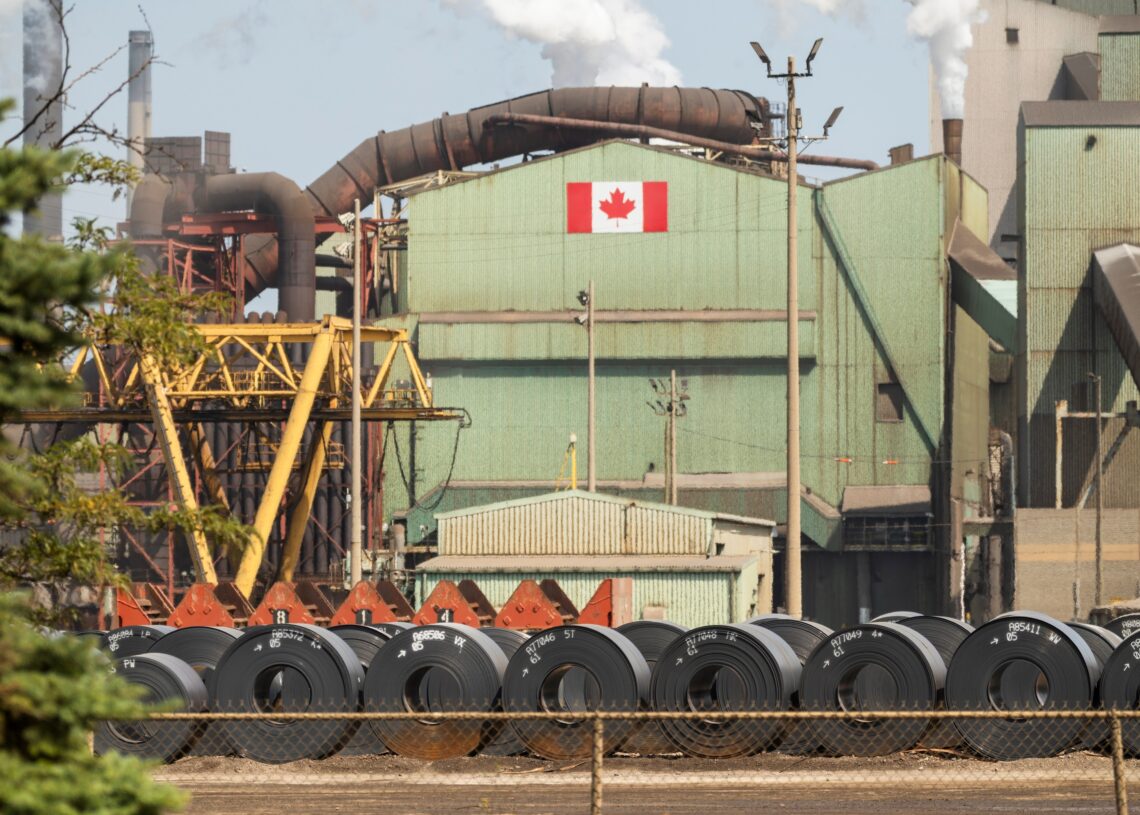
U.S. tariffs on some Canadian goods took effect early Saturday, after a potential deal between the United States and Canada fell apart, a move that immediately drew a pledge of retaliation from America’s northern neighbor.
Beer, dairy and a long list of other Canadian imports became subject to new 50 percent tariffs after talks on Friday collapsed.
Canadian Prime Minister Mark Carney said Saturday that Canada would enact retaliatory tariffs against the United States on Sept. 8.
“The new U.S. tariffs are designed to hurt us and divide us. They’re a miscalculation,” Carney said Saturday.
Negotiators had worked for weeks to reach a deal to avoid the tariffs, which President Donald Trump announced last month. Trump paused the implementation of the tariffs earlier this week as talks continued. But officials said late Friday night that a deal had broken down and tariffs would go into effect.
The two countries pointed a finger at each other for failure to ink a deal.
“This is a missed opportunity for Canada to partner with the United States,” U.S. Trade Representative Jamieson Greer said in a statement, noting that the offer would have given Canada “the best treatment of any major exporter to our market.”
Carney hit back Saturday, vowing that Canada was becoming stronger economically and less dependent on the United States.
“In the last year and a half, Canadians have met this moment with resolve, with purpose, with strength in many ways: vacationing in national parks, buying Canadian products, choosing Canadians,” Carney said. “Small acts of solidarity, repeated millions of times that make a statement: We’re masters of our destiny.”
There are currently no scheduled meetings for negotiations to continue, a senior Trump administration official told reporters.
The new tariffs apply to just 5 percent of the $382 billion in Canadian goods that the U.S. imported last year and are unlikely to have a significant effect on American consumers, economists said. But they are likely to invite retaliation — Carney had said “all options are on the table” — possibly sparking a trade war that could scupper hopes for preserving a unified North American trade bloc.
“Economically, (the new tariffs are) not that important — except that the relationship itself is extremely important,” said Mary Lovely, a senior fellow at the Peterson Institute for International Economics, a nonpartisan research organization.
A senior administration official said the negotiations included talks on steel, aluminum, autos and lumber tariffs — sticking points between the two countries. But Canada wanted further concessions than the U.S. could give, the official said.
In his statement, Carney said the progress had “not been enough to meet our objectives for Canadians.”
If Canada retaliates, Trump would be given options to respond, the administration official said.
Tensions between the two nations have been high since Trump last year began implementing sweeping tariffs on countries around the globe. Those tariffs have since been overturned by the U.S. Supreme Court, but Trump has turned to an array of other legal authorities to impose new levies.
Last month, after wildfires in Ontario sent thick smoke pouring into the U.S., Trump threatened to punish Canada with new tariffs. A day later, Trump announced the new 50 percent levies. The White House said they had nothing to do with smoke and instead were intended to punish Canada for retaliating against Trump’s tariffs in 2025, when officials in most Canadian provinces removed U.S. wine and spirits from government-run stores after Trump imposed tariffs on Canadian goods for what he said was a failure to prevent illicit fentanyl from entering the U.S.
Canada also imposed a 25 percent tariff on some U.S. autos in response to a similar move by Trump. The Trump administration says these actions unjustly penalized three industries — alcohol, autos and dairy — which are now the targets of the new 50 percent tariffs.
Many of Trump’s tariffs that have hit Canada have included exemptions for goods that fall under the United States-Mexico-Canada Agreement (USMCA), which accounts for the majority of imports. That is not the case with the 50 percent tariffs, however, which include no USMCA carve-outs.
Joseph Steinberg, an economics professor at the University of Toronto, said earlier this week that there will be enormous political pressure in Canada for Carney to retaliate. “The danger is really retaliation,” Steinberg said, adding that the tariffs could be “devastating” to specific industries targeted. One of those is the Canadian alcohol industry, which relies on the U.S. as its main exporting partner.
The U.S. and Canada rely on each other across industries, and many experts point out that a tariff war between the countries could eventually weaken both economies. The auto industry is particularly intertwined — cars are often sent between the U.S., Canada and Mexico during the building process.
“Tariffs may look tough politically, but in an integrated North American economy, they amount to economic self-harm,” Andreas Schotter, an international business professor at Ivey Business School, said in an email. “Canada and the United States do not merely sell products to one another. They make products together.”
The U.S. began talking to Mexico months ago about possible changes to the North American trade deal, the USMCA, that Trump negotiated during his first term, but no formal negotiations have taken place with Ottawa.
correctionA previous version of this article incorrectly stated that cheese was included on the tariff list. It is other dairy products.
The post U.S. hits Canada with 50 percent tariffs after talks fail, Carney vows retaliation appeared first on Washington Post.