Tropical Storm Moke will bring a chance of heavy rain and strong winds to Hawaii as it swings by the island chain a couple of hundred miles to the south Saturday night into Monday
The National Hurricane Center said the storm is not expected to grow as large or powerful as Hurricane Lala, which battered the Big Island last weekend.
Even though Moke (pronounced MOH-keh) was unlikely to strengthen into a hurricane, meteorologists warned that life-threatening flooding and mudslides were possible, particularly on the island of Hawaii, known as the Big Island.
The Big Island could pick up another five to 10 inches of rain, with isolated locations receiving up to 15 inches. Maui was expected to get one to four inches of rain and the remaining islands, including Oahu, one to two.
Blustery conditions were expected on the islands, with wind gusts reaching up to 55 m.p.h. A wind advisory was in effect from noon Saturday to Sunday evening for portions of Maui, Molokai, Lanai and the Big Island.
Large surf and strong rip currents were expected to bring dangerous conditions to portions of the Hawaiian Islands this weekend and into early next week.
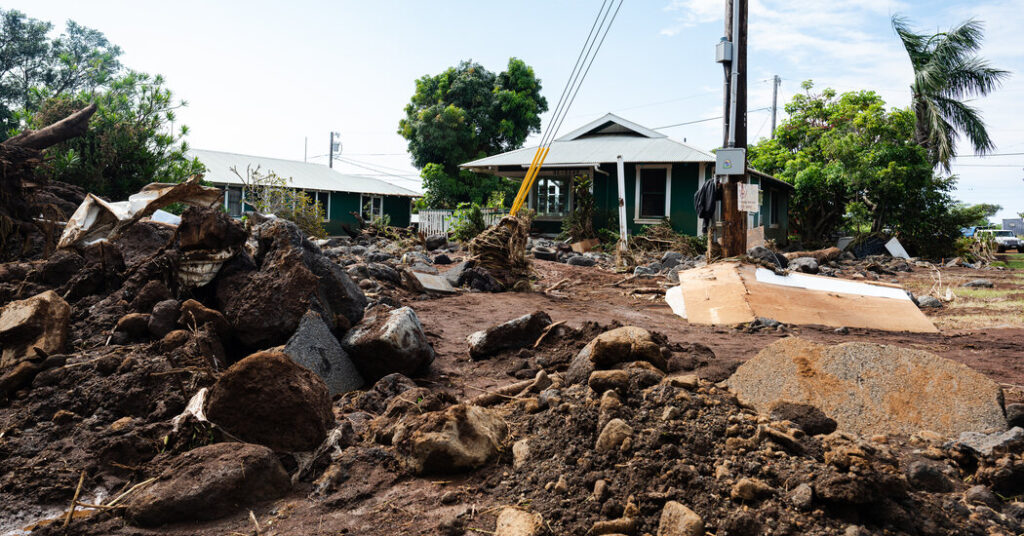
The alerts comes as people clean up from the damage that Lala left with its strong winds and heavy rains that ripped off roofs, flooded roads and knocked over trees and power lines.
“There are families and communities across Hawaii Island still without power, water and basic necessities,” said Breeani Kobayashi-Kualii, president of the nonprofit Hawaii Rise Foundation. “Some roads remain difficult because of downed lines and ongoing recovery work.”
The National Weather Service issued a flood watch for the Big Island from late Saturday night through Monday afternoon, alerting the public that overflowing waters from swollen streams could close roads.
A watch means that conditions are expected to be favorable for flooding. Forecasters advised people on the island to keep an eye out for more urgent warnings indicating that flooding was imminent.
Key things to know
-
Timing: The closest approach to the Big Island is expected to happen on Sunday.
-
Effects: The worst effects are expected to be flash flooding and mudslides from heavy rains on the Big Island.
-
Strength: The storm is not only expected to be smaller, more compact and weaker than Lala, but it’s also poised to take a track farther to the south.
Tropical Storm Moke may never become a hurricane
Moke is the second named tropical storm to form in the central North Pacific this season, with Lala being the first.
Back-to-back storms have affected the islands in the past, including Hurricanes Iselle and Julio in 2014, and Lester and Madeline in 2016, according to John Bravender, a meteorologist with the National Weather Service office in Honolulu.
This is not an unusual occurrence, he said.
While Iselle made landfall on the Big Island as a tropical storm, the others passed by the islands.
Lala also did not make landfall, which occurs when the storm’s eye passes onto land, but the storm’s outer edges moved over the Big Island.
Winds exceeded 100 miles per hour on the tallest mountain peaks, and over 30 inches of rain fell in the wettest locations.
Residents of Hawaii are still recovering from that damage. While local government agencies are establishing distribution centers, Mrs. Kobayashi-Kualii said there were still many gaps.
Even staff members at the hospital in Kau needed donated supplies because they weren’t able to make distribution times at local community centers, according to Elena Cabatu, a spokeswoman for the hospital.
She said the donations were “such a relief to staff who still have no electricity and started to wash their clothes the old-fashioned way — in buckets.”
By late Saturday morning, Moke was strengthening slightly, spinning over the Pacific Ocean 470 miles off the coast of Hilo.
“I’m hoping the winds won’t be as bad, but the rain is always something,” said Andrew Chun, a resident of Hilo whose home lost power during last weekend’s storm.
His wife, Gina Chun, a real estate agent, added that “right now, the most important thing is taking care of people and their basic needs.”
The National Hurricane Center said the center of the storm was expected to pass south of the Big Island on Sunday and then south of the smaller islands into Monday, probably on a track farther south than the one Lala took.
But the storm was still expected to get close enough to the Big Island to generate heavy rain.
“There is still a lot of moisture associated with this storm and in the air, and when you have that much moisture, it brings a threat of flooding,” said Liam Tsamous, a meteorologist with the Weather Service in Honolulu.
Maia Spoto and Kyveli Diener contributed reporting.
The post Tropical Storm Moke Threatens to Bring Up to a Foot of Rain to Hawaii appeared first on New York Times.