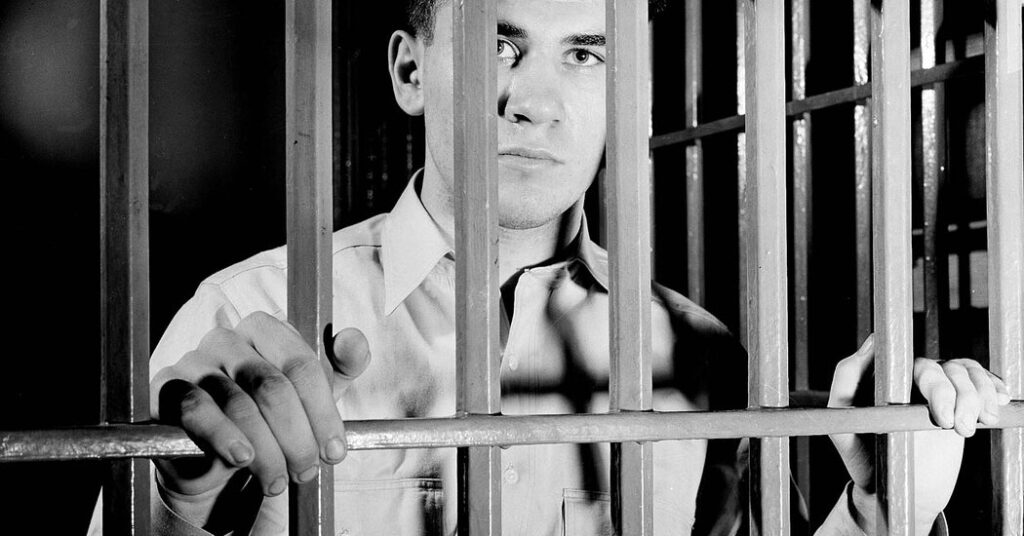
Francis Clifford Smith, who died on June 25 at 101 after spending 70 years in prison, was among the longest-incarcerated people in American history. Here are some others who spent most of their lives behind bars, even longer than Robert Stroud, the “Birdman of Alcatraz,” who was in prison for 54 years and died in a prison hospital in 1963.
William Heirens
Heirens, also known as the Lipstick Killer, confessed in 1946 to killing two women and a 6-year-old girl in three murders in Chicago. At the scene of the second murder, a message was scrawled on the wall in lipstick: “For heaven’s sake catch me before I kill more. I cannot control myself.” Heirens was a 17-year-old student at the University of Chicago when he was apprehended by the police. He later said he was coerced into signing a confession. He was found dead in 2012 at Dixon Correctional Center in Illinois, after spending 65 years and 181 days in jail. He was 83.
Sammie Robinson
Robinson was a teenager when he was sent to the Louisiana State Penitentiary, known as Angola, in 1953 after being convicted of attempted aggravated rape in Alexandria, La. His 10-year sentence became a life sentence after he killed a fellow inmate during a fight in 1954. Near the end of his life, Robinson sat down for an interview with The Visiting Room Project, a multimedia archive of Louisiana prisoners serving life sentences. He said he was set on fire with lighter fluid during another prison attack, suffering third-degree burns. His original rape conviction was eventually overturned, but he remained imprisoned for the murder. Robinson died in 2019 at 83, after 66 years and 85 days in prison, according to The Angolite, the prison’s newspaper.
Johnson Van Dyke Grigsby
In 1908, Grigsby got into a fight over a poker match at a small-town saloon in Indiana and fatally stabbed a man with a knife, he told Ebony magazine nearly 70 years later. He was charged with second-degree murder and was sentenced to life; he told Ebony the severity of the sentence was never explained to him. Incarcerated at the Indiana State Prison in Michigan City, he was denied parole dozens of times before being released in 1974. By then, he was 89, and had spent some 66 years behind bars. He struggled to adjust to life outside prison and voluntarily returned for a time before he left again, at 91. He died in 1987, at 101. Johnny Cash wrote a song about him, “Michigan City Howdy Do.” It went, in part:
Well, Johnson Van Dyke Grigsby was paroled at 89 He never walked on a carpet, never tasted dinner wine His old eyes were slowly fading as he walked out of the gate And he breathed the first free air he’d breathed since 1908.
Joseph Ligon
Ligon was 15 in 1953, when he and four other Black teenagers were arrested after a night of robberies and stabbings in Philadelphia that left two people dead, according to court records. He pleaded guilty and was convicted of two counts of first-degree murder, receiving a mandatory life sentence. Ligon acknowledged stabbing at least one person but maintained that he had not killed anyone. His lawyers later argued that he had effectively been convicted by association with the other teenagers. After Supreme Court rulings opened the door for people sentenced to mandatory life without parole as juveniles to seek release, Ligon was freed in 2021, after nearly 68 years in prison.
Warren Nutter
Nutter, who went by Jack, was 18 in 1956, when he was sentenced to death by hanging for killing a police officer in Independence, Iowa. Nutter had been arrested with a group of friends after a string of crimes and had escaped from the courthouse, only to return with a shotgun in an attempt to free his companions, according to his Associated Press obituary. He fatally shot the officer and later pleaded guilty to murder. His death sentence was commuted to life in prison by Gov. Herschel Loveless in 1957. Nutter remained behind bars for the rest of his life; he died in 2021 at 84 in a hospice room at the Iowa State Penitentiary after nearly 66 years in prison. He was Iowa’s longest-serving inmate.
The post These 5 People Spent Decades Behind Bars. Here Are Their Stories. appeared first on New York Times.