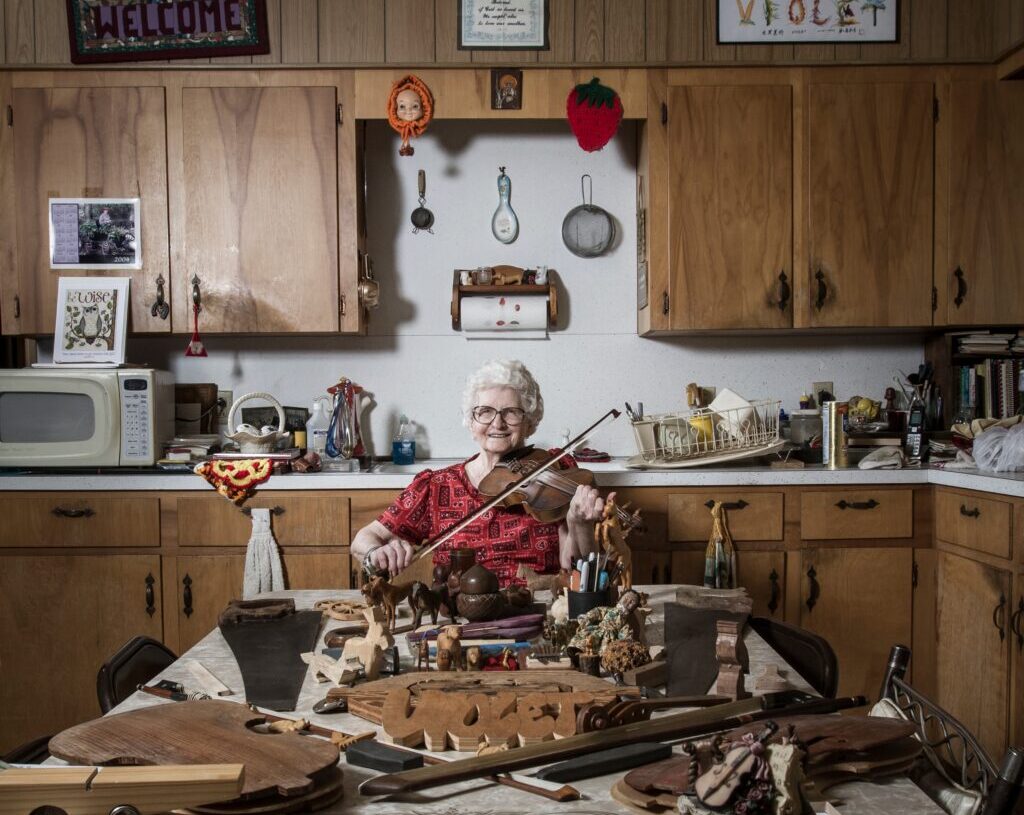
Growing up, she watched as her father carved fiddles with a hatchet and knife, shaping pieces of maple or pine he gathered near their home in the Arkansas woods. He had made his first fiddle when he was 14, in 1888. And while he had no formal training, he had gotten so good that neighbors would trade him a wagon, a bed or a cow for one of his fiddles. “With a little thinking and a little common sense,” he liked to say, “you can just about figure out how anything’s done.”
Violet Hensley, his third daughter, tried to follow that advice all her life.
While raising nine children in the Ozarks, she tanned leather, broke horses and made her own fences, roofing shingles and lye soap. She farmed, canned and felled trees, hauling timber out of the woods with a mule. And beginning in 1932, when she was 15, she followed her father in making handcrafted fiddles, often using wood that she chopped down herself: persimmon for the pegs, dogwood for the tailpiece, walnut for the fingerboard and a host of hardwoods for the back, sides and neck.
Ms. Hensley, a self-taught luthier and musician, became known as “the Whittlin’ Fiddler” and the “Stradivarius of the Ozarks.” She crafted 73 fiddles, all by hand; performed for more than 50 years at Silver Dollar City, a theme park near Branson, Missouri; and recorded folk songs and fiddle tunes like “Turkey in the Straw” and “One-Eyed Gopher.”
A Notable Life
This article is part of A Notable Life, an obituary feature telling the stories of remarkable people every Saturday. Read more from the series here:
A faith leader and martial artist, he fought for Black gay men with AIDS
Exploring queer themes and Chicano life, he became a bard of the U.S.-Mexico border
She still seemed fit as a fiddle at 99, when she fulfilled a childhood dream by performing at the Grand Ole Opry, making her debut on the radio show in 2016 with a performance of “Angeline the Baker.”
“This little lady was born in 1916,” banjo player Mike Snider observed, introducing Ms. Hensley to cheers from the audience.
Ms. Hensley was 109 when she died Aug. 7 at her home in Yellville, Arkansas. She had returned to the Opry two more times — most recently in 2018, the year she was inducted into the National Fiddler Hall of Fame — and was among the last living links to a pre-Depression era of foot-stomping American folk music.
“I just call this old-time music,” she told the Tulsa World in 1982, describing her love of songs like “Boil Them Cabbage Down.” “It ain’t fancy enough to be called bluegrass music.”
Her friend Brad Leftwich, a fiddler, banjo player and singer, called her music “a quintessential expression of an older generation of Arkansas Ozark music.”
“She welcomed and would sit down and play with anyone who was interested in her music,” he wrote in an email. But “what made Violet so special was not only music but her personality. She was the real thing, a mountain woman raised in the backwoods who in turn raised her own large family under difficult circumstances.” Ms. Hensley, he added, was “one of the most positive and upbeat people I have ever known.”
“When she plays,” fiddler Tim Crouch once said, “she doesn’t sound like anyone else.”
She didn’t look like anyone else, either: For one of her signature songs, “She’ll Be Coming ’Round the Mountain,” she would hold the fiddle aloft, playing it on her head, while dancing at the same time.
Ms. Hensley had no pretensions about her craft. Asked about the difference between a fiddle and a violin, she said: “If you can read music, you play the violin. I can’t read music, so I just play the fiddle.” She earned a little money from performing but insisted that she wasn’t a professional, noting that she supported herself with other jobs, including working in the kitchen of a local hospital.
Still, performing offered Ms. Hensley “a second life,” said her daughter Sandra Flagg. Ms. Hensley had effectively put fiddling and whittling aside after getting married at age 18 and starting a family. She went back to music only in the early 1960s, after a nearly three-decade hiatus, when friends persuaded her to enter Yellville’s Turkey Trot Talent Show. She came in second but drew the attention of Jimmy Driftwood, a folk musician who invited her to perform in the nearby town of Mountain View.
Grieving a loved one? Tell us what made them special.
The Post is publishing short reader-submitted obituaries as part of a new series, What We Remember, about everyday but extraordinary people.
The exposure helped Ms. Hensley land a spot at Silver Dollar City, where she began appearing in 1967, leading fiddle-making demonstrations and performing with her husband, Adren Hensley, a guitarist, and their daughters Flagg and Lewonna Nelson. She went on to appear on television shows including “The Beverly Hillbillies” and “Captain Kangaroo”; play at the Smithsonian Folklife Festival in Washington; and perform on “Live With Regis and Kathie Lee,” where she had limited success in teaching Regis Philbin how to fiddle (“Get it up under your chin, boy”).
She also welcomed journalists to Yellville, including CBS’s Charles Kuralt and a photographer for National Geographic, who took pictures of Ms. Hensley and her family rehearsing barefoot on a cracked concrete porch. According to Flagg, the photographer seemed more interested in the family’s pet baby skunks, which Adren had taken in after “bush hogging” a neighbor’s field and killing the animals’ mother.
The skunks “still had their full power,” Flagg said, “but as long as you didn’t scare them, they were fine.”
Ms. Hensley was born Mary Violet Brumley on Oct. 21, 1916, at her grandfather’s homestead near Mount Ida, Arkansas. Her father was a farmer and handyman, called on by neighbors to fix their plows and sewing machines. She was 11 when her mother died, requiring her to spend more time milking cows, raising chickens and chopping wood on the farm.
In 1935, she married Adren, wearing a yellow and green striped dress she made herself. “Our honeymoon began that afternoon by layin’ by the Irish taters,” she wrote in her memoir, “Whittlin’ and Fiddlin’ My Own Way,” with Randall Franks. “The next day, we plowed corn.”
Her husband died in 1997. Ms. Hensley was also predeceased by her sons Calvin, Russell, Gary and Larry, who was stillborn.
Survivors include five generations of Hensleys: six children, Sandra Flagg, Beatrice Porter, Lewonna Nelson and Marvin Jr., R.G. and Eddie Hensley; Wilma Flagg, who moved in with the family as a teenager; 32 grandchildren; 85 great-grandchildren; 29 great-great-grandchildren; and two great-great-great-grandchildren.
Beginning in her early 80s, Ms. Hensley and the family celebrated her birthday each year at Silver Dollar City, where she continued to perform up until the coronavirus pandemic. She whittled well after her eyesight faded, although it had been years since she made a fiddle. It took about 260 hours to craft one, and each fiddle created enough wood shavings to fill a five-gallon bucket. Some sold for upward of $2,000, she said, though it was never about the money.
“If I’m fiddling, I don’t want to stop; if I’m whittling, I don’t want to stop,” Ms. Hensley said at age 96, in a documentary short by filmmaker Joe York. “I play it my way.”
The post She set aside the fiddle to raise nine children. At 99, she made her Opry debut. appeared first on Washington Post.