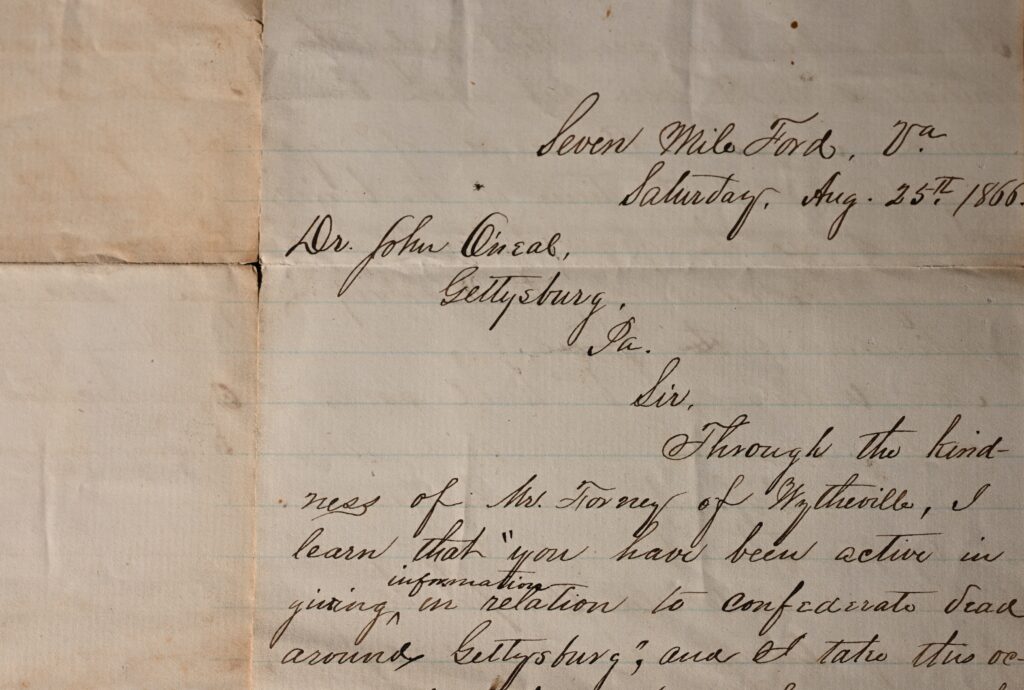
In 1866, a former Confederate army officer wrote to a doctor in Gettysburg, Pennsylvania, asking him to look for the grave of his brother, who had been killed in the Civil War battle there three years earlier.
Robert H. Dungan, of Seven Mile Ford, in rural southwest Virginia, was searching for the remains of his brother, Thomas, a schoolteacher with a wife and small daughter, who had been killed on July 2, 1863.
“I would take it as a very great kindness,” Dungan wrote to John W.C. O’Neal, a native of Virginia, who was known to help Southern families find loved ones buried on the Pennsylvania battlefield.
Thomas’s grave might be near a stone house, under a peach tree and marked with a board carved with his name, “Serg’t T.W. Dungan, Co. D, 48th Va.,” his brother wrote. He would gladly pay O’Neal for his trouble.
Dungan’s missive is part of a group of rare, original letters between the country doctor and grieving families of Confederate soldiers that have just been donated to a museum in Gettysburg.
There are more than 40 letters, many creased and ink-stained. They are all originals and many of them have likely never been seen publicly before, said Andrew Dalton, who heads Gettysburg History, and the Gettysburg Beyond the Battle Museum, where the correspondence was donated.
“It was one of the most exciting discoveries I’ve ever been part of,” Dalton said in a recent interview in the museum.
“I was just stunned reading the letters,” he said. “Sometimes we don’t get the aspect of … humanity through the purely military accounts” of Civil War battle.
“To read these letters from mothers and sisters and wives … it’s heartbreaking,” he said. “You have to feel for them.”
The brother of Pvt. John Micajah Goetchius, 22, of Columbus, Georgia, whose remains were found and returned, wrote O’Neal in 1871: “You can well imagine how comforting it is to us to have them. We look upon each particle of his dust as precious.”
The correspondence also illustrates some of the efforts Southern relatives made to recover the remains of their dead years after the war ended in a Union victory in 1865.
Many Confederates were buried in individual shallow graves or in mass graves containing numerous soldiers, Dalton said.
“With the Union dead it was much easier” to gather and bury the bodies, he said. Most of them went to the National Cemetery that was quickly established in Gettysburg, or were retrieved by their families.
But officials did nothing about the bodies of Confederate soldiers, and their families had no access to the battlefield, he said. “It’s the middle of the war, they can’t come here and do this.”
“Years and years go by, and at that point the remains are indistinguishable,” he said.
In 1869, O’Neal located the grave of Lt. Col. James Washington Hance, of the 53rd Georgia Infantry, who was killed July 2, 1863.
Six years after the battle the grave was marked only by the name “HANCE” carved in an old cherry tree, O’Neal wrote Hance’s father, William.
O’Neal had the remains exhumed and wrote that he would send them to the elder Hance, who told O’Neal he had lost two other sons in the war.
In 1864, with the conflict still on, a woman from Portsmouth, Virginia, sent O’Neal a picture of Col. James G. Hodges, 33, of the 14th Virginia Regiment, who was killed July 3, 1863. She apparently hoped it might help identify his body, but stressed that she needed the picture back.
In December 1865, Mary L. Jones, of Columbus, Georgia, asked O’Neal to help find the body of her husband, Col. John Augustus Jones, 41, of the 20th Georgia Regiment. He was killed July 2, 1863. He had been a lawyer, according to the U.S. Census. They had four children.
She described his mortal head wound. She wrote that she wanted to have the coffin opened and “examine [the body] myself as I never want a doubt to arise whether it is his, or not. I want to be sure of it.”
But she wondered: “Will it be possible to recognize the features? Or has it been too long.”
(Jones’s body was eventually found, but was lost when the ship on which it was being transported sank in a storm, Dalton, the museum director, said.)
Almost 4,000 Confederates and just over 3,000 Union soldiers were killed in the three-day struggle at Gettysburg, according to the American Battlefield Trust.
The battle came at the height of the war that helped end slavery in the U.S. — which the Confederacy was fighting to maintain. And it was the beginning of the end for Southern military fortunes.
In addition to the letters, the museum donation included a wooden trunk belonging to O’Neal, a sealed bottle of what appears to be medicine, and his college diary from the 1840s.
The donor was Barbara Crapster-Pregont, who said she was O’Neal’s great-great granddaughter. She grew up in Gettysburg but now lives in Merrill, Wisconsin.
Crapster-Pregont, a retired family doctor, made the donation in July after gathering the artifacts from a family home and garage in the Gettysburg area.
She said her family has roots in Adams County, where Gettysburg is located, and Carroll County, just over the border in Maryland, going back generations. “So a lot of stuff was saved,” she said in a telephone interview.
Other family members had previously donated O’Neal’s items to the Adams County Historical Society, now located at the museum, she said. She believed that was the proper place for the latest donation.
“It’s just what the family does,” she said.
O’Neal, then 42, had a busy practice in Gettysburg when the battle unfolded on July 1, 2 and 3, 1863.
“He was kind of minor celebrity of sorts in Gettysburg afterwards,” Crapster-Pregont said. “Growing up, the stories I heard, he was always one of those larger-than-life ancestors.”
Known as “J.W.C,” he was reportedly detained twice by the Confederates during the fighting, Crapster-Pregont said, and he helped treat wounded soldiers during the battle.
It was mainly after the armies left, and the surrounding countryside was strewn with the dead, that he began to compile lists of fallen Confederates and correspond with their families.
He eventually had hundreds of names in notebooks he kept, according to historian Gregory A. Coco’s book, “A Strange and Blighted Land.”
Over the years, with the help of O’Neal and others, many were exhumed and returned to cemeteries in the South, said Timothy H. Smith, the museum’s historian and director of education.
“In the end, however, many graves remained undetected,” Smith said in an email. “Undoubtedly there are still hundreds of soldiers buried on the Gettysburg battlefield today.”
The post Rare letters from kin of missing soldiers are donated to Gettysburg museum appeared first on Washington Post.