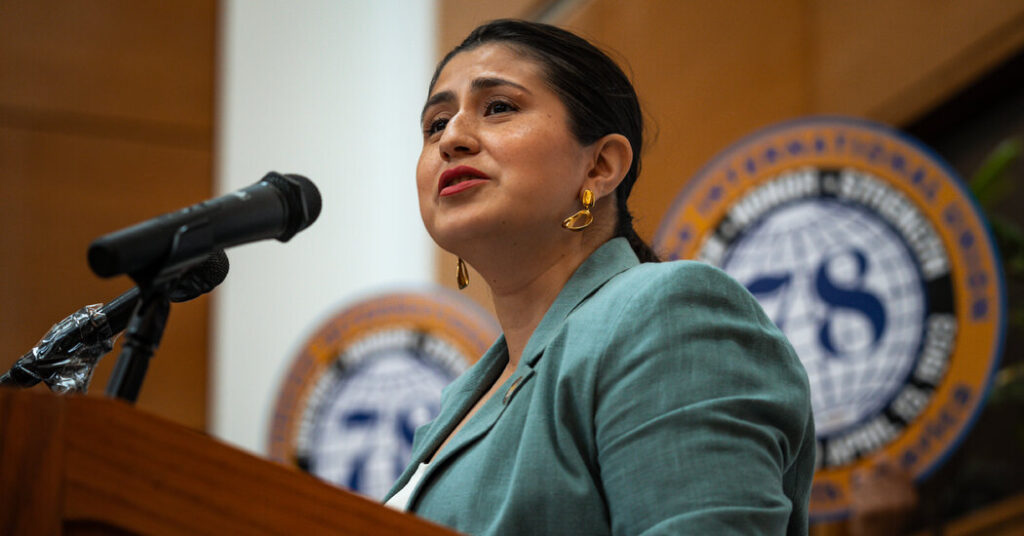
New York State officials on Friday pledged to scrutinize the billing practices of State Senator Jessica Ramos after a report in The New York Times that she repeatedly charged her campaign and the Legislature for the same travel expenses.
Two staff members who formerly worked for Ms. Ramos, a Queens Democrat and the chairwoman of the Senate’s Labor committee, told The Times that it was common practice for her to double bill for hotels and train fare. A Times analysis of state records found more than $30,000 in overlapping charges to her campaign and the state reimbursement system.
“This story is deeply disturbing,” said Mike Murphy, a spokesman for the Senate Democratic majority in Albany. “We will be making a formal referral to the Commission on Ethics and Lobbying in Government.”
A spokeswoman for the commission, which investigates complaints against New York public officials, declined to comment. New York State law bars representatives of that agency from confirming or denying the existence of an investigation.
Separately, a spokeswoman for New York State Comptroller Thomas P. DiNapoli, a Democrat, said his office was also reviewing Ms. Ramos’s billing practices.
In an article published early Friday morning, which was based in part on the interviews with the former staff members, The Times reported that one campaign worker had complained internally, saying the senator’s double billing was so frequent that it was burning through money she needed to run for office.
Neither Ms. Ramos nor her Senate office responded to requests for comment on Friday.
To examine Ms. Ramos’s billing practices, The Times compared campaign disclosure records with her state travel documents, interviewed the former staff members and obtained records of credit card transactions, emails and text messages about some of the expenditures.
The aides who spoke to The Times said they did not know how much Ms. Ramos double billed. But the Times analysis found that in just one expense category, there were more than 50 instances in which the dollar amounts that Ms. Ramos’s campaign paid for Amtrak tickets exactly matched legislative reimbursement amounts she received during the same periods.
Ethics experts say the billing underscores a need to strengthen oversight of legislative travel reimbursements.
Blair Horner, senior policy adviser for the New York Public Interest Research Group, said his organization would lobby for reforms in the next session of the Legislature early next year.
He said every legislator should have to swear “under penalty of perjury that they can’t double dip.”
“I think that would send a strong message that no elected official should be mixing campaign contributions and taxpayer dollars,” he added.
Ben Weinberg, director of public policy for another government watchdog group, Citizens Union, called on the Legislature’s internal oversight organization to examine how many other lawmakers may have engaged in similar billing practices. That commission has been derided by critics as being a toothless agency.
“The fact that this went unnoticed for five years raises serious questions about oversight and enforcement, and whether lawmakers are being held to the standard of accountability they’re elected to uphold,” Mr. Weinberg said. “The Legislative Ethics Commission should investigate how widespread this practice is.”
Lisa Reid, executive director of the commission, did not answer questions about whether her agency would open an investigation.
The Times analysis found that, from 2021 to 2025, at least 130 current and former New York State lawmakers used their campaigns to pay for lodging or train fare while also receiving legislative reimbursements. But it was not clear whether any of them were engaging in prohibited double billing.
The Times found that no state senator billed more than Ms. Ramos for lodging and train fare while citing state business as the reason.
State Senator Shelley B. Mayer, a Democrat from Yonkers and the chairwoman of the Senate’s Committee on Ethics and Internal Governance, called the allegations against Ms. Ramos’s billing a “serious matter.”
But she said she was reserving judgment until the state ethics panel concluded its investigation.
Ms. Mayer added that there were “ambiguities in the law” around travel reimbursements for legislators and would not say whether she thought the law bars senators from using campaign funds to pay for travel while also receiving state payments for the same purposes.
Other former and current state senators said they thought the rules around billing were clear.
Alessandra Biaggi, a Democrat who served in the Senate from 2019 to 2022 and who formerly led the upper chamber’s ethics committee, said that the Legislature’s ethics experts held detailed training sessions for lawmakers in which it was made clear that double billing for travel reimbursements was “at least unethical and at most illegal.”
She said that Ms. Ramos, who for a brief period in 2019 lived as Ms. Biaggi’s roommate in Albany, should know where the ethical lines are.
“You cannot double dip, it’s a known fact,” Ms. Biaggi said, “and if you’ve been in the legislature as long she has, she knows that, too.”
The post N.Y. State Senator Under Ethics Scrutiny Over Billing Practices appeared first on New York Times.