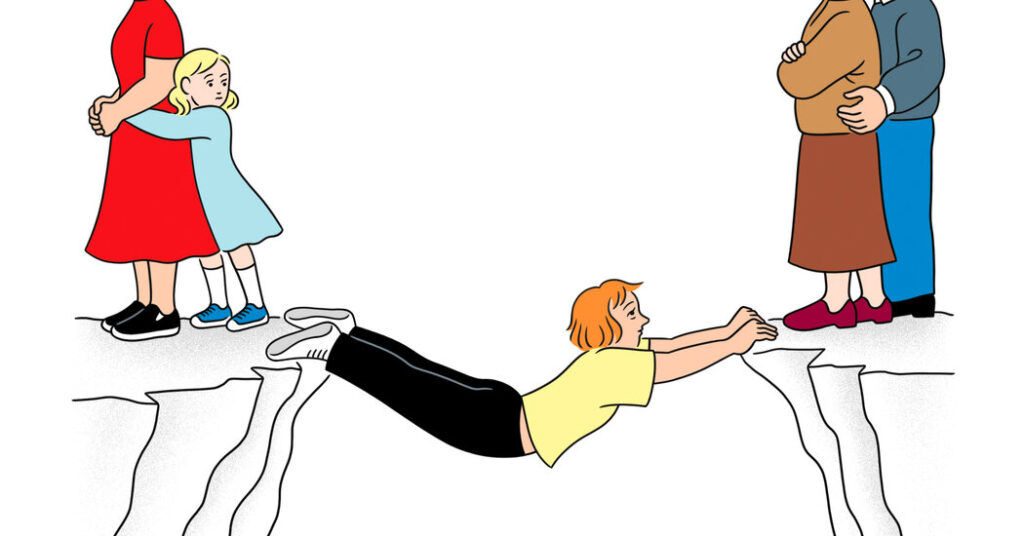
I am one of four adult sisters. Over the years, each of us has developed a somewhat strained relationship with our parents, though to varying degrees.
Our parents provided for us materially and were not abusive. Looking back, however, I think there may have been some emotional neglect. Whether that is the root cause or part of a broader pattern, my sisters and I have grown quite different from our parents in our values and outlook. We disagree on politics, religion, abortion, L.G.B.T.Q. rights, money and much else. I remain cordial with my parents, but we are not particularly close.
One of my sisters has gone much further and decided to have no contact with them. She has a young daughter, my parents’ only grandchild. The estrangement has been deeply painful for my parents, who frequently ask what they can do to repair the relationship. My sister, meanwhile, is firm in her decision and wants support from others rather than pressure to reconcile.
I find myself caught in the middle. I care about everyone involved. I sympathize with my parents’ sadness and confusion, but I also respect my sister’s right to set boundaries and decide whom she has relationships with. I do not want to become a mediator or messenger, yet the two sides seem to look to me for guidance.
What obligations, if any, do I have here? Is it ethical simply to maintain separate relationships with each side? Or do I owe something more to my parents, my sister or my niece because I may be one of the few remaining connections among them? How should I balance compassion for my grieving parents with respect for my sister’s autonomy? — Name Withheld
From the Ethicist:
I’m sorry you find yourself in this situation. Family estrangement of the sort you describe has become sadly familiar over the past decade or so. The strategy of severing all ties with one’s parents has been encouraged by certain high-profile therapists, and now Reddit, TikTok and Facebook bristle with supportive “estranged adult child” testimonials and tips. Nor is the therapeutic context accidental: The therapist’s professional obligations are primarily directed toward the client, rather than toward other people in the client’s life. A family friend who knows everyone involved may have sympathy for the parents as well as the child; the parents, however flawed, are fully real to that person.
It’s not that most therapists encourage all-or-nothing approaches to family ties. Far from it. But, to paint with a broad brush, therapeutic culture has tended to expand, sometimes recklessly, what qualifies as abuse or harm. In an earlier era, the complete severing of family ties seemed to be justified only by extreme circumstances, such as physical or sexual abuse, severe addiction and the like. Today the adult child going no-contact may speak of not feeling “seen” or of parents who weren’t “emotionally present,” failed to “respect boundaries” or were “controlling.” Sometimes the grounds — “narcissistic abuse,” some generalized “toxicity” — sound alarming but are so amorphous that they can be neither refuted nor verified. All these complaints can arise from genuinely damaging relationships. They can also describe ordinary parental shortcomings.
To be clear, nobody is required to remain in a seriously abusive relationship just because the abuser is a parent. But we should pause at the premise that total, you’re-dead-to-me estrangement (not just keeping your distance) is justified simply because continued contact makes someone less happy. A familiar “Cat’s in the Cradle” asymmetry may help explain why the adult child tends to be the one to sever ties and the aging parent the one to lament it; for the adult child, the relationship may no longer be central in the way that it typically remains for the parent. “I need to choose myself,” “I need to protect my peace”: However sincere, these sentiments can coexist with less edifying, more punitive ones. Parental suffering isn’t necessarily a regrettable side effect. In some cases, it’s part of the point.
All of which puts you in a difficult position. If you don’t want to be a mediator, that’s your prerogative. A therapist might even say it’s wise. But you do need to tell your sister and your parents that this is your stance. Make sure everybody involved understands that you respect your sister’s right to her decision and have compassion for your parents’ suffering. You’re not going to campaign for reconciliation or carry messages between them. Nor should you pretend that you think your sister’s decision was justified.
Still, I’m not a therapist, and I’m inclined to think your parents’ grief should be given weight alongside your sister’s grievance. So I don’t believe you would be out of order to ask, just once, if they would all be willing to meet with a family counselor. The counselor could help them decide whether it would help to include you. If so, your participation might assist people you love in reaching some kind of resolution with one another. I say might. I should confess that I’m not optimistic. No-contact culture has developed deft rejoinders to almost every effort at reconciliation. All the same, you have to live with this estrangement, too, and some of the pain it has caused is yours.
Readers Respond
The previous question was from a reader who was considering dating again after her husband became incapacitated. She wrote:
My husband was diagnosed with Alzheimer’s disease four years ago, and in the past year his decline has rapidly accelerated. … I have not only been a caregiver to him but also a single mother to our daughter, who is a minor. I have been operating a family life without a partner, and as the breadwinner. Lately I’ve been wondering if and when it’s ethically permissible for me to start dating other people. … I have a lot of working years and child-rearing years ahead of me — there is a large age gap between us — and I find myself desiring physical and emotional intimacy with a partner. — Name Withheld
In his response, the Ethicist noted:
It’s obvious that you’ve had a lot to carry for a long time, not least caring for your husband as his Alzheimer’s has progressed. And you do owe him continued stewardship as his spouse. But given that his condition has evidently left him unable to sustain a reciprocal emotional and marital relationship, these obligations don’t mean you have to give up emotional and physical intimacy for the rest of his life. Fidelity, in a situation like yours, involves a duty of care, but with the effective loss of a companion, you’re entitled to care for yourself as well. … Anyone you become involved with will need to know that you are married and that you remain responsible for your husband’s care. You should also consider the effect of a new relationship on your daughter and, depending on his level of awareness, on your husband. Those considerations, though, bear on how you pursue a new relationship, not on whether you may have one.
(Reread the full question and answer here.)
⬥
While I agree this should have been discussed when her husband was mentally able, she took a vow, and it should be honored. This not only sets a poor precedent for the minor child but in general is a confusing situation. In many respects, this would be an affair. Emotionally and physically cheating on her husband who cannot help the situation they are in. How would she feel if he did that to her? — Jennifer
⬥
When my beloved had early onset Alzheimer’s in his 50s, I was also his caregiver, although my daughter was grown. Eventually, I had to put my husband in a memory-care facility. I missed what I had with my husband and started to date. I found someone for a while, and it made me very happy. It didn’t take away from my love for my husband. Do what feels right for you. Sometimes affection and companionship are needed with a loss like this. — Dana
⬥
Please be discreet. My father was in the same situation. No one begrudged him companionship. What caused a huge break in our relationship with him was his insistence on bringing this woman to every social event (including those with my mother’s friends and family) and every holiday event. She even showed up at my mother’s funeral. — Cheri
⬥
Her husband may still have residual cognitive and emotional capacity despite his decline. If he is still living with her and is able to communicate and understand, maybe she should discuss this with him now and record the conversation. If he no longer has the capacity to understand, does not recognize her,and is in long term care, the Ethicist’s advice is sound. — Fiona
⬥
As a clinical social worker and geriatric care manager, I completely agree with the Ethicist. I especially appreciated your nuanced comment and reminder to consider the daughter’s feelings. I have had clients in this situation several times and the adult children were the ones most disturbed about the caregiver parent finding companionship with others. Careful discussion through all of this may prevent family strife. A partner has a duty to care manage and ensure safe, humane care, handle finances, etc. But with Alzheimer’s, we know that at a certain point in time, the person you married isn’t there anymore. I support caregivers taking care of themselves, being discrete and aware that others may not understand their actions, but they deserve a life while being a loving care manager to their spouse. It’s a very hard line to walk. — Brenda
The post My Sister Has Gone No-Contact With Our Parents. Do I Have to Choose Sides? appeared first on New York Times.