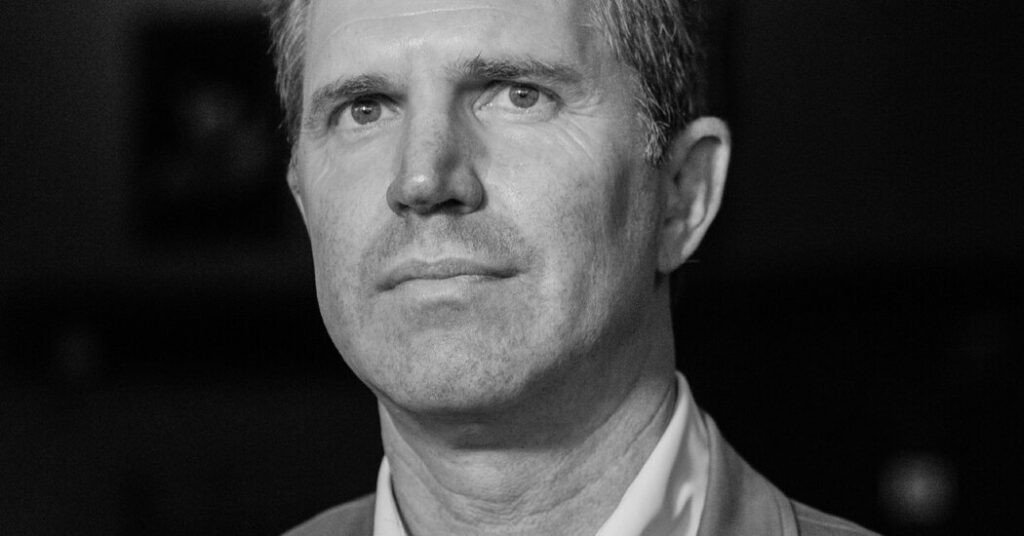
It must be a little awkward to be Andy Beshear these days, because just about every visitor looks him up and down with a suspicious squint and wonders: Is this guy presidential material?
When I sat down with the Kentucky governor for a conversation of more than an hour in his office, I gauged his grip (firm without being crushing), chatted about the Kentucky horse-racing scenes on the walls and pondered: Is this the next Bill Clinton? Or is he just another in the long stream of potential presidential candidates I’ve seen over the decades who appeal to everyone but actual voters?
While Beshear isn’t so well known around the country, the one thing he is recognized for is winning elections. Not only is Beshear a Democrat who has twice been elected governor of Kentucky — a deep-red state — but this year he also managed to have voters there give him the highest approval rating among Democratic governors.
For Democrats desperate to win back the White House in 2028 and repair the party’s toxic image in swaths of flyover country, Beshear is a thrilling reminder that it actually is possible for Democrats to win in states that aren’t just purple but glow red. Beshear represents the same state as Senator Mitch McConnell, but Beshear’s approval rating from Kentucky voters is more than three times as high.
So I dropped in on Beshear to try to understand what he would be like as a presidential candidate in 2028 and, beyond that, what lessons he offers Democrats for winning independent and working-class voters. I asked how he explained his electoral success as a Democrat in a red state that gave Donald Trump a nearly 31-percentage-point margin in 2024.
Focus on creating jobs and improving well-being, he said. “Eighty percent of my time I spend on things that matter to 100 percent of my people,” he added. “If I bring a new factory into a community, it’s not Democrat or Republican; it’s good for everyone.”
That’s his first principle. His second, he said, is to speak plain English.
“Could you imagine walking up to somebody and saying, ‘I’m sorry you lost your loved one to substance use disorder’?” he asked. “They’d look back at you and say, ‘I lost my kid to addiction.’”
And of people hurt by Trump’s cuts to food stamps, he said: “They’re not going to be food insecure; they’re going to be hungry.”
Of course, what Beshear is speaking isn’t just English but politician-y English. He’s disciplined in his messaging, repetitive and predictable in avoiding third rails, which in some sense may make him a little boring to a journalist. Then again, after Trump and after Democratic candidates who got carried away with pronouns and identity politics, maybe we all crave a little discipline and could use an occasional dull day at the White House. And I am drawn to a politician with a knack for speaking, as Clinton did, to ordinary Americans about their daily challenges and how he is going to make things better.
Beshear talks comfortably about God and faith (he is a church deacon, and his grandfather was a minister), and he avoids the condescension that liberals sometimes direct toward working-class Americans. (I’m guessing he would flinch at my reference to “flyover country” above.) But he’s more liberal than one might expect; he’s not a Kentucky version of Joe Manchin but, rather, inhabits something like the middle of the Democratic Party spectrum.
As governor, Beshear vetoed a 15-week abortion ban (the legislature overrode his veto), and has been a strong critic of Kentucky’s nearly blanket curbs on abortion. He proclaimed June to be Pride Month in Kentucky and vetoed Republican bills that would have had sweeping effects on transgender girls and boys, such as limiting bathroom access and preventing Medicaid dollars from being used for trans medical care. In 2024 he issued an executive order banning so-called conversion therapy of L.G.B.T. youth.
Beshear softened the culture war by explaining his liberal positions on trans issues with conservative-sounding language.
“I believe all children are children of God,” he said, explaining his motivations for protecting trans youth. “Maybe there’s a way with a common language, even with different starting positions, that we can get some things done.” He added that after vetoing a major anti-trans bill, “I won by the largest margin I ever have.”
Beshear had a huge advantage in Kentucky politics in that his father, Steve Beshear, was a popular two-term governor from 2007 to 2015. Instead of downplaying that advantage, he sometimes leans into it. When I asked him who his political heroes were, the first he cited was his father. (The others were Abraham Lincoln and John Marshall Harlan, known as the great dissenter on the Supreme Court.) Beshear was elected attorney general in 2015, and four years later ran against an unpopular Republican governor and won by less than a percentage point. He has focused on bringing good jobs to Kentucky and solving practical problems, and even his critics agree that he’s a good talker and storyteller — although Republicans scoff that he has mostly claimed credit for what they insist are their economic accomplishments.
“He hasn’t done anything that really has changed the educational or economic trajectories of the state,” Robert Stivers, a Republican who is president of the State Senate, told me. Stivers said that G.O.P. legislators recruit businesses to Kentucky, “but then he rides the wave that we’ve created.”
My sense is that the criticism is unfair and that Beshear has genuinely scored achievements with his push for jobs. He comes across as a pragmatist who has led a major effort to spur economic development while being deeply concerned with health outcomes. He has had a knack, as attorney general and then governor, for identifying issues that resonate with the public. These have included opioid litigation, education and the testing of rape kits.
Education is an issue I am passionate about. While it’s not clear how much credit Beshear should get for this, Kentucky is among the 10 best states in schools recovering from the pandemic in reading and math — an impressive record, considering how poorly they are funded. (Beshear has pushed successfully to raise teacher pay from abysmal levels, improve job training programs and introduce pre-K for all.) On the basis of the Urban Institute’s analysis of test scores adjusted for demographics such as poverty, Kentucky fourth graders are better at reading than those in California or New York.
While I was in rural Kentucky recently, reporting on other subjects, I asked all the people I interviewed what they thought about Beshear. Most were enthusiastic. By and large, they liked and trusted him and thought he was for the little guy.
Beshear is, of course, protective of people in his state. His prickliness about stereotyping people in Appalachia is directed not just at Democrats. “One of the worst, I think, is JD Vance in the book he wrote,” Beshear said, referring to Vance’s “Hillbilly Elegy.” “I think it’s poverty tourism. I mean, he made money judging the people of eastern Kentucky, saying that the joblessness and addiction is our fault because we’re lazy. He’s not from Appalachia. He is from the suburbs of Cincinnati.”
Beshear says he won’t decide on a presidential run until sometime after the November elections, but he already comes across as a candidate. He has a book coming out next month, “Go and Do Likewise: How We Heal a Broken Country.” And as the chair of the Democratic Governors Association, he is meeting national donors and making vital connections.
He can give a good, rousing speech, and he satisfies a Democratic audience with plenty of red meat; he does not shy away from thundering against Trump. When the Rev. Al Sharpton invited potential Democratic candidates to New York in April to speak to a largely Black audience convened by his civil rights group, Beshear stood out. Connecting with Black voters will be crucial in the Democratic primaries, so Beshear could have an advantage there and in the fact that the party has decided that its first 2028 primary will be in South Carolina.
“If there was one that was an eyebrow raiser, it was Beshear,” Sharpton said afterward. He wondered aloud whether Beshear might be able to repeat the 1992 magic of Clinton, another Southern governor.
Maybe.
I found Beshear intelligent, well spoken, telegenic and, perhaps most important for Democrats who are eager to win, very thoughtful about how to win back working-class voters without sacrificing core values. He has no known skeletons in his closet. And to my eye, he possesses a certain magnetism, without quite the dazzle of Clinton or the obvious intellect of Barack Obama.
This interview came at the tail end of my annual win-a-trip journey, in which I take a university student with me on a reporting trip. As we left Beshear, my winner, Brunella Tipismana of Yale University, and I compared notes. We both were taken by his charisma and charm — but we also sensed that he knew exactly what he was doing and had a firm hand on the rudder in order to stay on message. I would have liked to order him a couple of drinks to get his guard down, but I also recognize that a smart politician keeps his guard up when he’s chatting with me.
Some Democrats want a progressive presidential nominee who will appeal to the base and, so they say, increase voter turnout. I’m very skeptical of that approach. I want a nominee who can appeal to working-class voters in the handful of swing states that matter in a general election.
As I think about who could win the hearts of North Carolinians, Georgians and Pennsylvanians, Beshear would be high on my list. So would Senator Jon Ossoff of Georgia, although it may be easier for a governor than a senator to run against Washington and the status quo.
Yet people have said similar things about many other politicians only dimly remembered. Howard Dean led the polls early in the race for the Democratic nomination in 2004, and there was a time when John Edwards was the next Clinton. Beshear is popular in a small state, but none of us have any idea how he would do on a national stage. He has little background in foreign affairs, and in our conversation he was weakest when I asked him about the Middle East and arms sales to Israel; his answer was earnest but murky.
If he runs for president, progressive Democratic primary voters may be skeptical of a Bible-quoting Kentuckian. I asked him about some of his conservative positions: How could he succeed in Democratic primaries, I asked, given that he has said he supports capital punishment in theory (without actually executing anyone) and has described himself as a “strong supporter” of the Second Amendment and an opponent of an assault weapons ban, saying it would not be “right for Kentucky.”
Beshear pushed back, noting that he has advocated a red flag law to remove guns from people who may be a danger to themselves or others. “And let me tell you,” he added, “to stand up for a red flag law in Kentucky takes more courage than to be for an assault rifle ban in California.” He’s probably right about that.
Is he the next Clinton? I don’t know. But Beshear projects both passion and compassion, and he has — so far — been able to reach working-class voters. Count me impressed.
The Times is committed to publishing a diversity of letters to the editor. We’d like to hear what you think about this or any of our articles. Here are some tips. And here’s our email: [email protected].
Follow the New York Times Opinion section on Facebook, Instagram, TikTok, Bluesky, WhatsApp and Threads.
The post Is Andy Beshear of Kentucky the Next Bill Clinton? appeared first on New York Times.