For many watching Lindsay Clancy’s murder trial, the primary takeaway has been how the deaths of her three small children—Cora, 5; Dawson, 3; and Callen, eight months—were tragically preventable.
Lawyers for the Massachusetts nurse are arguing that she’s not criminally responsible for strangling her children, because she suffered from severe postpartum psychosis, a rare mental health condition that causes new mothers to experience delusions and intrusive thoughts. Defense attorney Kevin Reddington has put Lindsay’s health care providers on the stand, in an attempt to demonstrate how his client repeatedly sought help for her terrifying thoughts, only for her to be minimized, dismissed, and overmedicated at every turn.
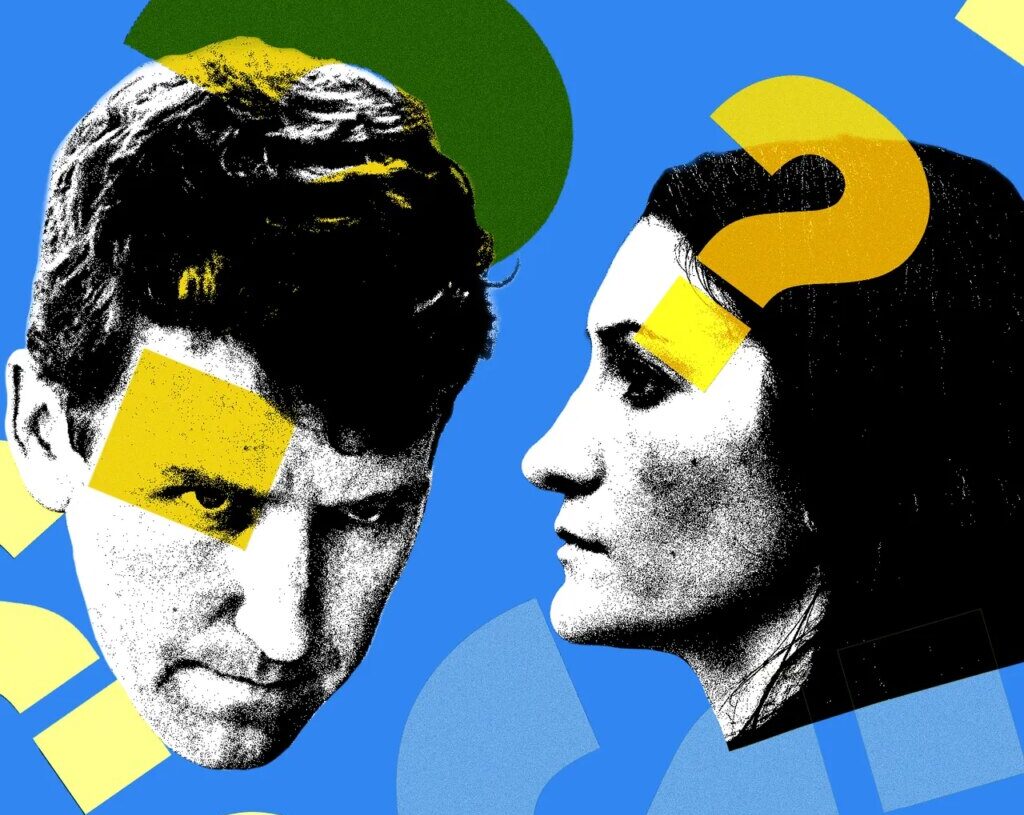
For others, including a thriving community of TikTok armchair detectives and conspiracy theorists, the Clancy trial has resulted in a much different takeaway: Lindsay’s husband, Patrick Clancy, was responsible, either literally or by virtue of being a neglectful husband. Many TikTokkers are convinced that he actually committed the murders and framed his mentally ill wife so she would take the fall.
To be clear, there is no evidence whatsoever to suggest this is true. Patrick is not on trial for the deaths of his children, and there has been no indication that he ever will be, or that he is anything other than a deeply grieving father. (Clancy did not respond to a request for comment.) But it’s hard to overstate just how popular this conspiracy theory is, and how rapidly it has overtaken discussion of the trial. The tabloid media has obsessively focused on Patrick, constantly publishing headlines about his life with his new wife Rachel Danis in New York (Patrick remarried earlier this year), and there are countless Reddit threads parsing their social media posts and analyzing his testimony.
Much of the TikTok commentariat’s focus has been on Patrick’s behavior prior to the murders, especially as it pertained to his wife’s postpartum mental health struggles. Per his own testimony, he was not always present at home, even at the height of her suffering. He went to brunch with his friends amidst her struggles with suicidal ideation, and took his daughter on a skiing trip. A month prior to the killings, Lindsay had disclosed to him that she had thoughts of harming the children, but according to his own testimony he had waved them off after she’d assuaged his concerns.
Some experts following the case say that while they understand the impulse to cast suspicion on Patrick, they caution against speculation or cruelly attacking the grieving father of three brutally slain children.
“It’s very easy to try to vilify the husband,” says Leslie Dobson, a forensic psychologist who covers the case on her social media platforms. “But the idea that he actually set her up, or drugged her, or actually killed the children—that’s very extreme.”
But a major driving force behind the antipathy toward Patrick appears to be that women recognize the broad contours of his alleged behavior toward his wife—and they are pissed as hell about it. This is evident when you look at the social media comments on the TikToks accusing Patrick, which are filled with harrowing stories from women whose husbands treated them insensitively while they were struggling with postpartum anxiety or depression, left them for another woman while they were at their lowest, or even emotionally or physically abused them.
(As many TikTokkers have pointed out, Rusty Yates, the husband of Andrea Yates, the woman suffering from severe postpartum psychosis who drowned her children in 2001, reportedly urged her to get pregnant again while she was in recovery from postpartum depression after her fourth pregnancy, against her psychiatrist’s advisement.)
Many right-wing (male) pundits have been inclined to dismiss these comments as the ramblings of female hysterics, who are somehow using their own terrible experiences with new motherhood as an excuse to demonize men or exonerate Lindsay. In an X post from last week, far-right pundit Matt Walsh referred to Lindsay’s defenders as “psychotic women on the internet … outright exalting or celebrating” her, attributing this sentiment to “a deep sickness in our culture.” Others have criticized those casting suspicion on Patrick as frivolous misandrists, who are too obsessed with true-crime podcasts and millennial feminism to maintain a logical perspective on the case. (An astrology meme suggesting that Patrick killed his kids because he was a Gemini is often cited as evidence of this perspective.)
Walsh’s reading is an extremely shallow one. The fact that women are empathizing with Lindsay does not suggest they are “celebrating” or “exalting” her, let alone excusing her crimes. But what it does suggest, pretty damningly, is deep structural perversity—not just with the institution of maternal health care in this country, as so many commenters have pointed out, but with the state of motherhood in the United States. Lindsay’s suffering ran so deep that ultimately she thought the only way to end it was to end her own life, and take the lives of her children. Nobody seems to be asking why so many women empathize with that.
The statistics tossed out every time someone proffers an analysis on why American mothers are so damn unhappy offer some insight. Mothers who work full-time in the US do 1.6 times as many childcare duties and household labor as full-time working fathers. Mothers are more likely than fathers to report feeling stressed or exhausted by parenting, and also more likely than fathers to report feeling like their parenting is being judged. Mothers are more likely to report higher levels of depression and anxiety than fathers; and a study published in 2021 found that suicidality rates among moms have nearly tripled within a decade through the mid 2010s. One study found that anxiety levels in some new mothers were equivalent to that of combat soldiers; similar findings were found among mothers of older children with special needs.
Many of the women commenting on the trial online speak directly to these feelings of immense stress and overwhelm, and clearly, Patrick serves as the ultimate stand-in for that frustration. “So many women have husbands that weren’t present or husbands that just didn’t know what the fuck to do for their wives after they gave birth,” says Dobson. “Patrick comes off as very tech-savvy but also very aloof, very not present. So we can easily project those feelings onto Patrick.”
Anne Emerson, the host of the true-crime podcast Criminally Obsessed, posits that the antipathy toward Patrick stems from women feeling as if the case “has opened up a new platform to talk about how hard it is” to get through the postpartum stage with so little support. “I definitely think that anyone who may feel they have a partner who isn’t supportive, this is a chance to rail against the system to some degree,” she says of the conspiracy theorists.
There’s no real reason to believe Patrick is guilty of killing his kids, but there is reason to believe he is guilty of failing his wife on some level, as many, many other husbands have. The outpouring of sympathy for Lindsay, as well as the calls for his head, indicates that women would like to see a lot more men held accountable for this specific behavior.
“I think the case could open up more opportunities for women to get help after they have their babies, as opposed to being villainized if they go through a medical emergency,” Emerson says. “Look at the lengths Lindsay went to to get herself help—and it failed catastrophically. Why did it fail? It wasn’t just the number of prescriptions she was on—it was a whole bunch of things. We have to take a cold, hard look at that.”
Ultimately, the obsessive focus on Patrick has nothing to do with Patrick at all. It has to do with a culture that makes it extremely easy for women to believe that someone like Patrick would frame his mentally ill wife for the murders of their children when her sickness became too much of an inconvenience. The fact that this scenario is more plausible to the majority of TikTok than the alternative—that Lindsay was struggling, and Patrick was simply tragically unable to support her—is a lot more damning than anything that Lindsay’s attorney could present on the witness stand.
The post The Patrick Clancy Conspiracy Theories Are Rooted in the Harsh Realities of Motherhood appeared first on Wired.