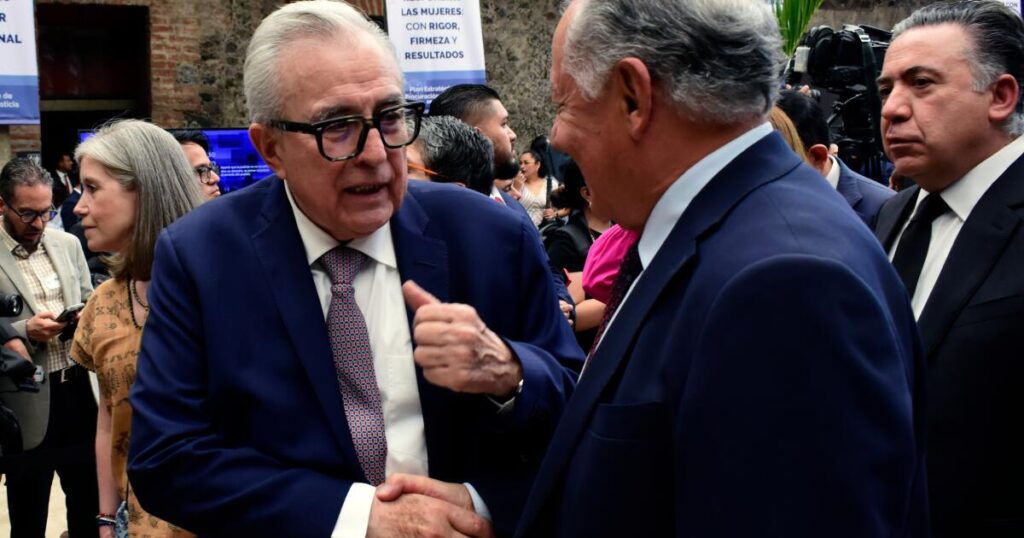
MEXICO CITY — A Mexican state governor — wanted by U.S. authorities on charges of collaborating with the notorious Sinaloa cartel — returned to office Friday, more than three months after going on leave following his stunning federal indictment in New York.
Rubén Rocha Moya, governor of the northwestern state of Sinaloa, resumed his duties as he denounced the “false allegations” against him as “driven by political and interventionist motivations from the national and foreign ultra-right.”
On May 1, Rocha Moya announced that he was taking a leave of absence to defend himself against “false and malicious” allegations. On Friday, he declared on X: “Today I return to the exercise of my responsibility as governor of Sinaloa with the strength of truth on our side.”
It’s unclear what prompted his return. Rocha Moya, 77, is a longtime stalwart of Mexico’s ruling Morena party and confidant of ex-President Andrés Manuel López Obrador, the leftist who founded Morena.
The case against Rocha Moya and his alleged confederates sent shock waves through the country’s political and law enforcement establishments.
The U.S. indictment of Rocha Moya — which essentially paints an entire Mexican state as being under cartel control — is also the highest-profile manifestation of the Trump administration’s very public vow to crack down on corrupt Mexican lawmakers allegedly in cahoots with organized crime.
Mexican cartels, experts say, thrive in large part due to collaboration with police and politicians, from street cops to mayors to governors. Mexican gangs employ violence and payoffs to ensure officials do not disrupt their many illicit enterprises, which extend beyond drug trafficking to extortion, fuel smuggling and other lucrative rackets.
Following Rocha Moya’s indictment, Washington demanded that Mexico arrest the governor and extradite him to the United States. But President Claudia Sheinbaum refused to comply, asserting that U.S. authorities did not provide sufficient proof of his alleged crimes.
Now, Rocha Moya will return to running a state that is ground zero for the smuggling of fentanyl, methamphetamine and other illicit drugs to the United States.
There was no immediate public comment from U.S. officials.
The case presented Sheinbaum with a dilemma: Either hand over the governor to U.S. prosecutors, thus alienating a core support base in the Morena party and undermining her frequent pledges to resist U.S. intervention, or keep hands off the governor, risking ire from the White House.
While U.S. authorities have bought charges against ex-Mexican governors and other former high-ranking officials, the case against Rocha Moya marked the first time that a sitting Mexican governor has been indicted.
In April, the U.S. Department of Justice unsealed the indictment charging Rocha Moya and nine other current and former Sinaloa officials with drug trafficking and collaboratingwith the Sinaloa cartel, among other allegations.
Prosecutors alleged that a cartel faction known as “Los Chapitos” — run by sons of Joaquín “El Chapo” Guzmán, the imprisoned kingpin — provided financial and other support to help Rocha Moya win the 2021 gubernatorial election.
Likely providing U.S. prosecutors with information to implicate Rocha Moya, experts say, were Mexican capos already in U.S. custody, including two jailed sons of El Chapo.
Rocha Moya’s term as governor is slated to end Oct. 21, 2027.
Special correspondent Cecilia Sánchez Vidal contributed to this report.
The post Mexican governor, indicted by U.S. on charges of collaboration with drug cartel, is back in office appeared first on Los Angeles Times.