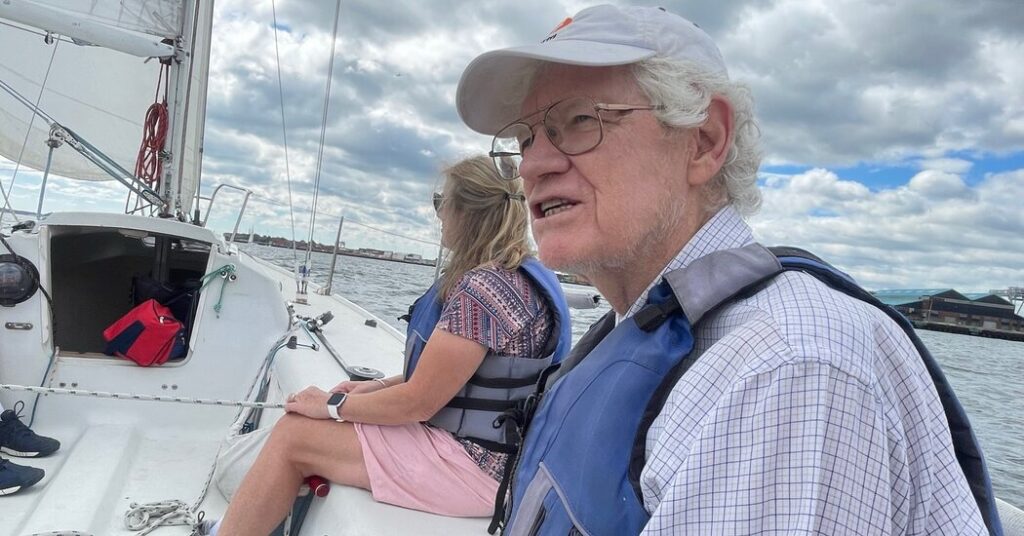
John Rousmaniere, a sailing writer best known for his chilling firsthand account of the worst disaster in yacht racing, the 1979 Fastnet Race between southwest England and Ireland, an event that changed the direction of his life, died on Aug. 8 in Westwood, Mass., outside Boston. He was 82.
His death, at a memory care center, was from Alzheimer’s disease, his family said.
Mr. Rousmaniere (pronounced roo-man-EER) is sometimes called the dean of American sailing historians. He wrote gracefully and without sentimentality about the sea and about a sport that is often associated with the Larry Ellison class of yacht owners, but that also appeals to plenty of nonwealthy people drawn by the freedom of open water and the exhilaration of a well-trimmed boat.
Educated as a historian at Columbia University, Mr. Rousmaniere wrote prose that was erudite — quoting Joseph Conrad, Lord Byron and E.B. White — but rarely stuffy.
He wrote “The Annapolis Book of Seamanship,” a practical reference that has been used by the U.S. Naval Academy and many recreational sailors, first published in 1983 and now in its fourth edition. In a more lyrical vein, he wrote “The Golden Pastime: A New History of Yachting” (1986).
He was an experienced offshore sailor when he joined the crew of a 48-foot Swan sloop, one of 300 yachts entered in the Fastnet Race in August 1979, with a planned route of 605 miles from the Isle of Wight to Fastnet Rock off Ireland and back.
A freakish storm slammed the fleet with gale-force winds and 50-foot frothing waves. Mr. Rousmaniere was at the wheel of the vessel when the owner raised his head from monitoring radio traffic and said, “People are dying out here.”
Amid seas that flipped 35-foot yachts “like bathtub toys,” as Mr. Rousmaniere later wrote, 24 crews abandoned their vessels, and 15 sailors died. Helicopter crews and commercial and naval seamen rescued 136 sailors.
Mr. Rousmaniere’s terrifying account, “Fastnet, Force 10” (1980), changed the sport and his life. (The title refers to the Beaufort scale, which defines a force 10 storm as one with winds of 55 to 63 m.p.h.; the scale goes up to force 12.)
As Mr. Rousmaniere intended, the book helped spur changes that made yacht racing safer. Boats evolved to become less prone to capsize; harnesses that tether sailors to their boats became stronger; and education about the risks of offshore sailing, and how to survive life-threatening scenarios, became more than an afterthought. Mr. Rousmaniere also helped to create the U.S. Sailing Association’s Safety at Sea course, which some 2,500 sailors take every year.
The tragedy, and writing “Fastnet, Force 10,” fostered in Mr. Rousmaniere a new appreciation for the vulnerability of life and sent him on a kind of spiritual quest, his wife, Leah Rousmaniere, said in an interview.
“It was after that book that he began to think about expanding his religiosity,” she said.
In 1984, at 40, Mr. Rousmaniere entered Union Theological Seminary in New York, where he met his wife, who was the school’s associate registrar. He received a Master of Divinity degree in 1988, and they married the following year.
Though he did not enter the ministry, he published “After the Storm” (2002), a ruminative book about well-known ocean calamities and how survivors have looked for meaning in their aftermaths. He admitted that introspection wasn’t natural to him.
“Ordinarily, I repress these sorts of emotions,” he told The Washington Post. “I’m a Yankee, after all.”
He added, “If life is a voyage, storms are a pretty good metaphor for what hits everyone at some point.”
John Pierce Rousmaniere was born on March 10, 1944, in Louisville, Ky., the eldest of eight children of James and Jessie (Pierce) Rousmaniere.
At the time of John’s birth, his mother was a receptionist in a doctor’s office. His father was a fund-raiser for institutions; with his Harvard roommate, John F. Kennedy, the elder Rousmaniere had been part of a team that won the national intercollegiate sailing championship in 1938.
When John was 11, the family moved to Oyster Bay, N.Y., on the North Shore of Long Island, where he learned to sail in Blue Jays and other dinghies. He attended St. Paul’s School, the prep school in Concord, N.H.
He received a bachelor’s degree in 1967 and a master’s in history the following year, both from Columbia. Drafted by the Army in 1970, he completed officer training and served his enlistment teaching history at the U.S. Military Academy at West Point, N.Y.
Uninterested in an academic career, he worked as an associate editor at Yachting magazine from 1972 to 1977 and then was an independent writer. For many years, he lived in Stamford, Conn., where he was a single parent to his two sons from the second of two short early marriages. Those marriages, to Sharon Zukin and Jody Hall, both ended in divorce.
Besides his wife, he is survived by his sons with Ms. Hall, Dana and Will; five siblings, Peter, David, Joe, Arthur and Kate Rousmaniere; and five grandchildren.
Mr. Rousmaniere helped the America’s Cup skipper Dennis Conner write a memoir, “No Excuse to Lose” (1978), and edited “Desirable and Undesirable Characteristics of Offshore Yachts” (1987) for the Technical Committee of the Cruising Club of America.
He also finished nine Newport Bermuda Races, three trans-Atlantic crossings and many other offshore cruises, logging some 40,000 miles of ocean sailing. He served as chairman of the selection committee for the America’s Cup Hall of Fame.
His own 1979 Fastnet race ended without serious incident, and he was unaware of the full scope of the tragedy until the finish line in Plymouth, England, where he saw the wharf crowded with stone-silent people anxious for news of their loved ones.
In writing his book about the disaster, he interviewed survivors, rescuers and grieving family members throughout England. “I took trains everywhere,” he wrote. “Having survived a force 10 storm, I was not about to strain whatever good luck remained by driving on the right-hand side of the road.”
The post John Rousmaniere, Who Documented a Sailing Disaster, Dies at 82 appeared first on New York Times.