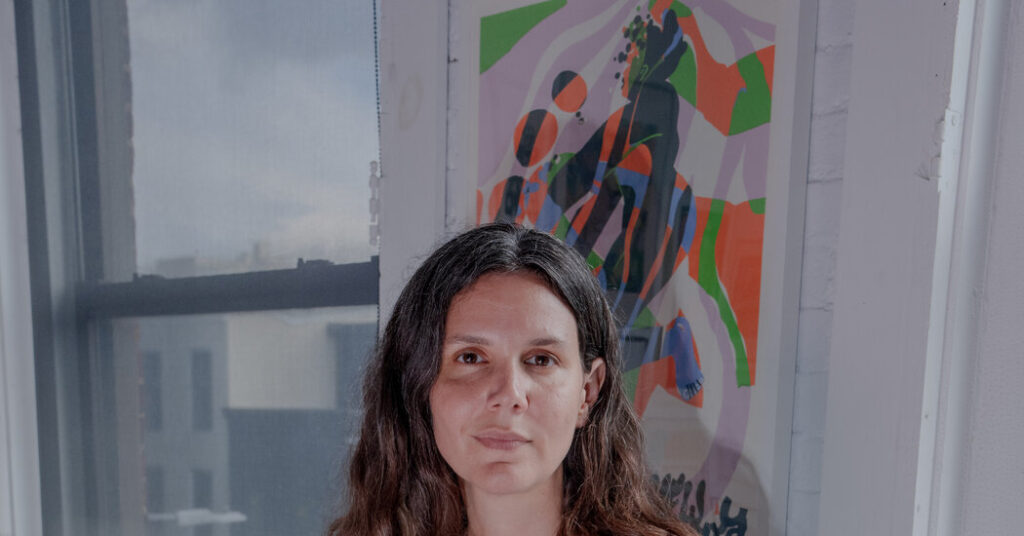
For the illustrator Eugenia Mello, whose action-oriented artwork in boisterous colors has decorated Citi Bike docking stations, UPS boxes and Poland Spring’s aluminum bottle series, preparation isn’t reserved for major commissions. It’s an everyday practice.
“Sometimes you get opportunities and you’re not ready for them, and sometimes you get opportunities and you feel like you’ve been training,” she said.
When the United States Tennis Association asked Mello to create the poster for the 2026 U.S. Open, which begins on Saturday, she felt ready. She had recently completed the New York City Marathon (5:02:58) and had spent years developing the crisp, energetic style that has become her signature, capturing figures in motion, often dancing.
“If you train well for something, you just show up and you do it,” she said.
The poster’s image, which centers on a tennis court engulfed by the New York City skyline, underwent 23 revisions during the approval process, but the final iteration most closely resembles Mello’s initial sketch. For Mello, 38, it’s also a nod to her own winding journey from Peru, where she was born, through Costa Rica and Venezuela, where she grew up, to New York in 2015.
Carrie Ehorn, director of Pro Tennis Marketing for the U.S. Open, sifted through more than 200 portfolio submissions before selecting Mello, who didn’t apply to the artist open call but instead was contacted directly by Ehorn. “We were drawn to her work right away: her use of color and tying the U.S. Open to the energy of the city,” Ehorn said.
In the past, theme art appeared only on tickets and promotional materials. This year, however, Mello’s work is traveling across the city on an ice cream truck starting on Aug. 17, and in tennis-themed video games for fans at Hudson Yards during the tournament and on their home gaming consoles year-round. “We were looking for something dynamic that could be used on multiple touch points,” Ehorn said.
From Mello’s studio in the Gowanus section of Brooklyn, she spoke about her lifelong fascination with movement, the ways she has come to embrace her cultural differences and her own ill-fated tennis career. These are edited excerpts from the conversation.
What does this year’s U.S. Open theme, “Celebrating Our New York Story,” mean to you?
A lot of what I’ve been developing for the past 10 years has to do with the city and how I’ve observed living here — the sounds, the rhythm and the movement of it all. Coming to a city that is so full of immigrants has been part of my visual research. This year, whoever traveled from Argentina or from China, or whatever other end of the world [to the U.S. Open] will have those colors ingrained in their memory. Something that sung out of me will be in somebody else’s song.
In what ways did the United States Tennis Association shape your vision?
Almost none, because in the end, they chose the beginning sketch. There was a freshness in the beginning. As you rework a piece [through] collaboration, it grows in some ways, but part of the artist’s work is to preserve the freshness of that original first sketch, when it was all possible. Sometimes you start overworking a piece, and then it loses the energy. .
How do you translate movement and sensation into visuals?
It really started when I moved to New York. I was drawing dancers incessantly, looking just to see how other artists have done it in the past. By chance, I was walking in the Italian futurist part of MoMA. The futurist paintings are static, but there is speed in them.
In front of those paintings is the Umberto Boccioni sculpture [a bronze man striding forward, titled “Unique Forms of Continuity in Space”]. It’s the heaviest material you can find, yet it looks like it’s moving. The way you move your hand on a page can also leave the sensation of speed, energy and vibration, depending on what tool you use. That has sort of guided how I do any kind of work.
Why do you use such vibrant colors?
Color is something that is inside of you. It’s informed by where you grew up and what you kept with you. I was born in Peru, but my family is from Argentina and Uruguay. All my formative years, I was in Costa Rica and then in Venezuela. It never occurred to me that there was anything but bright colors. In one of the versions, I reduced the amount of colors and it was completely different. It lost joy.
How do your roots — as an Argentine, Peruvian and Caribbean New Yorker — inform your work?
I loved how people moved in Venezuela and how they would dance every time there was a strike or every time there was too much traffic on the highway and a trip that was supposed to be 10 minutes would take an hour and a half. People would blast the speakers, get out of their cars and start dancing while they were waiting. Those are the stories that end up coming out. It’s given me a compass.
Do you have to play tennis to take on this project?
I would have never, in my wildest dreams, gone out searching for this. It was not on my radar. I love tennis. I played as a kid, and I stopped playing because the teacher told me that I didn’t run. And then this project comes as I’ve just finished a marathon. So it was a great story: Don’t limit me and do not limit yourself. The impossible is possible, and wild, amazing things can happen if you believe in your power.
You’ll be the first theme artist to paint a mural on the tournament grounds, live in front of spectators, beginning on Aug. 24 and at Hudson Yards on Aug. 30. What does this mean to you?
I love that people get to see that a human being did the work. It’s 23 versions, 10 years of thinking about it and a lifetime of processing. The best part is that I will get to meet people and we can have a conversation.
Regardless of where your art lives, what do you hope people will take away from it?
It’s beautiful when somebody can feel the energy in something. If a human makes something, energy can stay in that something and be transferred onto someone else. It’s hope of a beating heart. I hope that it keeps beating so that somebody will feel something. That’s proof that the magic is alive.
How do other people inspire you?
I’ve been listening to talks by a film director Lucrecia Martel. She’s an Argentine genius. She was talking about how important it is to not “disappear” our differences —she was talking about accents — to try to blend in. Actually our accents say so much of where we come from and where we’ve been. I lived in so many different countries, and I suffered so much that I had an accent. I would try to speak like the country I lived in to fit in. It has been so liberating to find value in all the things that make me so different.
The post Can She Translate a Big New York Sports Moment Into a Poster? appeared first on New York Times.