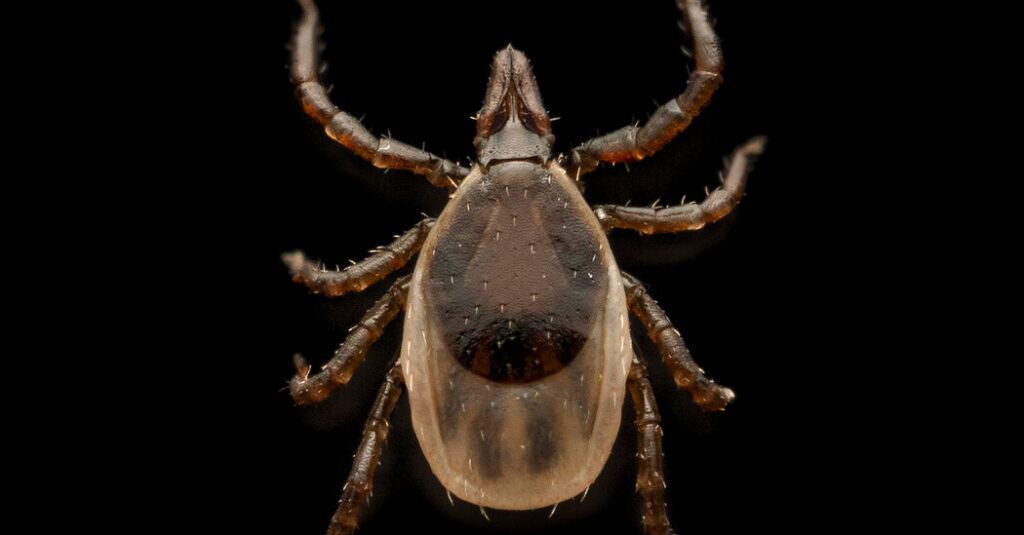
Do you know the revolting things a tick actually does after scurrying up your body? Once the bug has nestled in a warm, damp, often hidden spot where skin is thin and blood vessels are plentiful, two of its mouthparts saw through your skin to obtain an initial grip. Next, a third mouthpart, a barbed straw called the hypostome, bores into you and begins oozing spit. This spit has a diabolical chemistry that lets the bug feed undetected: The saliva at once cements it in place, numbs the bite site and secretes an anticoagulant to keep your blood flowing. For days, then, you supply the tick with its blood meal, as it rhythmically alternates between drinking your vital fluid and injecting potentially germ-filled saliva into the bite cavity.
The lone star tick, named for the white splotch on adult females’ backs, shares these disgusting eating habits with the blacklegged tick (more familiarly known as the deer tick, giver of Lyme disease) but is worse. It feels at home in a wider variety of habitats, from deep forest to suburban lawn. A deer tick can lay 1,000 to 3,000 eggs; a lone star can lay 5,000. Deer ticks merely wait in leaf litter or on a blade of grass for their next meal to brush past; lone stars can sense a target up to 15 yards away and aggressively pursue their prey. The lone star has longer mouthparts, which penetrate more deeply into flesh.
A deer tick, once attached to you, can take 24 hours or longer to impart its Lyme payload — so there is time to pull it off, in theory. A molecule called alpha-gal, which is present in a lone star’s saliva, can be in your blood almost instantly. This is a problem, because it gives some victims a dangerous allergy to red meat called alpha-gal syndrome. And while Lyme is “basically treatable” in 95 percent of cases, says Sam Telford, a professor of infectious diseases and global health at the Cummings School of Veterinary Medicine at Tufts University, with alpha-gal “there’s no known treatment.” Doctors advise people diagnosed with it to carry an EpiPen.
Unfortunately, the lone star is ascendant. Lyme disease is more or less priced in as an entrenched risk of Northeastern living at this point, but the more recent emergence of the lone star threat has punctured the delusion that we can just tough ticks out. Researchers at the University of Virginia published a study in November documenting the first known alpha-gal death: Two weeks after going on a camping trip in 2024, Brian Paul Waitzel, a 47-year-old pilot for JetBlue and father of three, ate beef at a school barbecue in New Jersey and several hours later went into anaphylactic shock. “Never knowing whether your next hamburger might be your last is a hugely attention-getting proposition,” says Richard S. Ostfeld, a disease ecologist at the Cary Institute of Ecosystem Studies in Millbrook, N.Y.
In 2023 — three whole tick seasons ago — the Centers for Disease Control and Prevention estimated that nearly half a million Americans already had alpha-gal syndrome. There’s reason to suspect that this number is wildly low. In states where the lone star is endemic, 24 percent of blood-donor samples have tested positive for alpha-gal antibodies. The tick itself, historically partial to the American South, is now well established in the Northeast and the Upper Midwest. In places where the two top ticks overlap, it’s starting to look as if the lone star could supplant the deer tick as the dominant species. And Ostfeld notes that the geographic reach of lone stars is not identical to that of deer ticks: “New populations are being recruited into the world of fearing and loathing ticks.”
One of those new populations — upsettingly for people who have long assured themselves that glass, steel and pavement are a moat against woodsy threats — is the Amtrak-corridor city dweller, in places like Washington, Philadelphia and even New York. Programs to increase urban green space, combined with complacency among tick-oblivious urbanites, have made a surge in metropolitan tick-borne illnesses increasingly likely. In June, The New York Times reported that ticks were present in most New York City parks and that people in both Staten Island and the Bronx had been infected with Lyme disease after being bitten. According to researchers with Columbia’s Eco-Epidemiology Lab, which has been collecting specimens in the five boroughs for several years, Brooklynites in Prospect Park, where there are relatively few ticks, express the most anxiety about the bugs.
Noah Edelman, an undergraduate researcher on Columbia’s team, had been doing these tick drags for three years without being bitten, but in July, in a Staten Island park, he felt an itch on the back of his waist and found an adult lone star attached there. He then experienced firsthand how dangerously unprepared most medical facilities are to treat this new threat. At an urgent-care center on Manhattan’s Upper West Side, he was prescribed doxycycline, the standard antibiotic for Lyme but one that is irrelevant for alpha-gal. “I was like, ‘Why are you giving me this?’” he says. “They’re like, ‘Well, this is our protocol for tick bites.’”
Conventional wisdom about ticks, in other words, is clearly lagging the fast-changing reality on the ground. From 2004 to 2016, reported cases of tick-borne diseases in the United States doubled. Four out of five of those were Lyme — nearly half a million Americans are estimated to be treated for it each year — but seven tick-borne maladies not previously reported in the United States also made their debuts. Ticks now account for four out of five vector-borne — which is to say, bug-delivered — illnesses in the country.
In April, the C.D.C. reported that emergency room visits from people bitten by ticks were up 50 percent from a year earlier and were the highest in a decade in most parts of the country. On Aug. 18, with 13 days still to go in the month, August numbers were already higher than for any full August on record. And in the lone star era, even summer’s end doesn’t bring relief: The threat of deer ticks and Lyme disease fades as fall arrives, but later summer and fall are precisely when the giant masses of eggs birthed by lone stars begin to hatch.
In other words, the worst part of the worst season of the worst year yet for the tick threat is just getting started. And it’s possible we’ll look back on this as the good old days.
The bug situation is getting out of hand: Every year, there are more of them, more kinds of them, in more places. Ticks — a tiny kin of scorpions and spiders — are just one plague. New bugs arrive in the United States as stowaways on the cargo planes and fast container ships that ply the world’s ever more hyperactive commerce networks. They threaten to make our lives into waking nightmares with B-movie titles like “Giant Needle Ants” (the Asian needle ant, which has a venom-dispensing stinger that can trigger anaphylaxis in people); “Flying Spiders” (the cold-tolerant yellow-and-black Joro spider, which can sail through the air when young and later grows into a palm-size arachnid); “Giant Snails” (the giant African land snail, carrier of rat lungworm, which can put you in a coma).
For now, though, it is the tick century, when a worrisome and potentially dangerous but forgettable-in-the-moment nuisance seems inescapably everywhere all at once.
Climate change, suburbanization and increasingly overlapping populations of people, mice and deer have led to more days each year when you might run into a tick, more places where you might have that encounter and more health problems it might inflict. And because the main drivers of the tick takeover are human-made, ticks embody a creeping sense that we did this to ourselves, that a reckoning is here.
Ticks, as much as they are a vector for exotic diseases, have in the post-pandemic era burrowed into our psyches as the carriers and transmitters of a raft of civilizational anxieties. Anxieties about fast-onset epidemics we aren’t ready for. About poorly understood illnesses, like post-treatment Lyme disease syndrome, that defy simple diagnosis but come amid a worldwide explosion in autoimmune disorders. About the long arm of climate change. Ticks have become thieves of our ease and joy, tainting our cherished hiking spots and vacation destinations, replacing a carefree relationship with nature with the menace of a sneaky, spreading, ever-shifting foe.
Not every tick carries pathogens. Roughly half of adult deer ticks in the Northeast have Lyme. Even those that do don’t successfully infect every victim. But the peril is real. The lone star, whose bite can change your life, can also give you diseases that, at their worst, can lead to hospitalization, organ failure or even death, such as tularemia (rabbit fever), Bourbon virus, ehrlichiosis and heartland virus. The deer tick, bearer of the Lyme-causing Borrelia burgdorferi bacterium, can also carry the microbes that induce the equally serious babesiosis, anaplasmosis and ehrlichiosis; the dangerous virus that causes Powassan; and even the molecule that can trigger alpha-gal syndrome. “It’s really a Pandora’s box of infection,” Thomas Daniels, who runs the Fordham Tick Index, says of the deer tick. Other ticks on the rise include the Asian longhorned tick (which can give you ehrlichiosis), the Gulf Coast tick (spotted fever rickettsiosis) and the American dog tick (Rocky Mountain spotted fever).
To people with trust issues, ticks are nature’s Deep State, an insidious network of scarcely visible malefactors poised to wreak havoc in our lives. A tale circulated online by the MAHA Moms Coalition, among others, holds that Big Pharma has been dumping boxes of ticks on Midwestern farms to amplify demand for a forthcoming Lyme vaccine. Another conspiracy theory suggests that the Gates Foundation, which has funded research into cattle ticks, is somehow behind the rise of alpha-gal syndrome, with the secret agenda of promoting veganism.
Most persistent is the idea that the Lyme epidemic began as a lab leak from Plum Island, the site of an animal-disease research center on Long Island Sound (and, as tick truthers would have it, of a secret military program to engineer ticks as bioweapons). Health Secretary Robert F. Kennedy Jr. has deemed the bioweapon origin story “highly likely,” and in December, the House of Representatives passed an amendment written by Chris Smith, a Republican from New Jersey, that would require the Government Accountability Office to “investigate whether the Cold War-era Department of Defense weaponized ticks with Lyme disease.”
It’s possible to dismiss these paranoid theories — all have been debunked — without ignoring the concern that fuels them: Why, more than half a century after a cluster of ailing children in Lyme, Conn., first drew our attention to the problem of tick-borne disease, is it only getting worse? Why can’t science solve this problem?
We could, of course, just kill all the deer. Where there are deer, there are ticks. A tick is generally born free of pathogens but eats three blood meals in its two- to three-year life span. For the first two of those meals, the deer tick typically feeds on small animals, which serve as the primary reservoir for the microbe that causes Lyme. When a tick feeds on an infected animal, the tick can become infected in turn.
Deer are not themselves hosts for the Lyme-causing agent, but they are integral to the Lyme epidemic and other tick-borne health problems, because they provide deer ticks and lone stars with their mating grounds and their final, largest blood meal, the one that enables them to lay their vile blobs of tick caviar and multiply en masse. (Soon after, the tick dies.) People may fret about ticks, but ticks aren’t thinking about people; a person who is bitten just had the bad luck to cross paths with a tick that might have preferred a rodent or a deer.
As part of his doctoral research in 1986, Telford oversaw an experiment on Great Island, a peninsula on Cape Cod, that shrank the deer population by more than 80 percent. The upshot: Reducing deer can reduce ticks, but only when done to an extreme degree. (Among other reasons: If you kill only, say, half a herd, ticks will just concentrate on the remaining deer.) “It’s more bang for your buck to go after the reproductive host,” Telford says.
There has already been one deer genocide, more or less. Before 1800, as many as 30 million white-tailed deer roamed North America. There were swarms of ticks, too, but fewer people to run into them. (Pehr Kalm, a Nordic naturalist, noted that the “very disagreeable insect” he encountered during his travels across the continent in the 1700s “may, in the future, cause the inhabitants of this land great damage unless a method is discovered which will prevent it from increasing at such a shocking rate.”)
Then vast tracts of forest gave way to farms, and with hunting unregulated, the white-tailed population plummeted to fewer than 300,000. Ticks in the first half of the 20th century were not a problem. But as farmland was reforested, human sprawl eliminated natural predators and increased edible vegetation. Milder winters let more fawns survive to adulthood. As a result, white-tailed populations have exploded back to around 30 million.
In response, the idea of mass deer slaughter has been revived. In 2014, the Department of Agriculture and the Long Island Farm Bureau announced a plan to kill as many as 9,000 deer. In a government-sanctioned cull, typically done at night when people are scarce and deer are active, a sharpshooter can do things sometimes forbidden in recreational hunting, like putting out corn as bait and outfitting a rifle with a suppressor, so killing one deer doesn’t alert its peers. A participating sharpshooter later described in a blog post “the devastation” of the disintegrating bullets he used, “often turning the entire skull into jelly.” Afterward, men in Tyvek suits field-dressed the animals; the venison went to food pantries.
But decimating a local herd is a very tall order. Outside of islands and peninsulas, most places have unpredictably dynamic deer populations — for every deer you kill or sterilize, another might arrive from elsewhere. Sterilization is expensive, labor-intensive and unpopular. Increasingly, deer are in densely populated places where hunting isn’t allowed. And the politics of killing deer — our Bambis, our Rudolphs — are more daunting still.
In Long Island’s planned Deer Massacre of 2014, for instance, only 192 deer were killed in the end, after pushback that included, just in East Hampton, a petition, a rally and lawsuits. A year later, the town paid a contractor $190,000 to sterilize more than 200 does and bucks, only to abandon the experiment amid complaints about taxes and animal cruelty and a lawsuit from a wildlife-advocacy group.
The surge in lone star ticks, an ominous development in virtually all respects, has nonetheless awakened, among battle-scarred veterans of the deer wars, hope of ending the stalemate. “That becomes a game changer,” says Tony DeNicola, a wildlife ecologist in Connecticut who founded White Buffalo, the nonprofit that the Village of East Hampton hired to sterilize its deer 12 years ago. “You get arthritic symptoms or Lyme disease — that sucks for you. But you might end up dead? The political conversation has really changed.” (It’s worth noting that an alpha-gal allergy can, in many cases, eventually fade, if a victim steers clear of meat for a while.)
In any case, deer aren’t the only bad actors here. Of the small rodents that serve as the Lyme-producing microbe’s primary reservoir, the white-footed mouse in particular has proliferated near people for the same climate and habitat reasons as ticks. It’s a problem that’s particularly acute in a place like the Hamptons, where the iconic privet hedges are welcoming to mice. Do something about mice, one idea goes, and you can do something about deer ticks, at least. (Mice play a less important role in the diet of lone stars.)
The proposed mouse solutions are less violent than the deer solution. A group at the Tufts veterinary school is testing an anti-Lyme antibiotic that could be “carpet-bombed” in areas dense with mice, says Linden Hu, a professor of medicine and microbiology at Tufts Medical School who is involved with the project, and would target just Lyme, bypassing public-health concerns about encouraging broader antibiotic resistance.
Another group, at M.I.T., is working to genetically engineer Lyme-immune white-footed mice, with the idea of releasing tens of thousands of them in a 100-square-mile Lyme epicenter to replace the local mice population and block the transmission of Lyme to ticks. The M.I.T. scientists are hoping to try this on Nantucket and Martha’s Vineyard and have been meeting with people there for a decade to engage the community. “There are communities that are so ravaged by Lyme disease,” says Jo Buchthal, the project’s research director, “that they’re open-minded; while they might not consider it for anything else, they’re willing to consider an ecological intervention,” like a genetically modified organism, “in that context.”
The science is impressive, but reality rarely cooperates. The areas dense with problem mice tend to be the areas dense with people; an approach that requires door-to-door canvassing of homeowners for permission to deploy a drug is challenging. Getting white-footed mice to reproduce on command turns out to be hard. Complex regulations govern the introduction of genetically engineered animals. And G.M.O.s at scale may well be an even tougher sell to the general public than a deer blood bath. Optimism, under these conditions, is not necessarily warranted.
Shelter Island, off the coast of eastern Long Island, has a lot of deer and a lot of ticks and is theoretically the kind of small, self-contained place where deer could be controlled. “Shelter Islanders eat ticks for breakfast,” Julia Weisenberg said, laughing a little. Weisenberg, who has a Ph.D. in linguistics, has taken ticks as her personal enemy. She hunts deer (and is a certified nuisance wildlife control operator), provides game-butchering services for the town, teaches hunter education and sits on the town’s Deer and Tick Committee.
In late July, she was in a field setting up archery targets, including a foam deer and a foam wild turkey, each painted with a white spot to mark the vital organs. Most likely no one on the island is as habitually on guard against ticks as Weisenberg, who sends her hunting clothes to a company called Insect Shield to have them soaked in permethrin, but the mowed grass and desiccating sunshine here that day were inhospitable to ticks, so she had sprayed her feet and legs with an insecticide and was risking shorts and Crocs.
The free adult archery class she was about to teach was sponsored by Shelter Island’s recreation program. She also teaches youth archery classes, and her hope is that some small percentage of her students will get hooked and become bowhunters. But just keeping the island’s white-tailed deer population stable at its estimated 700 requires killing at least 300 annually, and much of the island isn’t huntable because of its housing density.
She was pretty sure that the eight year-round residents who would attend the day’s class were motivated more by fun than pest control. “But a lot of them don’t like ticks, I can tell you that,” she said.
From 2017 to 2022, according to the C.D.C., Suffolk County, which includes Shelter Island, had the highest number of suspected cases of alpha-gal syndrome of any county in the United States. In 2023, it had the highest number of new cases of Lyme disease in the country. And in May, the first known case in New York of the tick-borne Bourbon virus, a potentially lethal infection that can bring on multiple organ failure, was reported in Suffolk County. Some Long Island landscapers now wear pantyhose under their clothes to stave off ticks. For people bitten by a tick, the general advice from Stony Brook Southampton Hospital’s Regional Tick-Borne Disease Resource Center & Clinic, as from most experts, is to seek medical care only if a rash or flulike symptoms develop.
Long Island is not only lousy with ticks; it maps the gothic story of the bug’s rise to power. Years before Lyme disease was named to describe what was at first mistaken as juvenile rheumatoid arthritis, locals on the East End had a name for the rashes and mysterious joint-swelling that some residents experienced: “Montauk knee.” It was on Shelter Island in 1981 that a microbiologist named Jorge Benach gathered the ticks in which the bacterium responsible for Lyme would first be identified. And the mere three miles separating Plum Island and mainland Long Island’s East End is the kernel of proximity around which the there-are-no-coincidences crowd has wrapped its lab-leaked bioweapon theory.
Shelter Island’s booming popularity over the past decade has meant more land cleared, more building, more people, more deer and rodents and therefore more ticks. Ticks, in turn, are starting to alter the character of the Hamptons and other vacation spots on the East Coast. Erin McGintee, an allergist in East Hampton, has had a seasonal patient tell her she is going to stop coming to the Hamptons in favor of staying in Florida year-round. (Florida has ticks, too; they just aren’t nearly as big of a problem.) “Why would people want to come vacation here when they have to worry about getting bitten by ticks out on the golf course and in their backyard, when there’s other places they could go where there aren’t ticks?” On Martha’s Vineyard, restaurants now offer alpha-gal-safe menus, and fears of alpha-gal syndrome, Bloomberg reported, are depressing Airbnb bookings. (It’s not just a problem for elite coastal enclaves; as The New Yorker reported this summer, “the syndrome now threatens farmers, ranchers, hunters and foresters across the South and the Midwest.”)
Weisenberg’s archery students arrived and took their places on a line 12 yards from the targets. A whistle sounded. Arrows flew. During a break, a woman named Gina, who had lived on the island for 49 years and signed up for the archery class with family members, told me she had been bitten by six ticks this summer alone. She had Lyme disease in the past, and she knew all about its bearer. “There’s a difference between larval ticks and ticks,” she said. “This is going to sound sick: I’ve had well over a hundred larval ticks by walking into a tick’s nest. I saw them. It was like hordes of soldiers coming over a hill.”
Her husband, Gerry, looked at my ankles disapprovingly. “Are you sprayed?” Like Weisenberg, he sends his clothes away to be treated with permethrin. “The whole family’s gotten Lyme disease,” Gerry said. As we stood there, his son-in-law Cori, who was wearing flip-flops, found a tiny tick on his toe. Another archer said that her mother once had Lyme and that she herself once had Rocky Mountain spotted fever; her friend volunteered that she’d had Lyme and that her mother has alpha-gal.
For a time, Weisenberg hoped that devices called four-posters might provide a partial solution to the tick scourge. Four-posters feature troughs baited with corn; when a deer bends to eat, its head passes through paint rollers that coat its head and neck with permethrin, repelling ticks. The devices have their own drawbacks: Deer ignore the less-caloric corn in years when acorns are abundant, or squirrels get to the corn first. The devices are also expensive, and you need a lot of them. But they can significantly reduce tick counts.
From 2008 to 2019, Shelter Island had four-posters deployed, and during the first three of those years, a Cornell study showed that the average number of nymphs (the tick life-stage responsible for the most disease transmission) counted during a single drag fell to 18 from 440. But starting in 2020, regulations from New York’s Department of Environmental Conservation required that the town get permission of every landowner within 745 feet of a feeder. Goodbye, four-posters.
Weisenberg now sees tick management as a losing battle. These days, she focuses more on educating people. Visiting schools, she wears a tick costume she made out of cardboard, using hand-painted black pool noodles for the legs, and hands out tick plushies. It’s about managing “personal risk,” she says: mowing the lawn, spraying your skin, doing routine tick checks, staying out of the woods. “It’s very constraining,” she says. “It’s kind of depressing.”
It’s tempting to just go where ticks are not. But ticks are a big problem in Africa, Asia and Europe, too, and have been found everywhere on earth, including Antarctica, thanks to migratory penguins. The least ticky place in the mainland United States is West Texas, and the least ticky nonfrigid countries in the world are in Oceania. Before you start pulling up Zestimates for Lubbock real estate or mood-boarding your Australian dream bunker, though, you’ll want to Google “West Texas + black widow” and “Queensland + coastal taipan.”
But total bug hegemony may not be inevitable. Science offers the glimmer of a more realistic path forward. Moderna is developing an mRNA vaccine for Lyme disease. Another company is at work on a Lyme-preventative monoclonal-antibody shot. Each is in early clinical trials.
The drug closest to commercial availability is a Lyme vaccine being jointly developed by Pfizer and a European vaccine company. It targets the same protein as LYMERix, a vaccine that was sold from 1998 to 2002 before being withdrawn from the market amid claims about side effects and class-action lawsuits alleging that it caused a type of arthritis. The new drug recently completed Phase 3 trials, but F.D.A. approval is uncertain. If the vaccine is approved, it will arrive in a larger, more Lyme-concerned market, but also in a world more mistrustful of vaccines. And with a likely four-dose schedule, which could deter all but the most motivated patients.
One of the most promising anti-Lyme drugs is a pill, in its Phase 2 trial, that would give people the same tick protection that they’ve been giving their dogs for years via monthly beef chews: the anti-parasitic agent lotaliner, which targets the nervous systems of ticks but not mammals. In an earlier study, the pill proved effective at killing ticks on people in less than 24 hours. Since Borrelia burgdorferi typically takes more than 36 hours to transmit from an attached tick, the pill could be highly protective against Lyme (and possibly reduce babesiosis and anaplasmosis, too). But for alpha-gal-bearing lone star ticks, Tufts’ Hu, who is working with Tarsus Pharmaceuticals on the lotaliner pill, says the drug, being a neurotoxin, could potentially make them more dangerous by stimulating them to increase saliva production as they die.
This points to a larger problem with the current phase of pharmaceuticals, promising as it might be. All of these drugs target a single pathogen: the one that causes Lyme. Nationally, that remains the most widespread tick-related health problem, but it is quickly gaining competition. The future of the tick crisis, already here, is a tick polycrisis.
But several tick experts perked up when mentioning what could be the holy grail: a vaccine to protect us not from this or that one-off affliction, but from ticks themselves. Recently, I visited a medical-research building in New Haven, Conn., where a postdoctoral student keyed in a code to unlock the door to a small, dark room, then opened a refrigerator labeled “Insect Environment Chamber” and retrieved a couple of test tubes containing live adult deer ticks. “We’re going to put them on you,” Dr. Erol Fikrig, chief of infectious diseases at the Yale School of Medicine, told me. “You think we’re kidding.”
Fikrig studies vector-borne diseases, and in his lab, we looked at the ticks through a microscope that made them 10 times larger. At first they were sluggish. “There’s no blood in there,” Fikrig said. “They get excited if you put your arm in there.” I gripped the test tube under the microscope, and a tick scuttled across the field of view. These ticks had been grown in the lab from an egg mass and didn’t carry pathogens.
Part of what makes ticks so pernicious is that you often don’t know they’re on you. But because pathogen transmission from tick to host can take a day or longer, disrupting the feeding process is a route to possibly blocking that transmission. There has been evidence since the 1930s that some mammals acquire tick resistance: After guinea pigs have been repeatedly exposed to ticks, ticks are unable to feed properly on them, and gardeners and hikers in high-tick areas have reported not being too bothered by ticks. And those with this resistance have a local reaction to a tick bite. If you feel a tick, the way you can feel a horsefly, you can ideally remove it before it can harm you.
Fikrig, who did earlier work that was foundational to LYMERix and eventually the new Pfizer vaccine, has spent more than a decade trying to figure out which proteins in a deer tick’s saliva account for the arsenal of stealth tactics — numbing, anti-clotting and so on — that keep you unaware of a tick bite. The idea is to then develop a vaccine targeting them. Starting in 2021, working with Drew Weissman, the Nobel Prize-winning immunologist whose work was the basis for the mRNA coronavirus vaccines, he injected guinea pigs with a cocktail that produced the antibodies for 19 proteins. Infected deer ticks weren’t able to feed properly on the animals or transmit the Lyme agent. “Much of the basic science is done,” Fikrig said. Now his lab is working on finding “the magic bullet” — a smaller set of proteins that might suffice. One, called Salp14, “is very good at inducing redness at the bite site,” he said, and “a target that induces redness by itself might be enough.” The lab has also had promising results suggesting that the same targets would work against other ticks, including lone stars. The mRNA approach, in addition to letting the lab test many different targets in an efficient way, would offer more flexibility as novel tick-borne afflictions emerge.
For a moment, I let myself imagine a world in which ever-multiplying ticks — always a new kind of tick, always a dangerous new cargo in its gut — simply cease to be a problem. That’s the dream: a single vaccine that makes all tick-borne ailments irrelevant, because it renders all ticks effectively harmless. But “it’s easy to say all that stuff,” Fikrig said. “It can take years to test all that stuff.”
And then Fikrig said something particularly unsettling. Ticks, which are currently the main vector of disease in the United States, are “extremely important,” he acknowledged. But only half of his lab is devoted to studying them. The other half is focused on mosquitoes, which worldwide are “arguably the most important vector for disease.” And because of climate change, they, too, are making inroads in the United States, particularly in the South, where milder winters are allowing them to survive longer.
Fikrig started listing diseases, previously unseen here, that have begun cropping up in the United States: West Nile virus; Eastern equine encephalitis; malaria; dengue fever; Zika; Chikungunya. “Mosquito-borne diseases,” he said, “are becoming more important in the United States.”
This is the tick century, yes, but the century is young.
Benjamin Wallace is the author of “The Mysterious Mr. Nakamoto: A Fifteen-Year Quest to Unmask the Secret Genius Behind Crypto.” He last wrote for The Times about philosophers working in the A.I. industry.
The post The Summer the Ticks Took Over appeared first on New York Times.