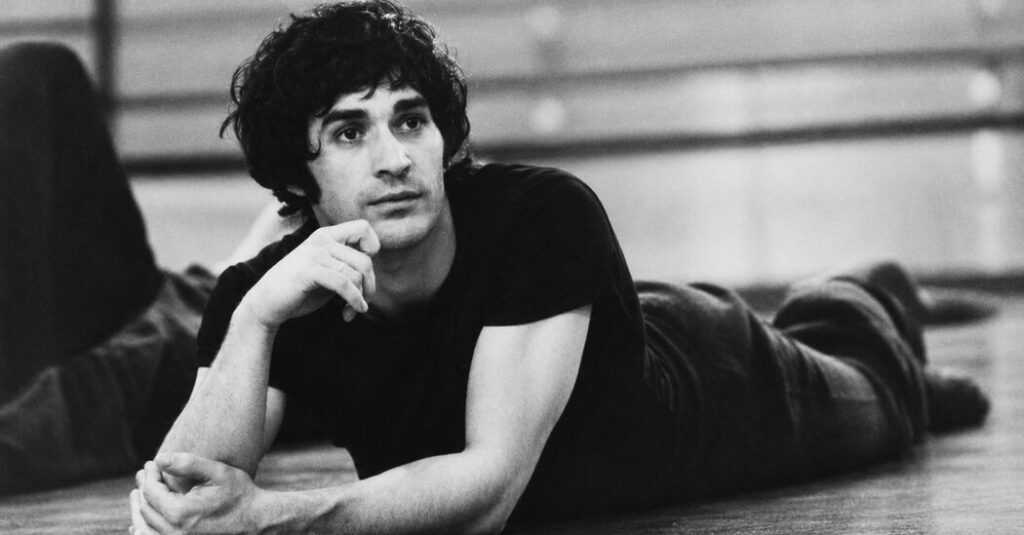
Ted Striggles, a dancer and lawyer who combined his disparate skills to support artists both struggling and successful, and to advise them on how to survive, including with his influential 1976 guide, “Poor Dancer’s Almanac,” died on Saturday at his home in Manhattan. He was 84.
Deborah Sale, his wife of 47 years, confirmed the death, which was caused by complications of white matter disease, a neurological condition.
As a young man, Mr. Striggles was a scholar-athlete, playing several sports as an undergraduate at Stanford in the early 1960s. He continued playing sports while pursuing a law degree at Harvard, until an injury necessitated knee surgery. While he was recovering from the operation, his younger sister suggested that he try ballet. That was when he fell in love with dance.
After graduating from Harvard Law School in 1967, he earned a master’s degree in dance at Sarah Lawrence College, studying with the eminent educator Bessie Schonberg. Not long after beginning his dance career, though, he needed another knee operation.
During the recovery period this time, he took a job as a lawyer with the prestigious firm Paul, Weiss. About a year later, he returned to dance, joining the hardscrabble world of choreographers and companies in 1970s New York City.
As a performer, Mr. Striggles was attracted to comical, satirical work. In a 1971 review in The New York Times of Elizabeth Keen’s “Poison Variations,” a humorous dance inspired by the play within the play in “Hamlet,” Don McDonagh praised Mr. Striggles as “malleable faced.”
Mr. Striggles also appeared in many works choreographed by James Cunningham; in “Maisie Paradocks,” he played a businessman with the head of a rabbit who responded with karate kicks to the enticements of Mr. Cunningham, who was dressed as a carnation.
From the start, Mr. Striggles also played a role in the administrative side of the performance world. “My involvement began, I guess, when I was in a small company that got a date in California,” he told The Times in 1979. “They needed airplane tickets and I was the only one with a credit card, so they made me business manager. In many arts organizations, it’s the one who has the adding machine that gets the job.”
For Mr. Cunningham’s Acme Dance Company, Mr. Striggles devised a system — then novel for dance — that pooled revenues and then divided them among the dancers via shares. Through Dance Theater Workshop, a choreographers collaborative that was becoming an important incubator for experimental dance, he began giving classes in economic survival for dancers.
Those lectures led to “Poor Dancer’s Almanac,” a guide that he compiled with Margery Simkin and Senta Driver. Its tone was equally informative and irreverent.
“When you were 6, you likely spent a great deal of time in earnest conversation with your friends over how sex worked,” Mr. Striggles wrote in the introduction. “You will recall that much of the material was there, but nobody had the story quite right.”
The almanac set the record straight on how to live as a dancer — explaining, for example, the difference between rent control and rent stabilization, and elucidating the possible drawbacks of squatting in an illegal loft.
At a time when many modern dancers often performed only a few times a year, unemployment insurance, Mr. Striggles wrote, was “the most important single funding source.” He showed how, by adding up their total weeks of employment (whether performing, tending bar or waiting tables), dancers could qualify.
The almanac was later revised and expanded by other authors. In the 1993 edition, in a section discussing liability in informal partnerships such as the kind created when two choreographers share a program, Mr. Striggles posed a hypothetical situation: “Suppose the other artist thoughtlessly filled her blank pistol with real bullets and unintentionally, though fatally, shot a certain unsympathetic New York Times critic.”
Would the other, weaponless choreographer be liable? Possibly so, he wrote.
In another 1976 book, “Fear of Filing,” he demystified taxes, jokingly starting with a quote from Dante’s “Inferno” — “Abandon hope, all ye who enter here” — before offering information and encouragement. “Fear of Filing” was distributed by Volunteer Lawyers for the Arts, a legal aid organization for which he later served as director and board chairman.
David R. White, who led Dance Theater Workshop from 1975 to 2003, said in an interview that Mr. Striggles was a “one-man defense force for artists.” In the mid-70s, when the celebrated avant-garde performing artist and composer Meredith Monk was broke, Mr. Striggles won a landmark case establishing that she could receive unemployment insurance even though she was on the board of her own nonprofit organization.
After retiring from performing in 1976, Mr. Striggles returned to Paul, Weiss, where he remained until 1979, when he served for a year as the executive director of the New York State Council on the Arts. Then he became a solo practitioner — still helping artists, often pro bono. Among his notable clients was Arthur Mitchell, the pathbreaking Black ballet star who was a founder of Dance Theater of Harlem.
For years, Mr. Striggles wore a black overcoat that he had bought in Italy as a college student. It had a cape lined in red silk, and many of the artists who saw Mr. Striggles as a hero thought it an apt costume.
Theodore William Striggles was born on April 9, 1942, in Des Moines, the middle of three children. His father, William Theodore Striggles, owned a small business and was later a bail bondsman. His mother, Anastasia (Pelekoudas) Striggles, managed the home.
Besides his wife, Mr. Striggles is survived by his older sister, Georgiana Fotinellis. His younger sister, Demetra Henderson, known as Becky, died in 2013.
In 1974, he was part of a team of dance company managers who pooled resources as a collective called DanceWorks. The collective grew into Pentacle, a leading support organization for the performing arts. Mr. Striggles later lectured on arts law at Pace University and New York University, and served on grant-making panels for the National Endowment for the Arts and the National Council on the Humanities.
In 2022, he was honored for his lifetime of service by the New York Dance and Performance Awards, known — in honor of Ms. Schonberg, his teacher at Sarah Lawrence — as the Bessies. The citation noted his “identification and institutionalization of subversive business practices in the arts.”
Mr. Striggles also received an award from the Dance Notation Bureau, a nonprofit organization that promotes the use of Labanotation, a symbolic system for recording dance movement. On a wall in his apartment, he hung a Labanotation script for a certain sequence of actions. When visitors asked him to interpret it, he would — by slowly raising his middle finger.
The post Ted Striggles, Who Helped His Fellow Dancers as a Lawyer, Dies at 84 appeared first on New York Times.