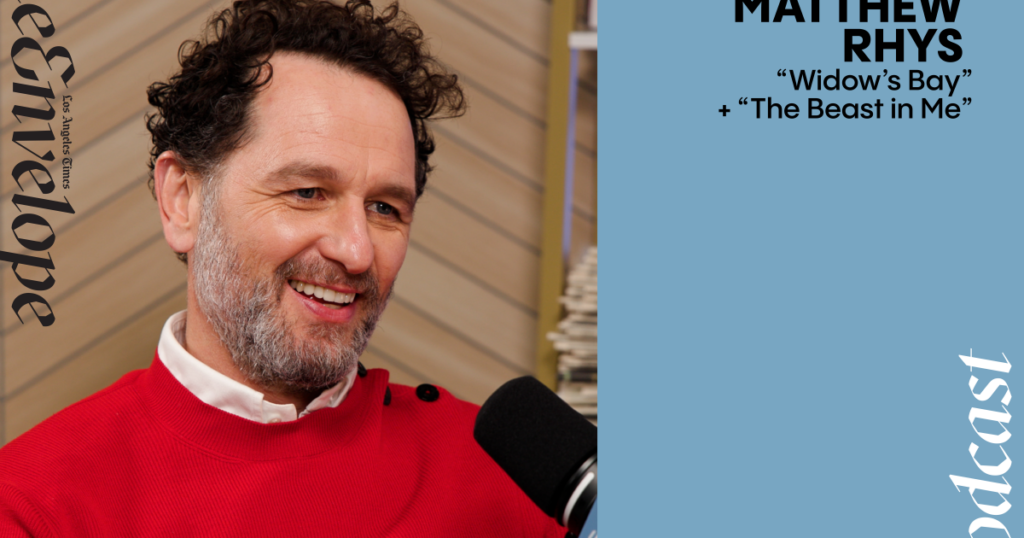
In this week’s episode of The Envelope podcast, the Welsh actor joins The Envelope for a conversation about his Emmy-nominated roles in “Widow’s Bay” and “The Beast in Me.”
Kelvin Washington: Hello, and welcome to this week’s episode of The Envelope. Kelvin Washington, Yvonne Villarreal and Mark Olsen here. We’ve been talking about it now for the last couple of weeks, but we’re less than a month away from the Emmys. Mariska Hargitay is gonna be the host. I’m looking forward to that because who’s living a better life than her? She’s nominated, of course. She’s hosting. And her Knicks won the NBA championship — she’s at this point an honorary Knick. I mean, it’s like she’s on the team.
Yvonne Villarreal: And she went to the Taylor Swift wedding.
Washington: That’s a good point.
Villarreal: Don’t forget that. And starring on Broadway.
Washington: So she is living her best life, yeah.
Villarreal: She’s living a better life than I am.
Washington: So I’m going to answer the question first. I’m gonna ask you, what are you looking forward to [at the Emmys]? Maybe some things you’re excited for. For me, it’s just seeing this culmination of all these things for her and just having a big moment there. I think she’s gonna own that space and I think everybody’s gonna enjoy it as well. What are you looking forward to?
Villarreal: I’m really, really excited to see my beloved Philip and Elizabeth Jennings as nominees — Matthew Rhys and Keri Russell. Not to be parasocial, but I just love that they’re both nominated. I just want a magical night for them both.
Mark Olsen: I don’t want to be a bring-down bummer here, but, you know, I find that the Emmys in particular, even more than the Oscars, kind of play favorites, and the same winners can happen again and again. It’s not as bad as it may once have been, but I’m always rooting for new blood, first-time nominees, people that it’s exciting to see them kind of get this platform. So nothing against your beloved, but I would be excited to see an underdog or somebody kind of an outsider. Say, for example, the rest of the cast of “Widow’s Bay,” which as you’ve said before, really came out of nowhere, [and] it’s become a bit of a favorite this season. And there’s some other performers there, Dale Dickey, Stephen Root, Kate O’Flynn, and I think any of them winning would be really exciting.
Villarreal: I won’t argue with that.
Washington: I was waiting on an argument.
Villarreal: We fight off camera.
Washington: And by the way, Mark, I mean, can good be good? Or great be great? If I’m great 10 years in a row, can I just be great 10 years in a row and win? You’re putting limitations on my victories.
Olsen: Yeah, but at some point, your shelf is full.
Washington: That’s true. Don’t worry about what’s going on in my mantle, all right?
That being said, we got Matthew Rhys, who you had a chance to speak to. Double nominee here, “Widow’s Bay” and “The Beast in Me.” Tell me a little bit more about your conversation.
Olsen: Just a rare double nominee, lead actor in a comedy series with “Widow’s Bay,” and then lead actor in a limited or anthology series or movie with “The Beast in Me.” And I think what’s exciting here is that these are just two very different performances. He’s this manipulative, maybe psychopathic real estate developer in “The Beast in Me,” and then this kind of harried, put-upon single dad and mayor of a small, cursed New England island in “Widow’s Bay,” and I think both of these roles show new sides of Matthew to audiences. But then when you take them together, it just feels like something else entirely.
Washington: All right, well let’s take a look. It’s M&M — Matthew and Mark — here now.
Mark Olsen: For the Los Angeles Times and The Envelope, I’m Mark Olsen. I’m here today with Matthew Rhys, who is nominated for an Emmy for lead actor in a comedy series for “Widow’s Bay” [and] lead actor in a limited or anthology series [or movie] for “The Beast in Me,” and another nomination as executive producer on “Widow’s Bay.”
Matthew Rhys: I forgot about the executive producer part. It’s an exciting time.
Olsen: And now being nominated for these two performances, which are very different performances —
Rhys: [whispers] They’re not really.
Olsen: Now tell me about that. You don’t think they are?
Rhys: Look, I think I was about to speak for a number of actors and I shouldn’t. I can only speak for myself. Sometimes there’s seemingly or feels like there’s very little difference in them. I’m not, I don’t pretend to be an enormously transformative actor, hunting for the “chameleon” praise.
Olsen: But do you consider yourself versatile? It’s so interesting to me to hear you say you don’t see these roles as that different.
Rhys: I wouldn’t say I’m versatile in that chameleon-like way or transformative way, I just try to work from a place… We’re already into it.
Olsen: That’s what we’re here for.
Rhys: I know. It always makes me nauseous. I do try to live in a place that feels real to me and that what we talk about, working from your center. So when I move away from that, things start to feel insincere, so I tend not to.
Olsen: With “Widow’s Bay,” a lot of the coverage around it has been talking about how it’s been a real surprise hit. And I’m just wondering, what is it that you think that audiences are responding to?
Rhys: You know, timing is everything. I do think there was a place that was ready for “Widow’s Bay,” whereby nothing of the sort had been around for a while. You hadn’t had “Twin Peaks,” although we were kind of slightly “The Office,” “Twin Peaks,” sprinkling of “Northern Exposure” maybe, but nothing I think of that sort had been for a while. So I think people were just ready for something different, and then we’re certainly different.
Olsen: Betty Gilpin, your co-star on the show, she is also a nominee, in a recent interview said that she feels like it’s as if audiences are rejecting this idea of a really sort of safe, algorithm-approved show. And do you feel the same?
Rhys: Absolutely, and it’s wildly refreshing to know that people are going, “No, we want something different. And we are intelligent enough to deal with it. So give it to us.” And that I found very, very inspiring, very encouraging — that television and film should be pushing itself continually for that original material and not relying on remakes.
Olsen: When did you realize that the show was connecting in the way that it is? I’ve seen in some other interviews you say that even when you were shooting it, you weren’t totally sure, didn’t totally think that it would connect with people.
Rhys: No, none of us — a lot of us were like, “Are we getting the tone right? Is this right? Is this going to work?” It was a swing. It was an absolute swing. A kind of beautiful one, nonetheless. But we were all concerned — not concerned, maybe just intrigued — as to how it would be received. And it was a little bit more word of mouth. Friends were saying, “Oh, I’ve seen your show.” And then throughout my career, it’s probably the job I’ve been stopped most for. And I’m not saying that happens often. But at least twice I’ve been stopped for it. So that’s been refreshing.
Olsen: And people are really talking a lot about this mix of tones. It’s a horror-comedy that’s both very much funny and scary. What was the challenge of getting that mix right?
Rhys: Making both real, ultimately. I know that sounds very obvious and stupid, but it’s true. And also Katie Dippold spoke to this, the creator and writer, where she said she kind of thought one can almost relieve the other. When there’s incredible tension from horror, when the laugh comes in, it’s almost a big laugh because it’s the relief of being allowed to laugh. So she says sometimes that can pay off in a way. It’s much harder the other way around, but it also works the other way around where you catch an audience off guard because they’re laughing and then you hit them with horror. So I think both bizarrely can help each other.
Olsen: I’m thinking about something like the episode that’s mostly on a boat, that gets very sort of slapstick-y at moments, but then there’s still something very terrifying about what’s happening there.
Rhys: Yes, we’ve hit the nail on the head. That kind of tone I found very hard. There are these borderline farcical moments of wrestling with a man who’s 400 years old and it becoming kind of very comedic physically and yet it has to remain that there’s this element of danger or threat that’s very real and palpable. And so those are the moments you try and ground in a way so that the extreme elements can also live in a real place.
Olsen: Because you mentioned a man who’s 400 years old, the mythology of the show gets more complicated as it goes along, right up until the very last episode. Were there moments where you had to sort of step aside and ask people to explain it to you?
Rhys: No, because I think the chronology is laid out beautifully throughout the series and you’re kind of led in a way where it unfolds very organically. So I was very relieved that to be the case that there’s no kind of, “Wait, where are we? What’s, who’s this?” So that I thought was kind of beautifully executed. And because of that, because of the detail in the backstory, then the story I think pays off far greater.
Olsen: The final episode really lands it so well as far as being both funny and scary and also the way that it sets up a next season, which happily is happening. The finale promises even more murder and mayhem for Season 2. I know the writers room is already hard at work. Do you have any insights on what at least you would like to see happen?
Rhys: No, I’m desperately intrigued as to what she has in mind because I wouldn’t have the first clue as to where to start Season 2. I’m very assured that the warped mind of Katie Dippold will helm us into a giddy storm.
Olsen: One thing I have to ask about “Widow’s Bay” is simply, in preparing to play this small-town mayor who’s very concerned about tourist season, did you refer at all to maybe the most famous other small-town mayor played by Murray Hamilton in “Jaws”?
Rhys: Well, I would like to say yes because “Jaws” is an enormous favorite of mine, but he’s a very different mayor, if you look at his mayor. He’s very assured. He gets a little frustrated with Brody, but he’s not that kind of cortisol-burning, wild-eyed panic that Tom Loftis is. He is far more assured of what he should be doing for the municipality than Tom is. I even said at one point, I said, “Can we get away with the jacket, you know, the anchor jacket?” And they were like, no, because that would be too obvious.
Olsen: I like that you had the impulse.
Rhys: A lot of my performances have some reference to “Jaws,” regardless of the piece, because I’m usually Quint. So I was very upset in the boat scene you referenced when obviously myself, Stephen Root and Hamish Linklater sat around and said, OK, Stephen Root, you are obviously Quint, what does that make Hamish and myself? Who’s [Richard] Dreyfuss and who’s Roy Scheider in this? And Hamish went, “Well, I’m Dreyfuss.” I was like, “I am not Brody.” They’re like, “You’re wearing the life jacket. Of course you’re Brody!” This is the kind of thing actors talk about.
Olsen: But you weren’t happy with that?
Rhys: I’ve always wanted to be Quint. I love Brody, but my heart lies with Quint
Olsen: Now, I came to realize that “Brothers and Sisters,” it goes back 20 years now that you were on that show. And I’m just so curious, working steadily in TV for 20 years now, how has the job of being an actor on TV changed in that time?
Rhys: I don’t think it’s changed, per se. From a personal point of view, it’s been incredible to play the wide variety that I’ve been allowed to. I think the scope of television has changed wildly in 20 years and the length and breadth of the variety there is kind of remarkable at times. And sometimes you wonder if it’s sustainable. If anything, it’s offered more opportunities, I think, for actors, but the kind of core fundamentals I think are still the same.
Olsen: Do you yourself watch a lot of TV?
Rhys: Yes, yes. I never watch myself, but yes. I tend to lean towards more documentaries than anything else. Fiction, I’m always like, “Oh, that’s the day job.”
Olsen: Because I know you’ve talked a lot about your interest in boats, and is there a lot of boats-and-restoration content out there?
Rhys: What, fiction or documentary-wise?
Olsen: I wonder what your algorithm is like.
Rhys: I don’t do much with Instagram but my algorithm is generally older men showing you how to kind of spile a garboard plank next to a keel, things like that.
Olsen: And are there a lot of documentaries about boats and restoration?
Rhys: There’s a lot on YouTube, none of which really hold your attention. What I think is like, where is the kind of “Chef’s Table” of boat restoration? That’s what I’m waiting for.
Olsen: I think you maybe have to be the one to make that show.
Rhys: I might have to, but I worry about the breadth of audience we’d have there. Or how to make boat restoration interesting to the masses. Therein lies the challenge.
Olsen: Well, they say niche markets sometimes …
Rhys: You can capture a zeitgeist moment.
Olsen: With your work on television, you have a really strong track record between “Brothers and Sisters,” “The Americans,” “Perry Mason,” now with “Widow’s Bay,” and also with “The Beast in Me.” For you, what goes into choosing a role?
Rhys: This is the real luxury of having a degree of choice. It’s not always choice, but more often than not, a project comes along that I’ll read and there’ll be a number of things. I’ll be like, “Ooh, I’ve never done it.” Like “Widow’s Bay,” I read it and I went, “The scripts are fantastic and I have never done anything like this in my life.” “Beast in Me,” the same, the writing’s so strong, but also that role is something I’d never done before. And the same, obviously, for “The Americans” and “Brothers and Sisters.” So if there’s an opportunity to try something very new, to me, it’s the ultimate luxury. And so that’s been a real driving force. And strong stories, the want of knowing how it ends, just simple storytelling.
Olsen: Do you find that your instincts have changed over the years? Are you looking for the same things that you feel like you were when you were starting in television 20 years ago?
Rhys: No, not necessarily. I always wanted, if I was fortunate enough, to do something that would challenge me, that would push me, that I hadn’t done, that’d scare me, that’d make me nervous every day on set, which a lot of these projects have done. I thought that would be all that I’d want.
Olsen: Because your character in “The Beast in Me,” again, I have to come back to this idea that you think these two roles are kind of similar, because your character on “The Beast in Me” seems so self-assured, like he has a confidence that Loftis does not have.
Rhys: Yes, that is very true and it was the observation of the wealthy that kind of led me there and especially uber-wealth, where there’s a real assurance of not having to try almost because there’s no need and this innate feeling that you will absolutely get your own way and people will bend to your will purely because of wealth.
Olsen: And now playing that role, getting a little taste of that, like, is that a nice place?
Rhys: What, self-assured?
Olsen: Is that a good position to be in, that people do what you want.
Rhys: Oh, I’m sure it’s great. I’ve never tasted it. It’s something I aspire to by the hour. And being riddled with all the cliched insecurities that every other actor, when you’re playing it, you go, “God, this feels great. To not even have to try with people must be so wonderful.” I’ve no desire to kind of glean the kind of affirmation from the person I’m talking to. Almost quite the opposite.
Olsen: “Widow’s Bay” has such a big ensemble, and then in “The Beast in Me,” really most of your scenes are just you and Claire Danes in this series of escalating conversations. Did you like that distinction? For “The Beast in Me,” did you like the pared-back intimacy of those scenes that the two of you have?
Rhys: Absolutely. I think that was the big draw of the piece, these two people who are kind of, they’re like two magnets in a way, they’re so drawn, they are so repulsed, they’re kind of images of each other’s shadow self, they see so much of each other while [being] polarizingly different. That to me was part of the great draw of that piece, with these two people and how they connected or seemingly didn’t.
Olsen: I don’t think you’ve worked with Claire Danes before?
Rhys: Prior to that, no.
Olsen: Because just in a practical sense, what is it like for two actors when you have so many of your scenes together? Like you sort of have to feel out not only how the characters are, but also how you as performers, as work colleagues, get through the day. What is that process like?
Rhys: I mean, look, with Claire, having known and watched her body of work, [I knew] she’s like a powerhouse and kind of brings that to set. And from day one of rehearsals, I kind of sat up and went, “Oh God, right, come on, let’s focus here,” because she has that laser that is on a switch. And when it’s switched, it’s on. And woe betide you if you haven’t prepared as well as she has. So that was very quick. The ascent of going, “Right, yes, A-game at all times, please.” Which is fantastic. It’s everything you want in a scene partner. It’s someone who kind of scares you and kind of raises your game and demands, you know, a kind of a better tennis game, although I’ve never played tennis. I’m sure it’s great.
Olsen: Do you feel like you’re that kind of actor too?
Rhys: No. I’m the one making fart jokes and then kind of going, “Will you concentrate?” I don’t think I have that kind of prowess, that kind of switch [that] is so alarmingly kind of night and day. I creak into it.
Olsen: Because there’s an intensity to your performance here. I mean, it goes big at times, there’s the “Psycho Killer” dance —
Rhys: The Achilles’ heel. I begged them to remove that scene because anywhere I see the scene direction “He dances” or “[Character] dances,” I can taste the vomit in my own mouth.
Olsen: And now did you choreograph that ahead of time?
Rhys: Nope, I just went for it. In fact a very charming woman came up to me on the street and she goes, “I love ‘The Beast in Me’ and I loved how camp your dancing was.” And I went, “Oh, it wasn’t meant to be necessarily camp.” Well, clearly it was to her. And also playing drunk, drunk and dancing, I was like, “Oh, some vicious planets are aligning.”
Olsen: And do you have a trick to drunk acting?
Rhys: Yes, I get drunk. It’s a very simple trick that most actors overlook. You just drink and then you’re drunk. The only time I venture into Method acting.
Olsen: But then about how many takes do you have in you?
Rhys: Two. No, no, I didn’t get drunk. I got tipsy. No, no it’s very different. It’s hard, it’s hard. That’s always a hard one because also we shot that over the entire day. So it started at like 8 a.m.And to be perfectly honest, sometimes you’ll do a take and it’s like, the drunk acting is too apparent. Let’s bring it back. Claire Danes nailed drunk acting from take one. And I was like, god— it! I mean, she’s done it again.
Olsen: And then also the chicken scene, how many chickens did you have to eat?
Rhys: I come into my own. Eating on screen is not and never has been a problem for me. I will take down any amount of food and I will not ask for a spit bucket. They were like, “Oh, we have a spit bucket.” I think, “No, I’m not spitting up perfectly good chicken” — and it was really good chicken. I think I went through about three chickens. What I loved about that scene, and this is what I love about all good writing, is when a brief element, usually it’s wordless, can say so much about a character or what the character is trying to do to the person in the room through a very simple action. So I loved that from what it did in that moment. He’s doing it overtly to try and intimidate her. It’s something which says so much about him and the way he does it, I thought it was an incredibly beautiful and shrewd piece of writing.
Olsen: Over the course of the series, how did you modulate how crazy to seem?
Rhys: Because it’s kind of present from the get-go. And that was a heavy reliance on the directors. We had some incredible directors on that. Antonio Campos, who kind of began and ended us, we had a little bit of a dial, and he was like, “Bring it back a bit” or “I think it needs a little more.” He was very good at truly kind of conducting in that moment. And we had the luxury of being able to do a few takes where he’s like, “Bring it up a bit” or, “OK, that’s good, let’s take it down a bit.”
Olsen: Were you happy with how that ended up?
Rhys: I don’t watch it. I haven’t watched myself in about 10 years. I get stuck on the wrong things. I become too concerned about the way I use my hands or how strange my walk is or the weird kind of idiosyncrasy of my mouth. So then when I’m doing it next, I’m like, “I am not going to do anything with my hands and I’m going to change my walk.” And then the director is like, “What is wrong with your walk and why are you sitting on your hands?” So I tend not to watch myself.
Olsen: You said 10 years ago. Did something really make you be like, “I’m not doing that anymore?”
Rhys: In fairness, it was more than 10 years ago. It was “Brothers and Sisters.” I started watching that and I was like, “Oh my God. Why has no one said anything? Look at my posture.” And then you become obsessed with sitting with better posture. And then everyone’s like, “Why are you sitting weirdly?” I was never clever enough to take from it a kind of positive critical foundation. I was taking the wrong things, usually physically attributed, that would get in my head when I was acting. And then that’s all I could think about while I was doing it, and I was on a road to ruin.
Olsen: So often you’re doing an American accent or a voice that is not your own and I know for myself I feel like I wouldn’t be able to think about anything but that, that’s all I would be able think about while I was performing.
Rhys: The accent is strange because I think in one way such an enormous part of my head is always working on the next sound to come out of my mouth. I think it stops you in a way from kind of acting, if that makes sense. It takes the self-conscious element out of you because you’re so busy working on something else. My acting teacher from drama school would always say, “Give yourself something to do to stop yourself acting.” It’s like you’re spending so much time thinking about the way you sound, it can relax you in a different way because you’re not thinking about acting.
Olsen: And then is it also a big challenge for you to try to make different American accents? How hard is it for you to do those different American sounds?
Rhys: It depends on the accent. I mean, sometimes the more extreme sounds are easier to hook into, like, you know, the Southern states or Boston or New York. Then you get, you know, California’s kind of softer, so it’s harder. It doesn’t have that extreme hook to find. And then there are just simply words in the American dialect that can take me down, like “murderer” or “world,” sometimes “girl” is tricky. But “murderer.” Which is unfortunate, because I played lawyers, spies who kill people. I’ve had to say it a lot. So I always go, “Can I say ‘killer’?” I just sound like I run out of battery.
Olsen: Do you find that living in America, has it helped you?
Rhys: Oh, without question, because going into a job, a couple of weeks before, I’ll be doing it — not at home, because it drives the kids crazy. They’re like, “He sounds so fake.” And then they’re like “Oh, here he is, he’s doing that again.” I’m like, “I’m not Dick Van Dyke, so I don’t know who you’re impersonating.” So yeah, you can go into the bodega and pretend to be American.
Olsen: On the day that Emmy nominations were announced, you did an interview with my colleague, Yvonne Villarreal, and you told her that you were meeting your partner, Keri Russell, also an Emmy nominee, at a mystery location. Would you mind completing that story? Where did you go?
Rhys: We went to the U.N. No, we didn’t, but I wish I could say that. We went to the Armory in New York with, oh God, I can’t remember the name of the exhibition. It was an incredible exhibition where three enormous tanks of water were filled with water and ceramic bowls and a current was introduced and then these ceramic bowls would clank into each other to make different noises in this incredible space. It was wondrous. Now, if the artist, for some unknown reason, watches this and goes, “I can’t believe he didn’t remember my name or the name of the exhibition,” I apologize profusely. But it was incredible.
Olsen: That sounds like a great way to spend the day.
Rhys: Yeah, it was. It was fantastic. And then we had a great dinner and celebrated and said, you know, “This is the high point, it’s downhill from here on out.”
Olsen: Well, the two of you were recently referred to as television’s first couple.
Rhys: I said that.
Olsen: And I’m wondering, I can only imagine you don’t walk around thinking of yourself —
Rhys: Oh, no, I do. I have a badge and a T-shirt, but no one believes me.
Olsen: But what does that make you think of when you hear yourselves referred to in that way?
Rhys: It kind of makes me laugh. You go, “Oh, God.” And also — and I hate to sound like I’m some bitter old fool, but I am — we’ve done it a long time. We’re of a certain age. You kind of know tomorrow there’s another first couple. So you go, “We’re today’s first couple, and it’s great. And we’ll take it and we’ll enjoy it.”
Olsen: Do you find, especially in the way that your personal and professional lives are intertwined, is it good that you have each other to keep yourselves in check?
Rhys: Yes, it also helps that you have a partner that fully understands what you do, because it’s a mad circus life and sometimes, you know, it’s hard, I think, for partners who don’t quite understand how crazy it is. So it is great in that respect that you fully understand what the other one is doing.
Olsen: And is that also part of where your interest in boats comes from? Is it something that’s totally separate?
Rhys: So she could kick me out of the house is why she bought me the boat.
Olsen: There’s something just totally separate from your work life.
Rhys: Absolutely, absolutely. And it’s something so other. … Opinions can vary so wildly, you know, critics can contradict each other in certain criticisms. The kind of more simple aspect, especially when I was restoring the boat, was that it felt a lot purer and simpler. That you can, at the end of the day, you look back at this piece of wood you’d be working on and go, “There we are, I did that.” And there’s no one saying, “Well, you could have done it this way.” You know what I mean? I always enjoyed the satisfaction it gave me in that sense.
Olsen: Wait, how many boats do you have?
Rhys: I only have one. She’s for sale, if anyone’s interested.
Olsen: Do you want to now find another boat to do this all over again?
Rhys: I don’t, because my wrists have given up. It was much harder than I thought it was going to be. It was an incredible journey, and it was kind of inspired by Hemingway, in a way, it was the same class of boat that he had. So I had all these giddy, kind of rose-tinted romantic notions of what I was doing until I was knee-deep in fiberglass, going, “Why did I think this was a good idea?”
The post Matthew Rhys’ pro tips for drunk acting, doing American accents and more appeared first on Los Angeles Times.