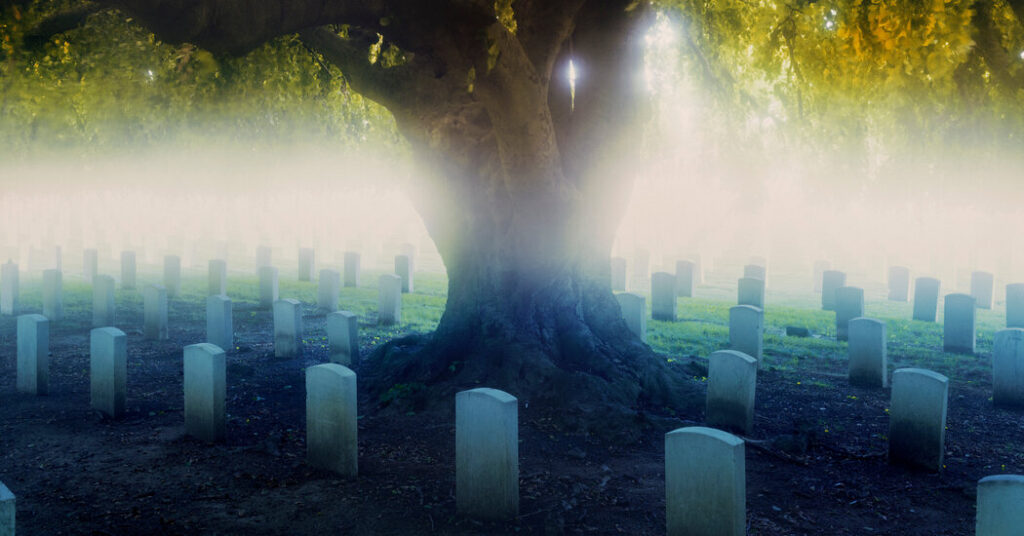
In June, my family and I hiked out to a pioneer cemetery near Duluth, Minn., along the cascading Saint Louis River. The wall of trees opened onto a clearing that was studded with crumbling tombstones and strange, squat obelisks. “Why are we here again?” my 9-year-old asked. She has auburn hair chopped at the jawline and believes fervently in magic. At her question, my 14- and 16-year-olds sighed and cast their gaze skyward, in a way that conveyed the great depths of their filial respect. They had heard my answer many times already.
Lately I’ve been haunting the graveyards of the Upper Midwest like the high school goth kid I never was. This is not out of any particular gloominess or moribund tilt to my personality. In fact, despite the daily horrors of our nation’s perma-wars and the expanding gulf between the rich and the poor, I remain — generally, and sometimes unwillingly — an optimist. But over the past year I’ve taken to strolling the necropolis. I find the practice steadying, a kind of forest bathing. Lakewood Cemetery, near my house in Minneapolis, is deeply calming — a timbered and shady oasis in the city. Take a jaunt through your local cemetery this August, and you will feel the jittery rhythms of the modern world recede, the physiological converse of being on your phone.
Some days I wander Lakewood trying to imagine the life of someone like Libbie Storer, whose simple white stone indicates she died at the age of 28 in the year 1873 — an unknowable inner universe, a brief life, long ago concluded. Some days I take a camp chair and set up office hours beneath an oak. This May, my only clients were a family of turkeys: one rested in the shade of the Carlsons’ canted markers, three paid their respects to the Bahr family, three more to the Langes. Their wattles swung in the breeze, a faint iridescence along their neck feathers. They looked like dinosaurs. The creatures’ mouths hung agape in the heat. Are we not all ugly in our grief?
I suppose I should note that it’s been a rough year and a half in Minnesota.
In June of 2025, the Twin Cities awoke to the news that overnight, a shooter had assassinated a Minnesota state representative, Melissa Hortman, and her husband in their home, and seriously wounded State Senator John Hoffman and his wife in their home, leading to a statewide manhunt. The killer was captured two days later hiding in a field.
In August, my quiet South Minneapolis neighborhood was devastated by the Annunciation Catholic School shooting, which left two children dead and 28 people wounded.
The day before that, I had been at the site of a different mass shooting. A man had fired dozens of rounds from a high-powered rifle into a crowd on a street corner, killing one and wounding six. I work as a mental health crisis responder for the city of Minneapolis, and my partner and I were called to the scene to provide emotional support for some children who witnessed the event. An officer led us past a pool of blood up to a second-floor apartment where a mother and two small children were waiting.
The family had heard the shooting just below them and took cover. Through a Spanish-speaking interpreter, the girl, who was maybe 6, told us about the screaming. The boy, who was maybe 4, eyed us silently and said nothing. After a few minutes, he went into his kitchen and returned with a package of SpongeBob SquarePants gummy snacks, which he handed to me wordlessly.
In December, agents from ICE and other federal agencies descended on the Twin Cities.
Perhaps it’s not so strange, then, to have spent the last year considering the ways death arrives unannounced.
When summer came, we were looking for a change. I had been working out an idea in my head that seemed within the reasonable bounds of weirdness. As my wife and I plotted our annual family road trip, I made my pitch: A cemetery tour of the Midwest! It would be fun! It would be appropriate for our fiscal moment, too, considering the soaring prices of literally all things. Summer becomes increasingly inaccessible each year, pools gated and membership-barred, summer camps requiring mortgages or perhaps loan sharks. But the boneyard is always free.
My wife took in the proposal, cast her gaze skyward in a way that conveyed the great depths of her marital piety, and said, “Sure.”
“It’s cemetery summer,” I whispered and pumped my fist.
A few days after my wife agreed to the plan, I found an even more willing audience for my cockamamie scheme. I was working a shift with the mental health crisis response team, which I do part-time. My partner that day was Colter Flanagan. Colter is outsize in many ways: a burly 6’3” Montanan with bright mischievous eyes, wavy black hair and a dark beard with a mustache that curls up rakishly at the corners of his mouth. He looks a bit like Captain Hook, if the captain were a fun hang.
In addition to working as a behavioral crisis responder, Colter was completing his doctorate in counseling psychology, and he was enthusiastic when I told him about my vision of a cemetery-centric family road trip. As we cruised around the city responding to calls, Colter told me about his academic research, which involved death and dying and mental well-being. Recently, he’d been interviewing death doulas and people near the end of life. The more people he spoke to, the more he felt we spend too little time contemplating our mortality.
It does seem that we’ve never been more culturally terrified to acknowledge death and aging, our own ephemerality. Cosmetic augmentation is on an unprecedented rise for young people. We are forever being reassured that 40 is the new 20, or 70 is the new 40 (which by my sixth-grade math also makes 70 the new 20 — confusing!). We live in a time when tech moguls attempt to outrun death, biohacking themselves via infusions of their children’s blood plasma, like something out of a hamfisted fairy tale. My wife teaches an undergraduate medical anthropology class and each year asks her students what they know about their parents’ and grandparents’ wishes regarding end-of-life decisions. Each year, most of the students say they’ve never discussed it.
Colter acknowledged how uncomfortable it can be to grapple with what he called the “existential dread” of dying. But he had come to the opinion that it was a privilege to be able to confront your death honestly. Many people never get that chance, living lives partly asleep, distracted into oblivion, dying suddenly, robbed of consciousness by illness or accident.
The topic was personal for Colter. When he was 19, one of his best friends died in a skiing accident. “That experience shook me to my core,” he said. At that time, Colter had been struggling with addiction, stuck in a destructive version of his life. He got clean and reoriented his priorities.
One hot summer day, when we were working together, I noticed he had the words “memento mori” tattooed across his thigh. It was shorts season. “I always want to remember that,” Colter said. “You, too, will die someday. Meditate on the fact.” For him, this act of daily contemplation was not morbid, but rousing. “It’s to inspire you, inflame you. To ask the questions of yourself: Is this the person I want to be? Are these the actions I want to be taking?”
So we embarked on a summer road trip, my wife, our three children and I, off to confront our personal demises. (Here I can sense America’s grandpas setting their newspaper beside the armchair, looking overtop their collective reading glasses, and asking if we visited Gettysburg. Sirs, we did not.) We rambled through Minnesota, Wisconsin, Michigan, Iowa and Illinois. On Madeline Island, in Wisconsin, we visited the La Pointe Indian Cemetery, shoved up against thundering Lake Superior. The grounds there are populated with tilted stelae and Ojibwe spirit houses, low wooden structures covering burial spots. The cemetery is cordoned off by a metal fence adorned with beads and bangles, strips of cloth and bark, plastic fidgets and sun-dried stuffed animals. We stood at the boundary and did not cross.
On Mackinac Island, Mich., in Lake Huron, we saw the graves of people who had been dead for 200 years. As we wandered in that sylvan cemetery, my 9-year-old predicted she would die by “wrecking ball,” which is not a phrase I encountered on other tombstones along the way.
During our sojourn, we saw grave markers etched with angels, with horses, with big-rig semis, with Santa Claus, with the logo of the Detroit Lions. People died in infancy and in the War of 1812, by falling through ice and by gunshot. On the northern shore of Lake Michigan, we visited the Gros Cap Cemetery, which claims to be the oldest continuously used cemetery in the United States of America. The land had been a burial ground for Anishinaabe people as far back as the 1600s, and for Michiganders as recently as the 2020s.
We talked about what might be a good way to die, or what that could even mean, and what we wanted done with our bodies after we were dead. Eventually the kids accepted that I was not going to stop talking about cemetery summer and engaged, in their own roundabout ways. Our 16-year-old, who loves cooking, settled on his final state: cremated and then sifted into the dough for his hand-pulled linguine recipe. “You know how there’s squid ink spaghetti?” he said. “Like that.”
By the end of the trip, I had begun to notice little cemeteries everywhere, humble lots beside rural highways, scenic benches dedicated to people long past, impromptu memorials at the bases of telephone poles. Everywhere there were lives that had been lived and commemorated. I understood this as a way of encountering the world: to remain attuned to the ghosts native to that place.
Back at the beginning of our cemetery summer, my family and I had spent some time among the pioneer graves near Duluth. Then we hiked on, down a fern-bound trail and across a shag carpet of pine needles that were burnt orange and toasting in the sun. I was thinking about a passage from the novel “Orbital,” by Samantha Harvey, which won the Booker Prize in 2024. The novel tells the story of six astronauts aboard a space station. Dr. Harvey describes an astronaut drifting between sleep and waking, observing Earth beyond the thin shell of the space station: “Our lives here are inexpressibly trivial and momentous at once,” he thinks. “We matter greatly and not at all. … Some metal separates us from the void; death is so close. Life is everywhere, everywhere.”
My kids were stomping down the trail, trying to top one another in a contest of outrageously dumb puns, cracking themselves up. It was the same kind of nonsense I could remember doing with my own siblings. The five of us schlepped onward into the glorious day, and life went on, for a little while.
Will McGrath is the author of the books “Farewell Transmission: Notes From Hidden Spaces” and “Everything Lost Is Found Again.”
The Times is committed to publishing a diversity of letters to the editor. We’d like to hear what you think about this or any of our articles. Here are some tips. And here’s our email: [email protected].
Follow the New York Times Opinion section on Facebook, Instagram, TikTok, Bluesky, WhatsApp and Threads.
The post I Spent My Summer in the Cemetery. There, I Found Strange Solace. appeared first on New York Times.