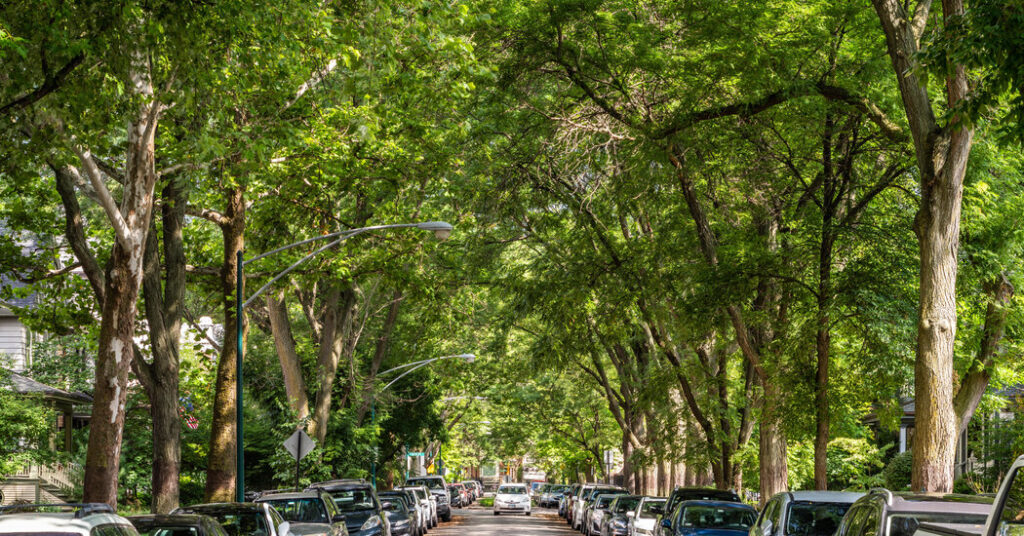
When it comes to urban trees, old is gold.
Many cities across the country, including New York, have been planting trees in neighborhoods where cooling shade has been sparse because of neglect in decades past. But a new study has found that simply adding trees is not enough: To get the most from tree cover, communities also have to preserve older ones.
“If we take care of trees, they take care of us, and might even help save our lives,” said Harrison C. Garcia, a student at the Northwestern University Feinberg School of Medicine and the lead author on the study. “They’re not just a luxury. They’re not just something to look at.”
For their research, published this month in the journal GeoHealth, Mr. Garcia and his co-authors used satellite maps from the U.S. Forest Service National Land Cover Database to track how tree canopies had changed in some of Chicago’s 77 neighborhoods between 2011 and 2021. Disparity in tree cover was wide. Some of those areas, like Forest Glen, have canopies of close to 50 percent. But some lower-income neighborhoods are practically barren of tree cover. Archer Heights, an immigrant enclave on the southwest side, stands at 8 percent tree coverage.
Instead of focusing on absolute numbers, the researchers matched changes in tree canopy over the years with mortality rates in those neighborhoods. They found that “each year-to-year percent increase in canopy was associated with around a 10 percent reduction in mortality” and that a .03 percent year-to-year increase in tree cover (roughly, 14,000 new trees) would theoretically result in 105 fewer deaths per year.
Decreases in deaths from chronic diseases — including respiratory and cardiovascular conditions, as well as from mental illness — partly drove that drop.
“The year-over-year piece is really, really fascinating,” said Michelle Stuhlmacher, an associate professor of geography at DePaul University in Chicago, who also studies the city’s tree canopy. “It shows longer-term investments or disinvestments.”
Dr. Stuhlmacher noted, though, that no study could fully account for the complex forces at work in a city as large and complex as Chicago. She was not involved in the GeoHealth study.
Studies have previously shown an association between tree cover and public health outcomes. The new study is novel because it tracks how the tree canopy expands or contracts in response to development, natural disasters and other forces, and how those changes in turn appear to correlate to communitywide health.
Mr. Garcia stressed that the study did not describe an explicitly causal relationship between tree canopy and mortality. Nor did it investigate the reasons behind canopy fluctuation.
In 2022, Lori E. Lightfoot, who was the Chicago mayor at the time, committed to planting 75,000 new trees across the city, with an eye toward less wealthy neighborhoods on the city’s South and West sides. Last year, the current mayor, Brandon Johnson, said that 68,000 trees had been planted.
But a sapling can take years to develop into a tree that becomes part of a canopy. And the sapling might not make it at all, especially under the increasing stress of climate change, which not only brings high temperatures but also more intense storms.
“Increased heat stress likely makes it harder for newly planted saplings to survive,” Mr. Garcia said.
That’s why it’s important to protect mature trees, in addition to planting new ones.
A study by Portland State University researchers published this year found that, of 33 American cities included in a survey, 73 percent were losing greenery. Crucially, that loss was concentrated in neighborhoods that were the hottest to begin with.
“We just keep seeing trees being lost in neighborhoods that are, in fact, the places that we need the trees the most,” said Vivek Shandas, a professor of climate change adaptation at Portland State and an author on the university’s study.
“The preservation side of the ledger really deserves more attention,” he said.
Mr. Garcia said that the work of maintaining a tree canopy, whether by planting new trees or preserving old ones, has to be ongoing in order to be successful. “Our models point in the direction that only continuous work to expand tree canopy could save lives,” he said. “If we choose to do nothing, while climate change worsens and canopy continues to decrease, the consequences could be much more dramatic than the gains we see.”
The biggest reservoirs in the U.S. are dangerously low
Water levels in Lake Powell and Lake Mead, the two largest reservoirs in the United States, have hit record lows this month, sending a system that provides water and electricity to millions into a state of crisis with no end in sight.
The shortage could have dire implications for growing Sun Belt cities like Phoenix, for key industries including agriculture and data centers, and for hydroelectric dams that power millions of homes across the Southwest.
The shrinking reservoirs are the result of low snowpack this winter, which was then erased by record heat in the spring. The combined reservoir system has not held so little water since 1957. — Scott Dance and Mira Rojanasakul
Here’s what to know, in text, maps and graphics.
More news from around the web
-
A $600 billion tranche of Biden-era clean energy funding has escaped President Trump’s cuts, according to Politico.
-
Prime Minister Mark Carney of Canada announced a multibillion dollar investment in wind and hydro power, Inside Climate News reports.
-
England’s ancient oak trees are dying in extreme hot and dry weather, according to The Guardian.
Read past editions of the newsletter here.
If you’re enjoying what you’re reading, please consider recommending it to others. They can sign up here.
Follow The New York Times on Instagram, Threads, Facebook and TikTok at @nytimes.
Reach us at [email protected]. We read every message, and reply to many!
The post Climate: Saving Old Trees Might Save Lives appeared first on New York Times.