After two and a half months abroad, President Paul Biya returned to Cameroon on Thursday, according to state media, as questions mounted about his health and succession plans.
Since assuming office in 1982, Mr. Biya has become known for frequent stays overseas, where he has amassed hotel bills that by some estimates have reached into the millions of dollars.
The Cameroonian authorities banned public discussions of the strongman ruler’s health in 2024 as speculation surrounding his absences grew. During his latest stint overseas in Switzerland, the president issued official statements but did not appear on camera or clarify the purpose of what his office called “a brief private stay.”
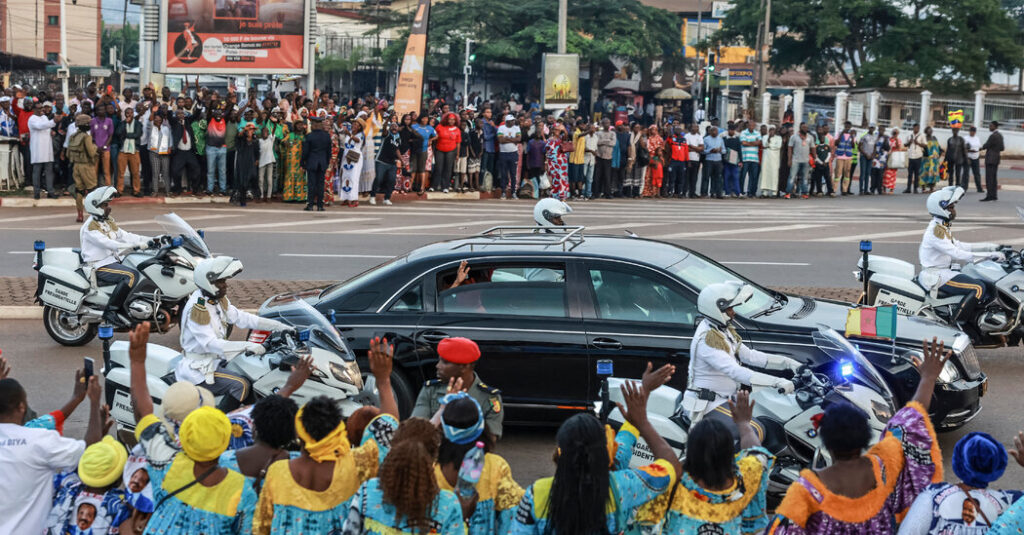
On Thursday afternoon, Mr. Biya’s plane landed in Yaoundé, the capital, the state broadcaster Cameroon Radio Television reported. Brief footage, which could not be independently verified, showed Mr. Biya shaking hands with officials before stepping into a car.
The state broadcaster televised large crowds of people singing and dancing outside of the airport, many of them wearing clothes printed with the faces of Mr. Biya and his wife, Chantal, who is also an influential public figure.
While Mr. Biya was away, Cameroon continued to grapple with armed conflict and political uncertainty. A militant secessionist movement in the English-speaking regions of the country is in its tenth year. Threats also loomed in the far north, where extremists affiliated with the Islamic State attacked villages earlier this year, seeking to expand their influence.
And more recently, a deadly landslide on Tuesday at a mine in the neighboring Central African Republic killed 100 people, including several Cameroonian miners.
Some Cameroonian analysts and journalists have said that the president’s most recent trip was among his longest and most troubling. This latest stint “weakened the perception of him as a genuine leader attached to his people and his country,” said Christopher Fomunyoh, the regional director for Central and West Africa Programs at the National Democratic Institute for International Affairs, a nonprofit organization in Washington.
Rumors have swirled in Yaoundé about succession battles behind the scenes among the president’s family and close advisers, analysts said. Contenders vying to assume control may include the president’s son Franck Biya and stepson Franck Hertz, the son of Chantal Biya, the influential first lady, said Manu Lekunze, a lecturer in international relations at the University of Aberdeen in Scotland. Tensions between factions within Mr. Biya’s political party are also likely to come to the fore once Mr. Biya’s reign ends, Mr. Fomunyoh said.
In April, Cameroon’s Parliament approved a constitutional amendment re-establishing the role of vice president, whose occupant would take power in the event of the president’s death, resignation or inability to hold office. But Mr. Biya has refused to anoint a potential rival by naming someone for the position, some experts said.
“The reason why he hasn’t appointed vice president is because he knows that if he sets out a clear pathway to succession, then it makes it much easier for people to kick him aside,” Mr. Lekunze said.
Mr. Biya extended his rule in a disputed presidential election in 2025. The government responded to opposition protests with mass arrests and lethal force, according to Human Rights Watch.
Mr. Biya is one of many aging, long-ruling leaders in Africa. Excluding monarchs, four of the five longest-serving current heads of state are in Africa. Mr. Biya is the oldest sitting president and has the second longest tenure, outranked only by President Teodoro Obiang Nguema Mbasogo of Equatorial Guinea.
The post Cameroon’s Aging President Returns From Months-Long Stay Abroad appeared first on New York Times.