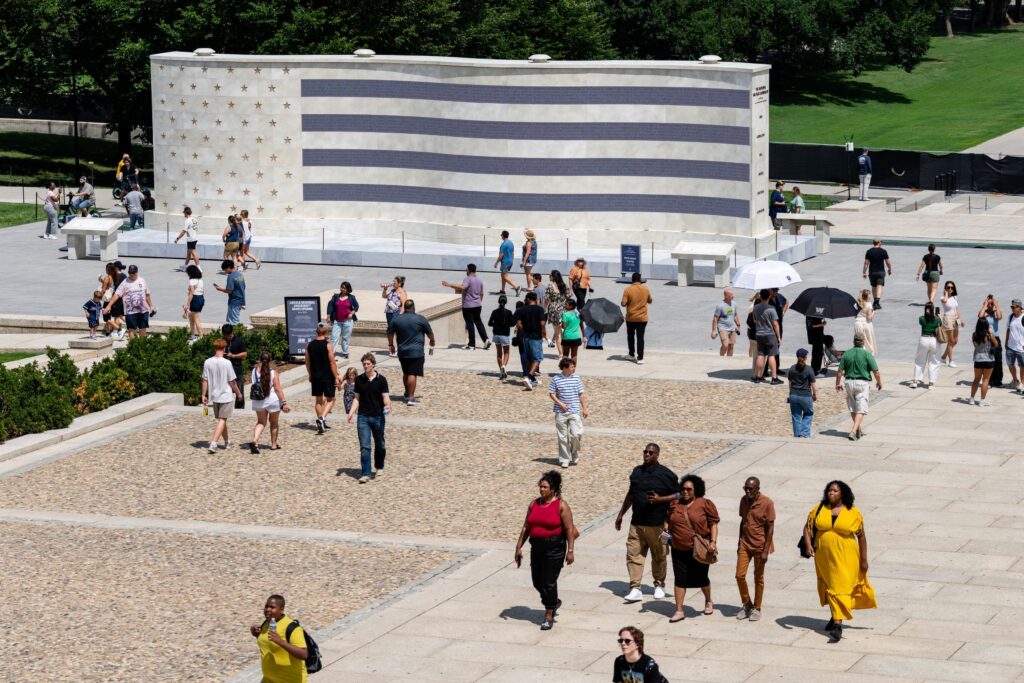
Canden Arciniega shuffled on the hot granite terrace on a mid-August morning, counting the names on her list. More than a hundred to go.
She crept along with the rest of a lengthening line of visitors toward her destination: the newly installed National Military Monument. Situated on the plaza between the Lincoln Memorial and the Reflecting Pool, the pop-up monument is a temporary tribute honoring the names of almost every person who has served in the military since the nation’s inception.
The monument comprises two 62-foot-wide undulating structures made to look like American flags blowing in the wind. On the stripes of the flags, an electronic display flashes a total of 6,000 names at a time, rotating roughly every minute.
There are about 41 million names.
While Arciniega stood waiting her turn at the monument, she looked out at other visitors who were here to see the names of their family members — Purple Heart recipients, Battle of the Bulge veterans, peacetime soldiers — light a large screen above some of the country’s most iconic landmarks.
One family took a day trip from Delaware. Another came from South Carolina. A woman drove from New Jersey.
Arciniega, 42, had a slightly different reason for being here.
The monument, which quietly opened in late July and is sponsored by USAA, the financial services company, was immediately popular in veteran circles. There is no single list of every person who has ever served, so USAA compiled names from multiple historical sources and public records. (Those currently serving are not shown without consent, according to USAA.)
The monument also allows visitors to use a code on their phones to request that the name or names of individual veterans be temporarily displayed in a prominent location on the flags.
After nearly an hour, Arciniega reached the front of the line. She conferred with a USAA crew member. Then a stranger’s name appeared in bold letters for all the Mall to see.
She took a photo and got back into the line.
Arciniega, the owner of DC by Foot, has spent much of her life introducing the National Mall’s memorials to visitors. She’s used to telling the stories of veterans who were killed or missing in action — those whose names appear on the Vietnam Veterans Memorial.
“You had to have given the ultimate sacrifice to have your name on that wall,” she said.
But the National Military Monument recognizes everyone. “For this one, I’m like, ‘This person came home, this person is standing next to me.’”
Arciniega’s company runs a popular Facebook page for D.C. travelers. When the monument opened, someone posted to the page asking if anyone could take a photo of their loved ones’ name. Arciniega was touched and agreed. More than 400 requests soon followed.
Now, Arciniega has about half a dozen tour guides — who spend much of their time on the Mall anyway — taking photos for people who can’t make it to D.C. to honor their families, their friends or themselves. They’re doing it for free.
“Since it’s not a hard stretch for us to do it, I thought we should offer,” she said. “And it’s taking on a life of its own.”
Kimberly McGraw, a single mom and disabled veteran who lives in a suburb outside of Chicago, was among the Facebook group’s 400 requests. When Arciniega sent her a photo of her own name displayed on the monument, she burst into tears.
“I’m sitting in my living room miles away, but it makes you feel seen and felt, like an embrace coming across state lines,” she said. “I am home in Chicago, and my service and my story still reached all the way to D.C.”
McGraw, 43, signed up for the Navy just after the attacks on Sept. 11, 2001. She served for two and half years before equipment failed in a training, she said, causing her to breathe in chemicals that gave her seizures.
“The monument notices us,” she said. “We’re still here, we’re still breathing, we’re fighting, and we’re raising the next generation.”
Andrew Johnson’s grandfather, Lewis, served in the late 1950s and early 1960s as a radio operator on the transport ship USS Boxer. Lewis was diagnosed with cancer this March; he died in April. When Andrew, who lives in Southwest Virginia, heard about the monument on the Mall, he knew which name he wanted to see displayed — a name that would help bring him and his family closure, he said. Arciniega sent him a photo last week.
“There’s rarely a thing that moves me to tears,” he said. “I know it would have meant the world to him, and it meant the world to me to see his name up there like that recognized. And I’m sure probably thousands of people saw it.”
Before her husband’s name was displayed on the monument, USAA asked Victoria High for consent — her husband, Army Sgt. Austin J. High, died by suicide in 2024 while serving at Fort Carson in Colorado. She agreed, but given the long drive from Georgia (where she relocated) and the three young kids she now parents alone, she was unable to make the trip to see the monument for herself.
So she contacted Arciniega’s group. “My husband recently took his life, and I have nothing of him anymore but a flag and photo,” she told them, requesting an image.
“I hope this offers you some solace,” Arciniega responded, photo attached.
High received the message while she was driving. She had to pull over, she said.
“To see that, and to see everyone worldwide would be able to see my husband’s name, I cried,” she said. “I was honored, proud. But sad at the same time.”
In a time of deep rancor over the direction of the country, Arciniega views her work as apolitical.
“There’s so much division and anger, and everyone arguing and hating each other,” she said. “I’m like, ‘I don’t know where you stand on things. I can do this for you. Thank you for your service.’”
On weekends, the wait for photos at the monument can reach four hours. In the blinding sun glinting off the Mall’s light granite in the summer swelter, that time can be grueling. Arciniega or one of her company’s tour guides visits about twice per day to check names off their list, usually one or two at a time. She makes trips between meetings and parenting her two young children.
Most days in her household start with something she tells her kids, a sort of family motto: “Let’s go put some good into this world.”
And now, her work can continue for longer than expected — USAA said Tuesday that the monument’s run in D.C. is extended through Nov. 12.
On a recent visit, Arciniega neared the front of the line yet again and pulled out her phone. This time was different. She gave the operator her names and then looked up as her own family members’ names filled the screens.
JAMES SCHWANTES.
Her uncle who served as a Marine in Vietnam.
BETTE MCCARTY.
Her grandmother who joined SPARS, the women’s branch of the Coast Guard, during World War II.
“‘Bette’ was a nickname, but she’d be okay with it,” Arciniega said, voice shaking. She filled her cheeks with air and let out a little puff.
Then she got back in line.
The post At new military monument, volunteers help faraway families connect appeared first on Washington Post.