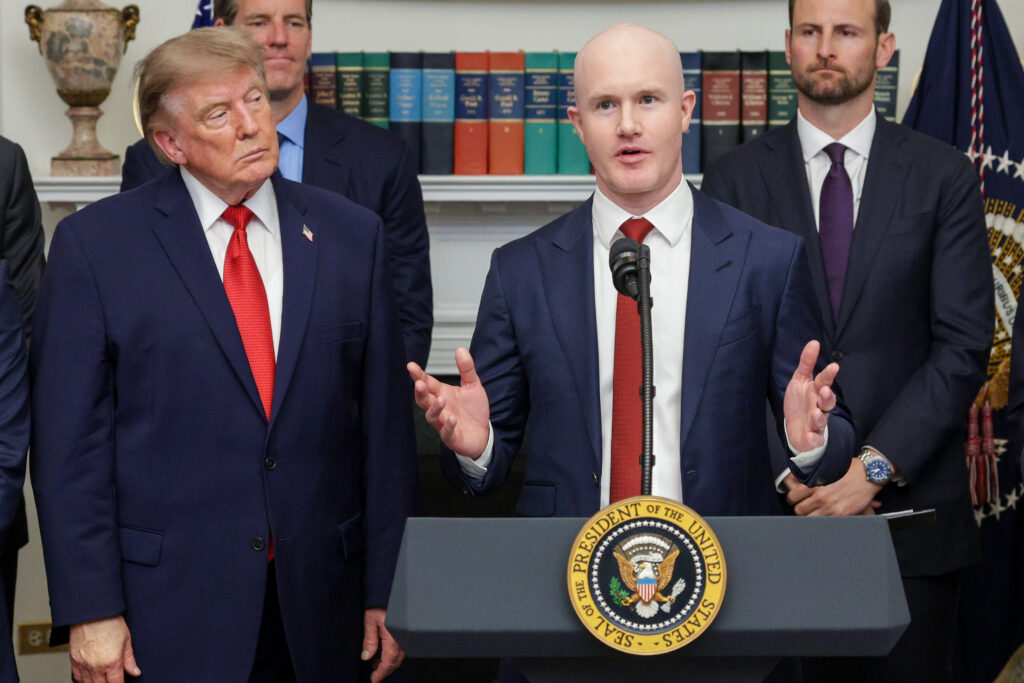
Surrounded by executives from Coinbase, Ripple and other leading cryptocurrency companies, President Donald Trump on Wednesday called for Congress to pass legislation that could lend greater legitimacy to the fast-growing industry — which includes the Trump family business.
The gathering in the Roosevelt Room at the White House highlighted the political clout that the crypto industry has amassed in just a few years by spending hundreds of millions of dollars to elect political allies, including Trump.
Trump stands to personally benefit from the industry’s current top legislative priority, which could usher in more mainstream adoption of digital assets. In 2025, he took in more than $1.4 billion from cryptocurrency, digital tokens and other related partnerships.
The White House event celebrated the steps that the administration has taken to unwind Biden-era limits on the crypto industry. Those limits were spurred by the 2022 collapse of the FTX cryptocurrency exchange, which harmed millions of investors. Trump and the executives said their next goal is to pass the Clarity Act, which would establish a federal rule book for digital assets. Industry officials say they have been held back by uncertainty over regulation.
“It’s very, very powerful structured legislation which will keep us ahead of China, keep us ahead of everyone else and will open the door to the next wave of innovations and innovators,” Trump said.
The president’s endorsement presents a quandary for the industry, as many Democrats say they will support the legislation only if it has strict guardrails to prevent Trump from further profiting from cryptocurrency while in office. The use of the White House to promote legislation that stands to help the Trump family’s businesses could further exacerbate those concerns, especially as Democrats campaign on allegations that Trump has leveraged his office for financial gain.
As a real estate developer and entertainer, Trump faced unprecedented conflicts of interest during his first term. But his family’s expansion into the crypto industry before and during his second term has exacerbated ethical concerns.
The Trump family started a crypto firm, World Liberty Financial, just months before Trump won reelection in 2024. Trump and first lady Melania Trump also launched their own meme coins around his inauguration; they have declined in price more than 90 percent since January 2025, according to Coinbase.
The White House event is the latest salvo in the industry’s years-long efforts to lobby Congress to pass legislation that would define which federal agencies are responsible for regulating digital assets. Executives like Coinbase CEO Brian Armstrong have made high-profile visits to Capitol Hill, industry advocacy groups have launched ad campaigns to bolster the legislation, and the industry’s super PACs have spent millions to unseat vulnerable members of Congress who oppose the Clarity Act.
The Clarity Act “would make all of the progress that this administration has made durable into the future, so it could survive for decades and decades to come,” Armstrong said.
Republicans had hoped to hold a vote on the Clarity Act before Congress left this month for its five-week recess, but Senate leaders punted the vote until September amid opposition to some of the bill’s provisions.
The Clarity Act would split authority for regulating crypto tokens between the Securities and Exchange Commission and the Commodity Futures Trading Commission. It would also set anti-money-laundering laws for crypto platforms, treating them like traditional banks.
The bill would set ethics rules that ban senior federal officials, including the president, vice president, members of Congress and their spouses, from creating or sponsoring digital assets while in office. The attorney general would have sole authority over enforcing these ethics rules.
Democrats have balked at handing that authority to the Justice Department, arguing that the attorney general, who is appointed by the president, could refuse to investigate the president and his allies. Some Democrats have expressed specific concerns about Trump, arguing that he could sidestep the ethics provisions as written by allowing his children to take control of his crypto-related business.
“We wanted to make sure that the enforcement portion of the bill would not just be enforced by DOJ, but it has to be the state attorneys general” as well, said Sen. Angela Alsobrooks (D-Maryland), who was involved in working with Republicans to come to a compromise on the overall Clarity Act.
Sens. Thom Tillis (R-North Carolina) and Ruben Gallego (D-Arizona) drafted a counterproposal to address the ethics concerns and sent it to the White House. Tillis said the proposal would incorporate state attorneys general in the enforcement process.
Tillis told reporters before the August recess that he had not received a formal response from the White House and that if the changes were not adopted, he had committed to Democrats that he would vote against the bill.
The post Trump joins leaders of crypto companies in push for industry-backed bill appeared first on Washington Post.