Mark Robichaux, a former reporter for the Wall Street Journal, is a fisherman and author.
Something is going wrong along the U.S. Atlantic coast, and it is visible from the air, from the water and at the docks. In the Chesapeake Bay, osprey chicks are dying in their nests at rates not seen since the DDT era. Scientists say a key reason for their deaths could be that there are not enough fish for the birds to eat. In Maine, lobstermen have seen their bait supply tighten, leaving them to fill traps with pig hides and frozen fish, whatever will hold on a hook. And all along the Eastern Seaboard, as striped bass fishermen head out in the middle of the season, charter captains are finding what their customers already notice: fewer baitfish.
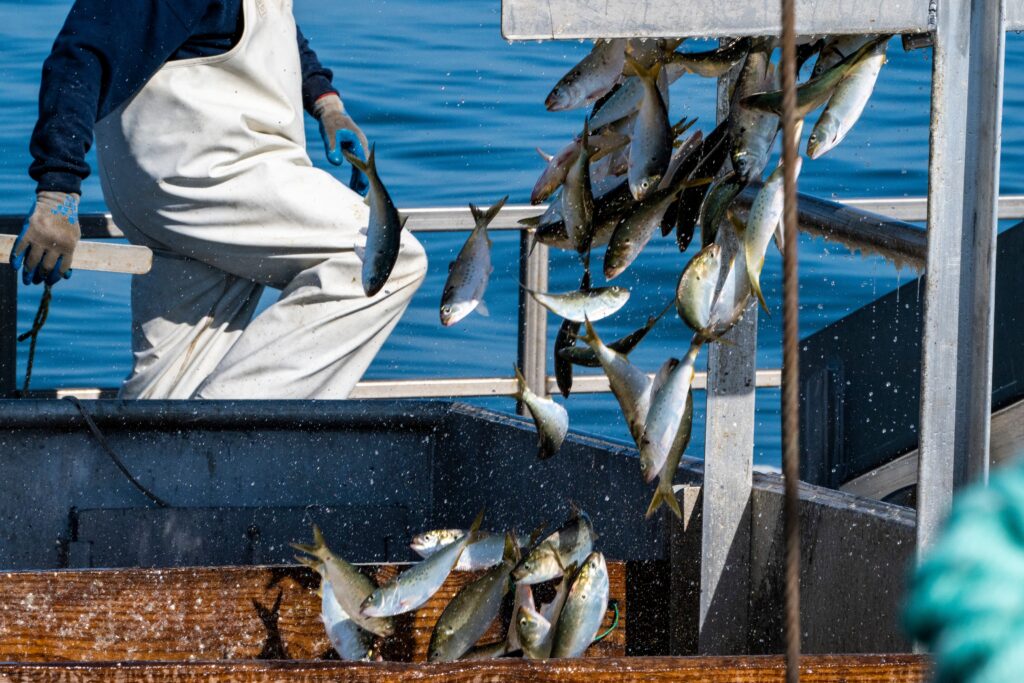
The thread that appears to connect all of it is a small, oily, unglamorous fish that most Americans have never heard of. Atlantic menhaden — called bunker in New York and pogies in New England — are the engine of the East Coast food web. Stripers, bluefish, bluefin tuna, humpback whales and osprey eat them. They underpin billions of dollars in fishing economies from the Carolinas to Canada. When menhaden disappear from an area, everything above them in the food chain feels it.
Most are never eaten by people — they’re “reduced” into fish oil and meal for feed and supplements.
The warnings were accumulating last fall. Since then, they have become harder to ignore — and the system built to respond to them has only grown more paralyzed after a decade of half measures and regulatory delays. The result is a fishery with no one meaningfully at the wheel.
Atlantic menhaden are managed by the Atlantic States Marine Fisheries Commission, a 15-state body that functions less like a regulator and more like a negotiating table. In October, the commission’s own ecological models — which account for menhaden’s role as food for predators such as striped bass, not menhaden in isolation — found that a cut of more than 50 percent in the catch limit was needed to reliably hit an ecosystem-based fishing mortality threshold.
The board reduced the catch limit by 20 percent instead, enough to avoid “overfishing” under the current standard but short of the healthier benchmark scientists say menhaden’s predators need. The commission says it will revisit further cuts this fall.
Omega Protein, a U.S. subsidiary of Canada’s Cooke Inc., runs the last menhaden reduction plant on the Atlantic coast, in Reedville, Virginia. When Cooke bought Omega in 2017, the deal included Omega’s fishing fleet. The boats were spun off into a separate company, Ocean Harvesters, which is 80 percent owned by a nephew of Cooke chief executive Glenn Cooke, with Omega holding the rest. U.S. law requires American citizens to control 75 percent of any fleet fishing U.S. waters. A federal lawsuit claimed that the arrangement was a sham; courts dismissed it twice, most recently this month for failure to state a valid legal claim.
Ocean Harvesters’ fleet pulled nearly 300 million pounds of menhaden from the water in 2024 — roughly 70 percent of the entire coast-wide harvest. Within the Chesapeake Bay, it operates under a separate 51,000-metric-ton cap that the fisheries commission said the company exceeded in 2019, prompting a review by the U.S. Commerce Department. Omega said at the time that it would comply with the more permissive cap Virginia itself had set, arguing the commission’s cap was “arbitrarily low and unscientific.”
For four straight legislative sessions, Virginia lawmakers failed to pass menhaden research funding, including this year, when the General Assembly killed three reform bills meant to fund research, expand monitoring and make harvest data public. Gov. Abigail Spanberger (D) intervened through a budget amendment to provide $2 million for a Chesapeake Bay menhaden study.
In June, a peer-reviewed study in Frontiers in Marine Science found osprey chicks in the Chesapeake Bay starving at alarming rates. Researchers at William & Mary’s Center for Conservation Biology, the U.S. Geological Survey and the Virginia Aquarium tracked 571 osprey pairs across 12 study sites, finding an average reproductive rate of just 0.51 young per pair in high-salinity zones — compared with 1.36 in low-salinity zones, where menhaden aren’t the primary food source. In Mobjack Bay, one of the longest-tracked sites, births have dropped more than 80 percent since the mid-1980s.
The study wasn’t designed to pin down a single cause, but the authors “suggest that reduced availability of Atlantic menhaden … is a primary driver of poor reproductive performance within high-salinity waters.” The pattern is hard to read any other way: Chick survival collapses where menhaden are scarcest, in the same waters where the reduction fishery pulls hundreds of millions of pounds a year.
The study’s lead author has cautioned that his research doesn’t try to establish that menhaden harvesting caused the decline — a fair scientific distinction. Regulators should follow the science and take into account public comment. But regulators also don’t need proof of a single cause before acting to protect a public resource. When the best available evidence points this clearly in one direction, the burden shouldn’t fall on the public to establish certainty before the fishery is reined in.
In Louisiana, the stakes were found rotting on the beach. In September 2023, Omega and a different company spilled an estimated 850,000 fish in three incidents off the Louisiana coast. State-funded research has estimated that tens of thousands of redfish die in menhaden nets every year. Omega and the other company declared the spills “infrequent” and “an unfortunate reality,” and said they were moving to stronger nets. The industry has a name for those dead redfish: bycatch. Fishermen call it a massacre.
This spring, Louisiana lawmakers passed three modest oversight bills — requiring tracking on menhaden vessels, stiffer penalties for buffer zone violations and public disclosure of harvest data. But the one measure that would have constrained industrial seiners — limiting net depth to protect redfish and speckled trout killed as bycatch — was brought to the floor and defeated.
This is what rudderless fisheries management looks like. Not a single dramatic failure, but a series of ineffective measures and deferred decisions.
Conservationists, birders, lobstermen and sportfishermen keep asking: Does it make sense to pull hundreds of millions of pounds of a cornerstone baitfish a year, grind them into meal and oil, and ship some of them to Indonesia, Vietnam and elsewhere? Virginia is the only state left on the East Coast that allows this “reduction” seining of menhaden. Every other Atlantic state restricts menhaden fishing to bait only.
Fixing the problem doesn’t require new science. It requires the will to act on the science that already exists. Cut the coast-wide catch limit to match the ecological targets. On Aug. 5, the commission voted to open the Chesapeake Bay cap to public comment. Ocean Harvesters denies the fishery is hurting Bay menhaden and opposes cuts.
Lawmakers should follow through and pass Louisiana’s net-depth rule the next time it comes up.
Ecosystems don’t wait for institutional reform. They respond to pressure in real time — and by the time the collapse is visible in the models, it is usually already underway.
The warnings are no longer subtle. The only question left is whether the people who manage this fishery will act on them — or wait until there’s nothing left to manage.
The post The battle over a tiny fish that runs the East Coast food web appeared first on Washington Post.