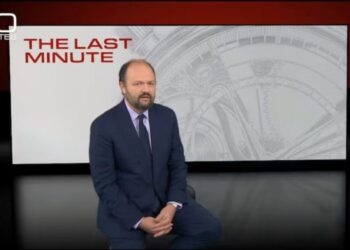
Gary Rosen is a senior fellow at the American Enterprise Institute and the author of “American Compact: James Madison and the Problem of Founding.”
The cover story in this month’s Atlantic by Tyler Austin Harper is the most devastating indictment of the ideological perversions of higher ed that I’ve read in a long time. Harper arrived at Bates College in Maine in 2020 as an idealistic new PhD in comparative literature, grateful for the tenure-track job that promised him that rarest of prizes these days — a career in the humanities.
But Harper is Black, and he quickly discovered that his race — and the views that were presumed to go with it — were far more important to his college and his colleagues than his actual scholarly interests. He resigned from his plum job last year. “I was angry about the culture at Bates,” he writes. “I was sick of being treated like a racial prop rather than a professor, which included being continually recruited to do Minority Work I found silly or degrading.”
Harper’s eloquent and very public exit will undoubtedly do some good, not least because he’s a self-described socialist whose testimony will be hard for complacent liberals to dismiss. His case may rally other scholars to speak up about the suffocating intellectual conformity of the DEI regime. But it may also encourage them simply to bail out. By quitting, he has become an outsider, depriving Bates of a dynamic figure who might have agitated for change.
Harper’s decision to escape is a perfectly understandable personal choice, but the reforms so urgently needed in higher ed will be the work of scholars and administrators ready to fight for their own institutions, even at some cost to their comfort and standing on campus.
The great model in this regard is my former teacher at Harvard University, the political theorist Harvey C. Mansfield, whose half-century of resisting progressive orthodoxy in Cambridge, has been a noble if thankless task. Scholars of a conservative bent have also taken the lead in launching the centers of civic thought that have sprung up in recent years at public universities in red states such as Texas, Florida and Ohio. As columnist George F. Will writes, these programs are based on the once uncontroversial notion that studying “the nation’s intellectual patrimony” is a worthwhile activity for young people emerging into citizenship.
Still, conservatives cannot fight these battles alone, not only because our numbers in the academy are so small (as surveys constantly remind us) but also because it risks insularity and ignores the substantial common ground we share with many on the campus center-left. Here it is worth singling out two recent critiques by academic insiders who, though appalled by the Trump administration’s crude assault on the universities, understand why trust in higher ed, especially at the elite level, has reached new lows.
The first is a report published in the spring by Yale University’s Committee on Trust in Higher Education. Its recommendations include, as a starting point, a revision and simplification of the university’s mission statement, stripped of the faddish social and political goals added in recent years. Yale’s mission, the committee writes, should be its traditional one: “to create, disseminate, and preserve knowledge through research and teaching.” The university, the committee urges, must also treat free speech as a “first principle” and work to “open minds” on campus to ideological and political perspectives largely unrepresented in the curriculum.
A second report, issued around the same time by a group of distinguished scholars convened by Vanderbilt and Washington universities, takes a clear-eyed view of the state of research in the humanities and social sciences. While noting “an abundance of serious scholarship” in every field it investigated, the commission highlighted the many ways in which disinterested inquiry has been undermined in the name of “social justice,” especially by efforts “to suppress scholarship that challenges a rigidly enforced orthodoxy.” As the report tartly observes, by analogy, about the most troubled fields: “If and when the department of astronomy morphs into the department of astrology, it will at some point make sense for the administration to object.”
Progress is also visible elsewhere. Andrew Delbanco, a scholar of American studies at Columbia University, is the president of the Teagle Foundation, which is helping universities reestablish courses focused on major philosophical and literary texts as a “gateway” experience for undergraduates. The pedagogical aim of this return to the liberal arts, he writes, is “taking hard questions seriously, thinking before speaking, honoring the right of others to speak and be heard.” He quips that the task ahead is to “Make the Classroom Great Again.”
That’s a motto to which I happily subscribe, as would many others in the saner precincts of the right and the left who want to revive and defend higher ed. I feel sure it’s how Tyler Austin Harper saw his own job during his lamentably short career at Bates.
The post I see why this Black professor quit. But here’s why I wish he hadn’t. appeared first on Washington Post.