Regarding the Aug. 17 news article “U.S. commander: Mental health is a priority”:
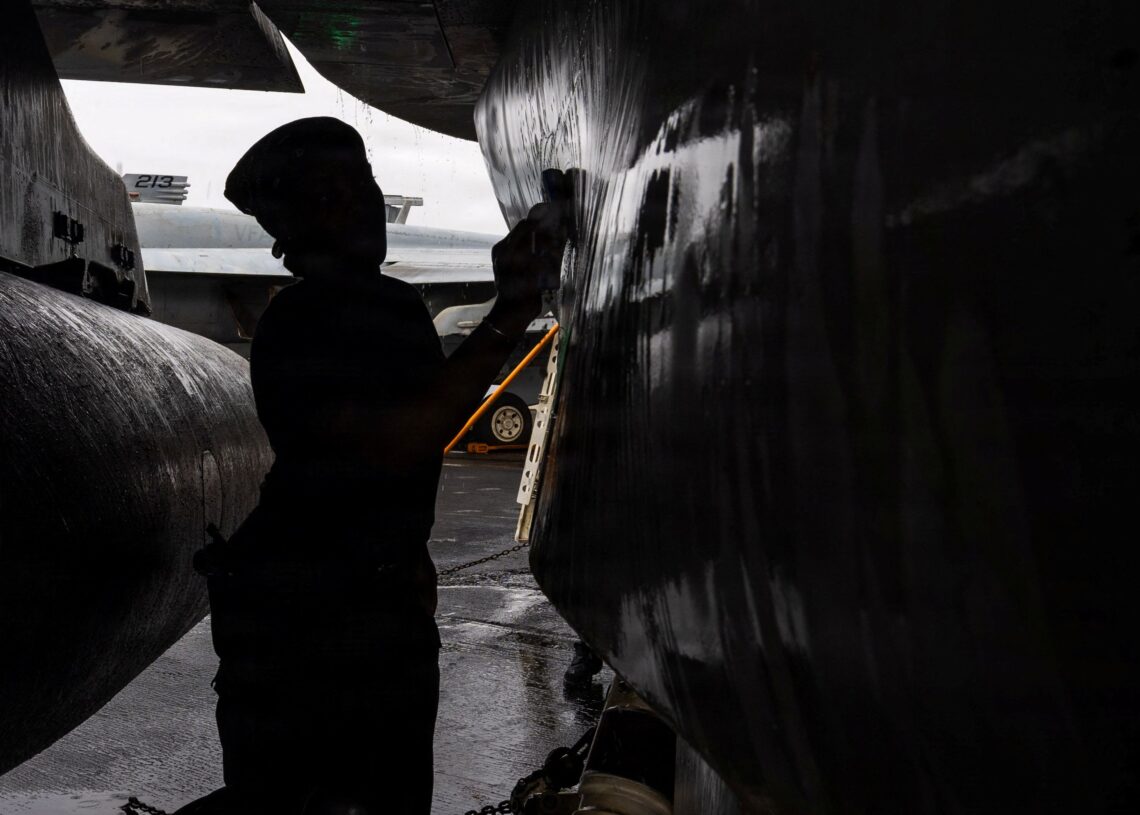
The men and women aboard the USS Abraham Lincoln haven’t set foot on land since November and are more than a month past their planned seven-month schedule. That is reportedly about to change soon as part of a planned rotation with the Pacific-based aircraft carrier USS George Washington.
I was a carrier sailor for two years and am familiar with the sacrifices of the honorable patriots at sea. There are few workplaces in the world more dangerous than a deployed aircraft carrier. I served during peacetime, but there were times when we came perilously close to the battle that we were all trained for.
I knew what I had signed up for, just as the crew of the Lincoln does today. In addition to the endless workdays, I always knew, in the back of my mind, that an enemy with an itchy trigger finger would love nothing better than to put us at the bottom of the ocean.
There are many obstacles to carrier life — separation from family, lack of privacy and sleep deprivation — although after a 16-hour workday, the sound of fighter jets taking off and landing above my sleeping area became a maritime lullaby.
Perhaps above all, the sailors and Marines selflessly putting their lives on the line for their country need support from their commander in chief. What they got instead from President Donald Trump was a message of indifference when he said that the sailors haven’t been out on patrol long enough.
Vin Morabito, Scranton, Pennsylvania
The Post reported in the Aug. 14 news article “Democrats demand answers amid reports of poor conditions on the USS Abraham Lincoln” that Sen. Richard Blumenthal (D-Connecticut) said conditions seem to be worsening onboard the USS Lincoln, as sailors’ families report alleged food shortages, broken toilets, moldy showers, water contamination and faulty mail systems that prevent care packages from arriving.
Yet, Defense Secretary Pete Hegseth dismissed the reports as “completely misrepresented.”
Instead of dismissing concerns, Hegseth should demand an independent investigation and let the facts speak for themselves.
Our sailors risk their lives for this country. They deserve decent living conditions and honest leadership, and above all, they deserve to be heard.
Tom Scorby, Saint Charles, Illinois
The nuclear order can still be rebuilt
It was with a glimmer of hope that we read that the world is sleepwalking into a new nuclear arms race in the Aug. 17 editorial “The old global nuclear order is dead. What comes next?” The wake-up call is welcome, but the editorial advocated only limited attempts to confront the increasing danger. Incremental arms-control measures, while useful, are not an adequate response to the escalating nuclear threat.
Another danger not mentioned in the editorial is the use of artificial intelligence in nuclear weapons systems, which increases the risk of miscalculation. Ironically, Americans’ safety depends on the quality of the AI systems used in the nuclear weapons systems of North Korea and other adversaries.
As the editorial noted, in the 1980s President Ronald Reagan and Soviet leader Mikhail Gorbachev came tantalizingly close to agreeing to eliminate all nuclear weapons. Their attempt was made possible by organized public opinion in favor of the abolition of all nuclear weapons. A mass movement is needed again. One hundred nations — a majority of the world’s countries — have now signed or joined the Treaty on the Prohibition of Nuclear Weapons, which is the only long-term solution to the nuclear dilemma.
In a world in which nuclear weapons were outlawed, the United States, with its excellent conventional forces and protection offered by two oceans, would have little to fear. The first step toward safety, as advocated by the editorial, is for the public to awaken from its slumber and find its voice.
James Muller, Auburndale, Massachusetts
Henry David Abraham, Sarasota, Florida
The writers were, respectively, co-founder and co-author of the Constitution of International Physicians for the Prevention of Nuclear War, winner of the 1985 Nobel Peace Prize.
I spent 30 years working on nuclear proliferation for the U.S. government. The Aug. 17 editorial made a number of valid points about nuclear weapons and the importance of preventing their spread and use. For example, it rightly pointed out the need to refresh the mechanisms of strategic dialogue and arms control among the nuclear powers, many of which have lapsed or become obsolete, and to focus on actions to reduce the risk of nuclear war and escalation.
But the old global nuclear order is not dead. Bilateral nuclear arms control has lapsed, but the multilateral nonproliferation system remains in place. Support for the Non-Proliferation Treaty, which prohibits most countries from acquiring nuclear weapons, and for the International Atomic Energy Agency, which verifies that prohibition, remains broad and deep.
The lesson from the wars in Ukraine and Iran is not that both countries should have nuclear weapons. The lesson is that the wars exposed the inability of nuclear powers to impose their will through nuclear coercion.
Nuclear weapons are still needed to deter nuclear attack by others, but the United States will be better able to navigate these dangers if we treat deterrence as a necessary evil and not a security panacea.
Mark Goodman, Bethesda
Letter submissions
Send letters to [email protected].
Submissions must be exclusive to The Post and should include the writer’s address and day and evening telephone numbers. Letters are subject to editing and abridgment. Please do not send letters as attachments. Because of the volume of material we receive, we are unable to acknowledge submissions; writers whose letters are under consideration for publication will be contacted.
The post I know what U.S. Navy sailors sacrifice. Trump’s indifference stings. appeared first on Washington Post.