President Donald Trump’s Administrations have overseen the construction of hundreds of miles of barriers along the U.S.-Mexico border in the more than a decade since he first pledged to build a wall spanning the boundary, with hundreds more currently in progress. But one small portion of that planned wall—stretching merely 17 miles—has become the center of a hard-fought battle.
That section of the project, which extends across challenging terrain in Texas’ Big Bend National Park that has historically seen relatively few attempted border crossings, has faced pushback from everyone from public lands advocates to congressional lawmakers to local residents.
Read More: What’s the Status of Trump’s Border Wall? A Key Campaign Promise, Over a Decade On
The Trump Administration has been pushing the construction of the border wall in Big Bend despite the public outcry, going so far as to bypass a score of environmental laws to expedite the project.
But on Monday, after months of opposition, Customs and Border Patrol (CBP) Commissioner Rodney Scott announced that CBP had paused “all construction” in the park while he visited the site to conduct a “personal, on-the-ground evaluation.” In post on X, Scott wrote that he would be working to “evaluate the terrain and listen to local leadership, community members and stakeholders” over the next “couple of days.”
Texas Gov. Gregg Abbott also said on Monday that he had spoken with Department of Homeland Security (DHS) Secretary Markwayne Mullin, who Abbott said had “committed” to not building “a wall or a fence” in Big Bend. Abbott said there were “other tools” to ensure border security.
Here’s what to know about the Trump Administration’s efforts to build the border wall in Big Bend, and the opposition the project is confronting.
What the Trump Administration is seeking to build in Big Bend
Big Bend National Park sits in a remote southwest corner of Texas along the U.S.-Mexico border in Brewster County. The Administration has sought to build 17 miles of barriers across that section of the border as part of the larger border wall project.
Perhaps the most recognizable image of Trump’s wall is the “primary wall,” a structure built from tall steel bollards up to 30 feet tall that makes up the first line of the barrier system that would be encountered by those travelling north from Mexico. The section of the project planned to run through Big Bend, however, would look notably different, according to Scott.
“CBP is building one new access road, improving existing roads, installing detection technology, and placing vehicle barriers in limited, strategic locations,” he said. “We are NOT building a 30-foot wall or stadium lighting through Big Bend National Park, Big Bend Ranch State Park, or the Black Gap Wildlife Management Area.”
The portion of the wall in the park would be made up of a non-contiguous “vehicle barrier system,” according to the CBP, which consists of “steel posts supported by continuous steel rails,” power cables, cameras, roads for patrol cars, and shelters along the border.
According to the agency’s Smart Wall tracker, an interactive and frequently updated map that shows the status of the border wall, CBP has several construction projects interspersed along the border labeled as a “vehicle barriers … technology & patrol road.” A couple of these are located at the southern tip of the park; one sits far west near Presidio County, while others are located at the eastern edge of the park. These sites are in the Chihuahuan Desert, which presents a difficult landscape to navigate filled with steep canyons and mountainous terrain.
A controversial push to speed construction
In June, the Trump Administration waived more than 20 environmental and preservation laws intended to protect Big Bend’s landscape in order to accelerate the construction of the border wall in the park.
To do so, the Administration invoked a section of the Illegal Immigration Reform and Immigrant Responsibility Act of 1996, which allows the government to bypass laws that obstruct the building of border wall.
DHS defended the move at the time by describing Big Bend as an “area of high illegal entry” and saying that “there is presently an acute and immediate need” to build more barriers.
Migrant encounters are relatively rare at the section of the border that runs through the park, however—and have become more so in recent years. The park includes roughly 118 miles of what’s known as the Big Bend Sector of the border, which spans 517 miles from Sierra Blanca, Texas, to Sanderson, Texas, and covers roughly one-quarter of the full length of the U.S.-Mexico boundary. CBP recorded a 74% decrease in border crossings through its Big Bend Sector between fiscal years 2023 and 2025, with apprehensions dropping from 11,823 to 3,096. There were a total of 237,538 migrant encounters along the U.S.-Mexico border in FY 2025, meaning that the 3,096 apprehensions in that sector accounted for just 1.3% of the total number. And CBP’s planned border wall in the park would only cover a fraction of a fraction of the full sector.
The Administration’s move to bypass the environmental laws triggered immediate opposition. Bob Krumenaker, the park’s most recent former superintendent, called the news “devastating” to Marfa Public Radio and referred to it as “giving CBP unfettered authority to do anything they want within the national park.” Legal challenges also followed in the form of multiple federal lawsuits, while members of Congress made efforts to block DHS’s funding for projects in Big Bend.
Why the project has faced opposition, and from who
Grassroots organizations, conservation groups, businesses, local communities, and lawmakers have also made efforts to fight against the construction of the border wall in Big Bend.
Much of the opposition stems from concern over the park’s natural landscape, which is home to an array of wildlife and is effectively undeveloped. Other groups oppose the construction because they view the park as a cultural and heritage site, while still others have voiced concerns for the impact the planned barrier construction could have on the tourism economy there.
A series of lawsuits have been filed in an effort to block DHS’s plans to construct the border wall in Big Bend.
One lawsuit from the Center for Biological Diversity challenged DHS’s waiving of laws to carry out construction in the park. “Until now no administration has been heartless enough to waive laws in a national park like Big Bend, so we’re suing to uphold the U.S. Constitution and protect this crown jewel,” Laiken Jordahl, national public lands advocate at the Center for Biological Diversity, said in a statement according to a news release.
The Center for Biological Diversity had previously filed a lawsuit that argued the construction would “devastate the region’s wildlife, recreation economy, and natural and cultural heritage.”
Another lawsuit, filed by The People of La Junta for Preservation and Far
Flung Outdoor Center, a tribal nonprofit and an outdoor recreation company, argued that the construction will cause damage to archaeological sites associated with indigenous peoples and could threaten protected religious freedoms.
Groups have also mounted protests and sent letters to lawmakers to call for the planned construction to be halted.
In March, the grassroots organization No Big Bend Wall sent a letter to several leaders on congressional committees on behalf of 132 organizations asking that the use of any federal funding for the border wall in Big Bend be prohibited.
All the Democratic members of the Texas delegation in Congress sent a letter to Mullin later that same month voicing “staunch opposition” to the wall.
“This proposal threatens preservation of one of America’s crown jewels, Texas’ largest state park, and the state’s only congressionally-designated Wild & Scenic River,” the lawmakers wrote. “Construction and maintenance of a border wall segment and the associated roads, secondary barriers, power lines, towers, and lighting will disrupt natural biodiversity, river dynamics subject to routine flash flooding, and one of the darkest night sky areas in the world.”
Over the following two months, more than 2,000 people rallied at the Texas Capitol building in Austin, and seven former superintendents of Big Bend National Park urged Mullin not to waive federal laws to build the border wall in the park.
In early August, video showed heavy machinery bulldozing the land at Big Bend. A bipartisan group of Texas House lawmakers soon after sent a letter to Gov. Greg Abbott on Thursday in which they urged him to halt the Big Bend construction, citing “damage to one of Texas’ most pristine and irreplaceable landscapes” that they said had already begun with the movement of bulldozers and construction equipment into the park.
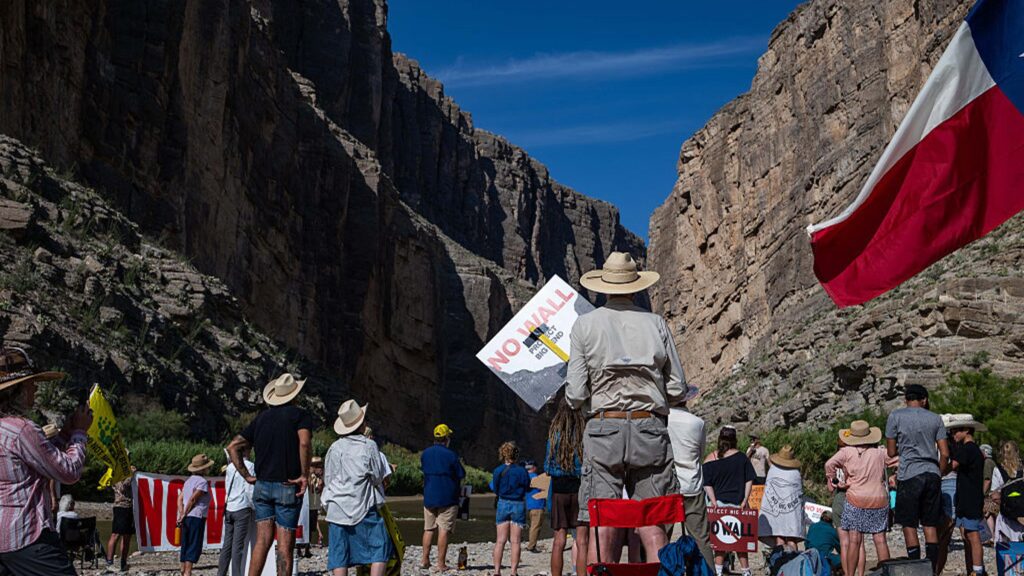
Last Wednesday, a large crowd of protesters gathered in the park chanting “No road. No wall. No wire. No way,” as they held hands in a circle. They also held a large banner that read “NO WALL,” along with a series of other wildlife-themed flags and signs.
More than 140 local businesses, recreation groups, and outfitters who rely on the tourism economy in the park also penned a letter on Aug. 4 to Cornyn, Cruz, and Abott asking them to halt the border construction to preserve the vibrant tourism economy that lives within the park.
Scott released a statement last week in response to the public reaction specifying that “what people are seeing right now is survey and design work—NOT construction of a wall through the park.”
Following Scott’s later announcement that CBP would be pausing construction on the wall in Big Bend, the National Parks Conservation Association (NPCA), which has pushed back against the Big Bend construction, lamented the damage that it said the project has already done to the park’s lands.
“The people have spoken, and they do not want the Trump administration to bulldoze America’s national parks for border infrastructure,” said NPCA President and CEO Tiernan Sittenfeld in a statement. “Unfortunately, the federal contractors’ bulldozers have already inflicted tremendous damage to one of America’s most iconic national parks. Their heavy equipment has torn through miles of priceless wild landscape, wreaking havoc on sensitive wildlife and irreplaceable habitat.”
The post How One Small Section of Trump’s Planned Border Wall Became the Center of a Big Battle appeared first on TIME.