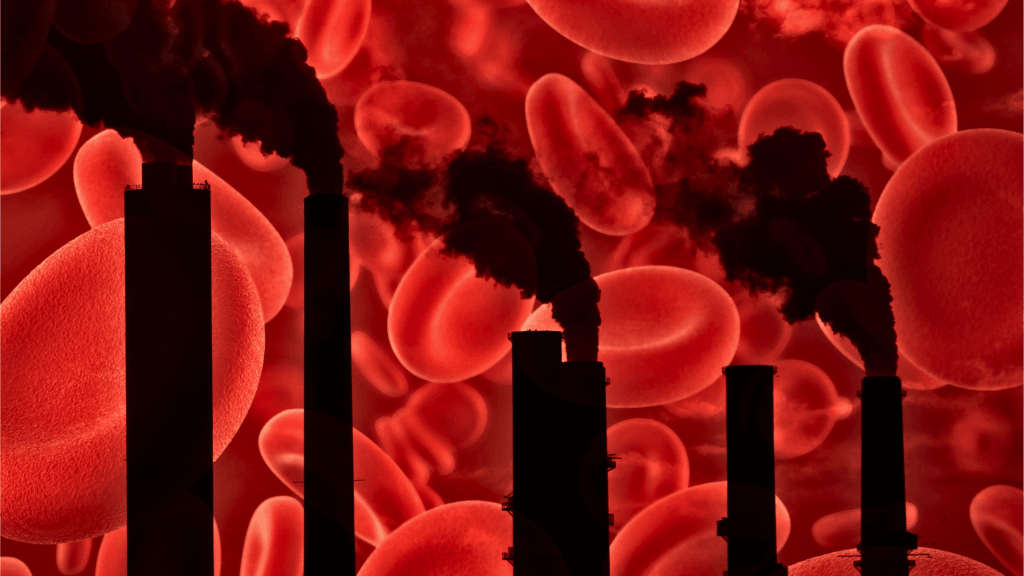
Rising carbon dioxide levels in the atmosphere do a lot of damage—heat waves, droughts, wildfires, superstorms. Now it appears there’s another knock-on effect that had never before been measured. According to a new study in the journal Air Quality, Atmosphere and Health, the changing chemistry of the atmosphere could be leading to changing chemistry in our blood—with potentially dangerous effects.
If CO2 is indeed messing with our blood, it’s no wonder. During the early rise of Homo sapiens, carbon dioxide levels in the atmosphere measured a consistent 280 parts per million (ppm). Those conditions prevailed until roughly the middle of the 18th century when the Industrial Revolution began pouring greenhouse gasses into the air from factory smokestacks. By 1900, CO2 levels had risen to nearly 300 ppm; by 1980, that figure had jumped to nearly 330 ppm. Since then the numbers have exploded, standing at 425 ppm today.
That’s very bad news for the healthof the planet—and equally bad for the health of our bodies. Every breath we take—indoors or out—draws in more carbon dioxide than our bodies were originally adapted to cope with. To determine just what the impact of this is, environmental geoscientist Phil Bierwirth, of Australian National University in Canberra, and environmental health scientist Alexander Larcombe, of the University of Western Australia, took advantage of a 21-year survey—from 1999 to 2020—conducted by the U.S. National Health and Nutrition Examination Survey (NHANES), during which government investigators sampled the blood of 7,000 subjects every other year to see how the body responded to all manner of environmental pollutants.
The period the NHANES researchers surveyed was a particularly bad one for the planet when it comes to carbon dioxide emissions, since in just those 21 years, U.S. CO2 levels rose from 369 ppm to 420 ppm. In their work, Bierwirth and Larcombe were looking for rising levels of serum bicarbonate, a chemical marker associated with rising levels of CO2—and they found just that, with a 7% jump in bicarbonate over the 21 years.
Much in the way oceans can become more acidic as they absorb more carbon dioxide, the same can be said for blood. “Bicarbonate,” said Larcombe in an email to TIME, “is the body’s main chemical ‘shock absorber’ for keeping blood from becoming too acidic, and a rising level is an indicator of the body compensating for more CO2.”
But bicarbonate can do only so much, and even over relatively small stretches, higher levels of CO2 in the blood can take a toll. “From short-term studies at moderately elevated CO2 (the sort of levels common in poorly ventilated rooms),” wrote Larcombe, “that means headache, tiredness, and declines in concentration and decision-making. Over longer periods, animal studies raise the possibility of oxidative stress, inflammation, tissue calcification in the kidneys and arteries, and effects on bone.”
At the same time bicarbonate levels have been rising in the blood, calcium and phosphorus levels have been falling, the study found. In addition to producing higher levels of bicarbonate, the body responds to rising carbon dioxide by drawing CO2 molecules out of the blood and storing them in bones in the form of carbonate—an ion composed of one carbon atom and three oxygen atoms. Phosphorus and calcium, which assist in this process, are drawn from blood into bone as well.
“Falling calcium and phosphorus in blood is what you’d broadly expect if that [CO2] storage process were being asked to do more work,” says Larcombe. Here too, bodily functions may suffer. “Low calcium (hypocalcaemia) produces muscle cramps, lethargy, numbness and tingling in the fingers, and disturbances of heart rhythm. Low phosphorus (hypophosphataemia) can lead to weakness, fatigue and impaired oxygen delivery.” The good news is, we’re not there yet, with Lacrombe stressing that such symptoms would occur only at “much higher CO2 concentrations than today’s atmosphere.”
What’s more, at moment, our bodies are are doing a good job of adjusting to the level of CO2 that does exist in the armosphere—even if just barely—since most people are not experiencing the warning symptoms Larcombe describes. But the famed CO2 hockey stick—the y-axis graph that shows greenhouse gasses and global temperatures steadily rising—is pushing us ever further into the danger zone.
As with so much concerning the environment, it will be young people who will pay the highest price for the mess preceding generations have made. Not only are growing bodies more susceptible to environmental toxins, but babies born into the current world will be alive for more of the latter decades in which atmospheric CO2 will be at its highest—assuming more stringent curbs on greenhouse emissions are not put in place now. Most projections call for atmospheric CO2 concentrations to reach 500-plus PPM by mid-century, a level that will exceed tolerable carbon dioxide levels in the blood, Larcombe says.
The answer—again and always—is to undertake the hard work of curbing greenhouse gas output before anything like those astronomical levels of CO2 are reached. That’s not a job many decision makers in high-polluting countries have shown any consistent willingness to take on—the result being that the world has now briefly breached well-intentioned stop signs like the Intergovernmental Panel on Climate Change’s proposal to limit global temperatures to no more than 2°C above those of pre-industrial levels. The problem is emissions and temperature limits are not the only ones in play here; so too are biological ones.
“I think that what we are seeing is because our bodies are not adapting,” said Bierwirth in a statement that accompanied the release of the study. “Maybe we can never adapt.”
The post How Climate Change Is Messing With Your Blood appeared first on TIME.