For the first three decades of my life, I lived, like everyone else on Earth at the time, under the nuclear sword of Damocles. As a kid, I can remember beginning each new school year practicing “duck and cover” drills, diving under our desks hoping against hope that by doing so, we’d protect ourselves from the ominous cloud of horror that everyone and everything we knew was about to be obliterated by a nuclear attack.
Then something unimaginable happened in a small white house on the edge of the North Atlantic that would change the course of history.
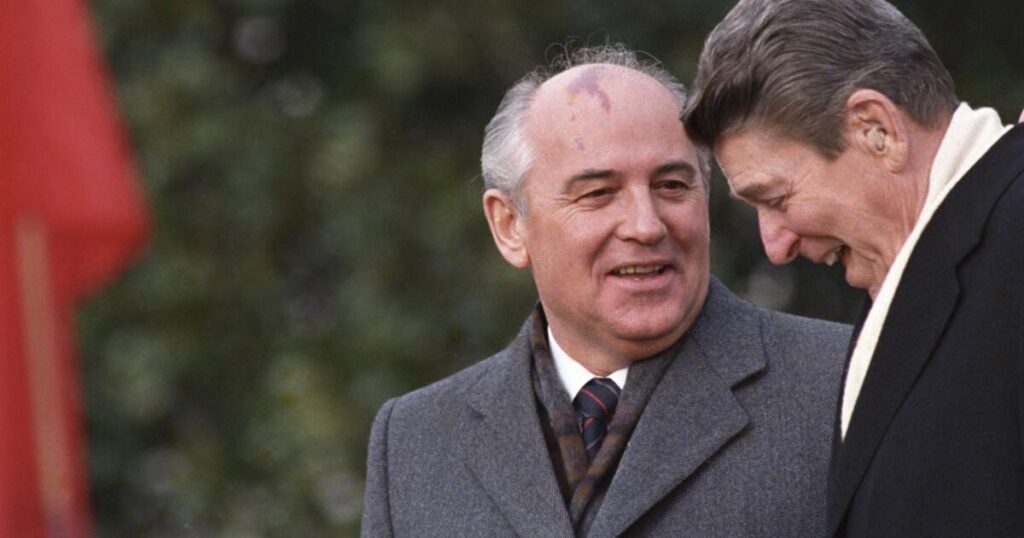
In October 1986, President Reagan met Soviet leader Mikhail Gorbachev in Reykjavik, Iceland, to resolve the question of whether we were destined for nuclear war or if we could step back from the brink. At a moment when 70,000 nuclear weapons existed throughout the world, these two fierce adversaries sat down across from each other and looked past decades of fear and suspicion to find a middle ground.
I play Ronald Reagan in a new film set during that extraordinary weekend. The story of their meeting is a testament to the power of diplomacy and to what is possible when two sides come together in the name of mutual interest and peace. Thanks to their courage to engage in conversation, the United States and Russia reduced nuclear weapons by 80% over the following decade. That weekend marked the beginning of the end of the Cold War.
A film like ours can play a significant role in helping the public understand the stakes of the nuclear arms race and what would happen if, God forbid, nuclear weapons suddenly filled our skies. I hope Reagan would admire our new film in part because not only did he understand the power of cinema as an actor, but he shifted his own views on whether nuclear war was winnable after watching the ABC film “The Day After” a few weeks before its 1983 premiere while he was at Camp David.
I may have disagreed with some of what Reagan believed, but I deeply respect him for having the strength to engage directly and in good faith with our greatest adversary. He bucked domestic business pressure and policy hawks, and in doing so he showed the world that strong leaders pursue dialogue.
Forty years later, that lesson is more important than ever.
The last arms control treaty between the U.S. and Russia — a legacy of Reykjavik — expired earlier this year. Today, we are facing a new, three-way arms race with Russia and China. In addition, numerous other countries have developed or are seeking nuclear technology with a de-emphasis on inspections. Countries that swore off the bomb — from Poland to South Korea — may be reconsidering.
Nuclear weapons in today’s arsenals are up to 80 times more powerful than the bomb the U.S. dropped on Hiroshima. Many are still poised to launch at a moment’s notice. New technologies from artificial intelligence to hypersonic missiles make the situation even more complicated than it was during the Cold War.
There have been many close calls and misinterpretations that nearly ended in nuclear catastrophe because of a lack of communication and dialogue. In 1983 — just two weeks before 100 million Americans watched “The Day After” — NATO conducted a military drill that took place over several days called “Able Archer,” which simulated the start of a nuclear war. The exercise took place during heightened U.S.–Soviet tensions, just after the deployment of missiles capable of reaching Moscow in eight minutes. The Soviets readied for nuclear war fearing it was cover for an attack.
We’re not immune from this happening again. Just last year, the U.S. and Russia traded escalatory comments about repositioning nuclear-armed submarines. Without an open channel of communication, we risk misinterpreting intentions and actions — and the consequences could kill millions.
To avert disaster, we must start talking to one another. Dialogue is not weakness. It does not mean agreement, endorsement or surrender. Rather, it is a safeguard for our future, the first step in finding a path forward that will make this planet we share safer for all of us.
As the former president said: “A nuclear war can never be won and must never be fought.”
Jeff Daniels portrays Ronald Reagan in the new film “The Brink of War.”
The post As nuclear tensions spread worldwide, Reagan’s lessons are more relevant than ever appeared first on Los Angeles Times.