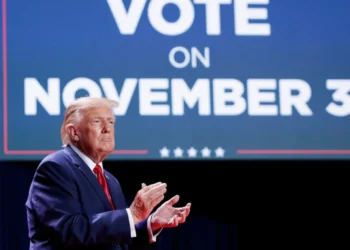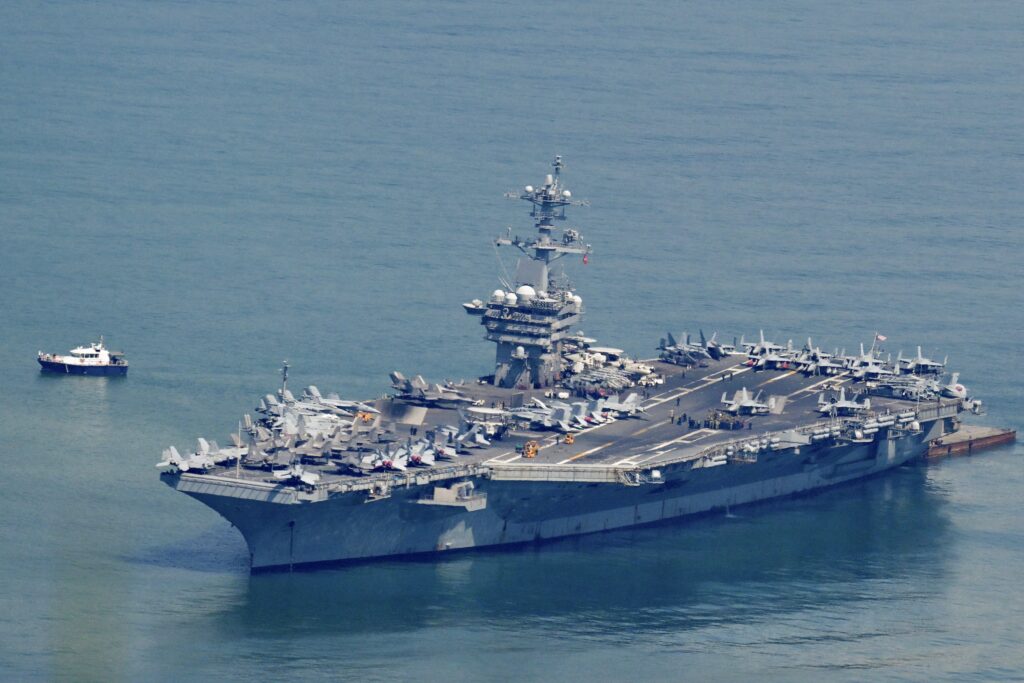
President Donald Trump announced on Truth Social over the weekend that he had instructed Defense Secretary Pete Hegseth to “substantially reduce” joint military exercises with South Korea. His post landed alongside news that the USS George Washington, a nuclear-powered aircraft carrier deployed in the Pacific, had been ordered to the Middle East.
Taken together, the two events show the risks of Trump’s erratic foreign policy. The president suggested the curb on military exercises was payback for South Korea’s unwillingness to join the Iran war, highlighting that America’s defense commitments are less than ironclad. And leaving the Pacific without a carrier on patrol invites further probing and provocation by adversaries.
Ironically, the administration’s own strategy documents cautioned against spreading the military too thin. The United States is not ready to fight multiple wars at once, especially if one involves a near-peer adversary such as China.
Trump’s war of choice against a regional power — the “little excursion,” as Trump called the Iran campaign — has drawn down stockpiles of some high-end weapons to dangerously low levels. According to some estimates, nearly 80 percent of the Pentagon’s THAAD interceptors, roughly half of its Patriots and nearly half of its Tomahawk missiles are gone. Early in the conflict, reports suggested the U.S. had sent at least some of a South Korean THAAD battery’s missile stock to the Middle East.
January’s National Defense Strategy warned about the risk of America “being drawn into simultaneous major wars across theaters.” Last year’s National Security Strategy said the U.S. should conserve its resources, shift burdens to allies and rebuild its industrial base before any real test of American power arrives. The test is here, and the country’s readiness is in question.
The U.S. still fields a fearsome military with unmatched reach. The Navy operates 11 supercarriers. Peacetime maintenance, training schedules and overburdened shipyards currently allow only three or four to be at sea at any given time. War sets a different pace, but the Pentagon isn’t acting like it.
Trump needs to recognize how sharply the U.S. is being squeezed. Fast-tracking missile purchases and funding the development of low-cost alternatives to restock the larder is a good first step. Cutting both unnecessary bloat and complacency in the Pentagon’s bureaucracy is a necessary second. The administration’s $1.5 trillion defense budget request is fiscally ambitious, but it might be a necessary one-time ask to put the U.S. on sounder footing. Will every penny be spent wisely?
Just as important is holding allies close. Trump’s rough talk on burden-sharing is understandable in peacetime. Done when the U.S. military is so visibly stretched, it starts to look reckless.
The post Trump inverts his own foreign policy mantra appeared first on Washington Post.