Welcome to The Midterms, Actually. Every week I’ll be writing about two things: one big idea or trend I see forming across the 2026 primaries, and one thing I’m hearing from a voice on the ground. Let’s get into it.
One Big Idea: The electability conversation we should be having
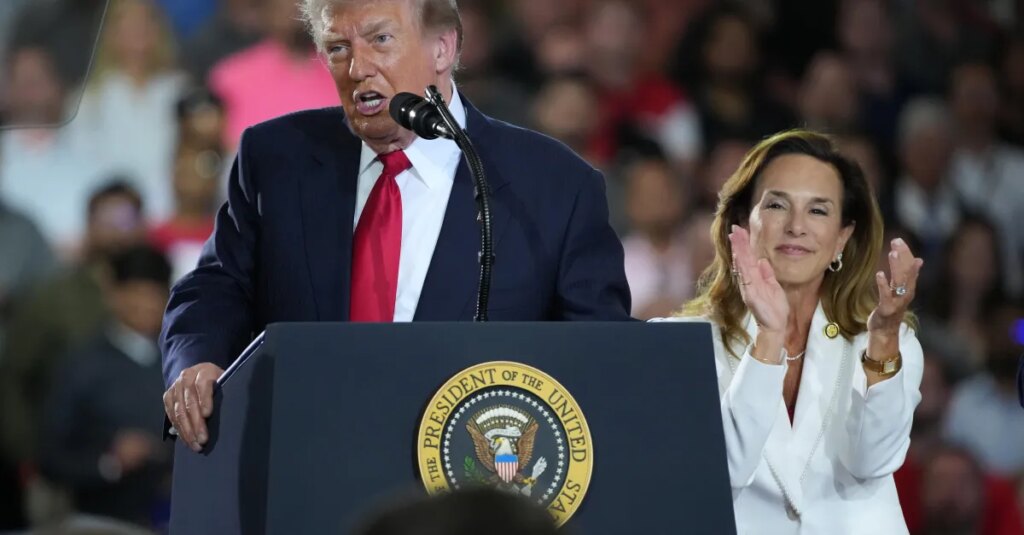
Here’s something you wouldn’t know from most of the coverage of this year’s midterm elections: The biggest electability problem belongs to President Donald Trump and the Republicans.
GOP candidates in the midterm elections must contend with defending an unpopular president leading an unpopular war, not to mention $4 gas (if they’re lucky). The administration has upset its own base at various moments — first tariffs, then the release of the Epstein files, now a worsening war — and the party has followed Trump into backing scandal-plagued candidates in the general election, including Ken Paxton in Texas and Max Miller in Ohio. To top things off, more than six years after the January 6 insurrection, any Republican who wants to remain in the president’s good standing cannot acknowledge the fact that he lost the 2020 election, an issue that helped cost the party major races in 2022 and could still bite in 2026.
Tom Tiffany, the Republican Senate candidate in Wisconsin, has stood side by side with Trump’s efforts to overturn the 2020 election, as my colleague Zack Beauchamp wrote about recently. Just this weekend, Tiffany said he did not regrethis efforts at all, even after events like the Jan. 6 insurrection. And Trump has done nothing to help candidates move past these concerns; his pardons for January 6 defendants and (so-far failed) attempts at creating a government fund for payouts have kept the issue fresh.
Yet still, the focus of Politics World (and to some extent this Substack) has often been the story that’s more dynamic: the changing nature of the Democratic Party. In doing so, “electability” has become synonymous with the ideological battle between moderates and progressives, and specifically the idea that left-wing candidates, in particular, are electoral underperformers.
Take the latest edition of the New York Times political newsletter by chief polling correspondent Nate Cohn, which asks, “Could El-Sayed Cost Democrats Michigan?”
These candidates of the activist left often seem to fare much worse than mainstream progressives, even though they may not be very different on the issues. The members of Justice Democrats, which includes the Squad and many of their congressional allies, fare about five points worse than other Democrats. Elizabeth Warren, who might count as part of that broader group of activist-backed progressives who aren’t democratic socialist, has underperformed the Democratic baseline in Massachusetts by as much as 10 points on net.
On one hand, Cohn’s point is real — there is a trend of electoral underperformance among the most activist progressives worth analyzing. But the sample size is small (there are only nine members of Justice Democrats) and there are some complicating factors — mainly that the most progressive candidates often compete in uber-blue areas, so their organizing efforts are more focused on the primary than the general.
There is also the reality of identity: Candidates of the left are often from a marginalized background — a woman, a person of color, maybe even both — and while the piece doesn’t mention the reality of things like racism, sexism, and (especially lately) Islamophobia, I’d argue that it’s a force multiplier in these conversations about progressive electability. What was Andrew Cuomo’s closing message against Zohran Mamdani if not dripping in Islamophobia? Prominent “Squad” members like Ilhan Omar and Rashida Tlaib continuously face even uglier rhetoric and conspiracy theories, and few politicians in America get more gendered attacks than Alexandria Ocasio-Cortez. Would Democrats have been so willing to discard Francesca Hong as unserious if she weren’t a woman?
These are ultimately questions batted around between political insiders that will be resolved in November, but the conversation also does the work of flattening just how unpopular Trump’s second-term MAGA agenda has been. That Democrats have a shot at retaking the House — much less the Senate — seemed far from certain in early 2025, considering the tough election map and partisan gerrymandering advantages. The president has upended the landscape through his sheer unwillingness to moderate, and there are no signs he’s hit his electoral floor.
As we turn to November, it’s important for political coverage to reflect the main character of these elections (Trump). The president’s drag on electability should be front and center, with Republican candidates pressed about the administration’s actual policy at least as much as Democrats have been asked about Zohran Mamdani or Hasan Piker. Whichever party wins control of Congress, Trump will have far more power come January 2027 than any of the Democratic factions we’re discussing.
This is not to say we should “ignore the polls” — Trump’s plummeting approval ratings and voter discontent with issues like Iran and inflation are also derived from surveys, after all. But, as we saw in some surprising results in primaries this month in Michigan, Wisconsin, and Minnesota, the polling side of the midterms should also not be treated as predictive gospel — and that goes double for platforms like Kalshi and Polymarket that have become integrated into mainstream media coverage and narrative-setting platforms like X. I’d also add that only bettors care about the spread — to most voters, who won is all that matters.
Cohn and other top polling analysts like Nate Silver acknowledge the limits of predictive certainty in their writing, of course, and discuss Trump as well. But I do worry whether focusing on these kinds of small-bore distinctions between candidates risks getting ahead of things, especially after the primaries — a time when voters do consider electability as a factor — are over.
It reminds me a bit of 2016, when the poll-driven anticipation of a Hillary Clinton victory pushed political coverage beyond the actual questions facing the public at the moment. That year, it sometimes felt like the press wanted a head start on holding Future President Hillary accountable, which presented a false balance between her inconsistencies and Trump’s overt extremism that — in my opinion — helped change the expected result in the process.
This November, there’s a risk of repeating the same cycle. And in overfocusing on the supposed unelectability of the progressive left, we underplay the central story of this midterms: the massive delta between the actions of this administration and the voting public, and whether Republicans can either find a way to reframe that agenda or push Americans to weigh other issues instead. That’s what this election will be about.
Last month, I was re-reminded of all this after reporting for a recent episode on gas prices for America, Actually. We stood outside of a Speedway in Allentown, Pennsylvania — the heart of the state’s Seventh Congressional District, a key battleground in the midterms — and asked people about the most important issues for them heading into the general election. There, it was clear that people were mostly wrestling with their own financial struggles, but also their feelings about Trump, and the gap between his promised priorities on the campaign trail and the current reality.
“I voted for him with his promises to the American people. And I think he’s let us down,” one Allen voter told me in our episode. I asked what the biggest broken promise was. “The prices…it’s skyrocketed. … My main objective is a roof over our head, pay our bills, and then what’s left? There’s hardly anything left.”
So consider this a coverage corrective. I have tracked the changes within the Democratic Party in our election coverage (and will continue to!), but I think this portion of the calendar requires us to update our language. The most toxic and consequential bromance in politics isn’t between a mayor and a Twitch streamer — it’s between the president and the party he’s reshaped in his image.
What I’m hearing
This week, we’re back in Michigan! I asked a few questions to Orlando Bailey, executive director at Outlier Media, the Detroit-based newsroom that focuses on finding innovative stories in Black communities and beyond. He is also the co-founder of the award-winning podcast, Authentically Detroit, and a regular contributor to WDIV-TV and Detroit PBS.
Abdul El-Sayed will likely be the most-watched Senate race in the country this fall, after he survived a bruising primary against Haley Stevens. What’s one thing about that campaign you’ve seen on the ground that’s been less visible in the national coverage?
The national conversation has largely focused on two fronts: first, trying to understand and define the values of the Democratic Socialists of America while assigning El-Sayed to that wing of the Democratic Party — a label he rejects, noting that he considers himself a “capitalist.” Second, his call for the United States to stop funding weapons for Israel in its current conflict with Hamas, a position that has also been incorrectly conflated with holding antisemitic views.
What has been less visible in the coverage I’ve seen on the ground is the multiracial, multigenerational progressive coalition across the state that is supporting El-Sayed because they feel aligned with his message. I was on the west side of the state in Saugatuck, and my waitress was wearing an Abdul for Senate button. That surprised me because Allegan County tends to be more conservative. His lawn signs were everywhere, too. His message is connecting in ways I didn’t expect, and in places I didn’t expect.
Part of the reason the margins were closer than expected is that progressive candidates still seem to lag behind moderate Democrats in Black communities. Why do you think some Black Democrats preferred Stevens to El-Sayed — and can he improve with those voters ahead of the general?
I always take polls with a grain of salt, of course. I knew he wasn’t going to win the primary by double digits based on what I had been watching play out on the ground and online. El-Sayed actually lost Detroit to Stevens. I want to draw a distinction between Detroit’s large Black population and the Black electorate — the two are not synonymous. Black voters are still holding his feet to the fire over his participation in the Uncommitted movement during the last Democratic presidential primary, although he eventually came around to support Vice President Harris’ bid for office. Harris also endorsed him [after] the most recent primary.
There’s another issue, and I’ll say the quiet part out loud: There is a fraught relationship between Black communities and Arab American communities in southeastern Michigan. There is a history of conflict and mistrust between the two. Arab Americans own many of the commercial establishments that Black residents frequent, and tensions can reach a boiling point when people feel surveilled, cheated, or otherwise mistreated. Those tensions have, at times, escalated into violence, including incidents involving gas stations. El-Sayed is now being forced to have that hard conversation. He will also have to localize his policy priorities and explain plainly to people who are struggling how his agenda will affect their bottom lines.
I’ve found the Donavan McKinney race interesting. He’s a Black candidate near Detroit associated with DSA, and he’s maybe flown under the national radar. Tell me about McKinney and his race?
McKinney started as a community organizer on Detroit’s east side, which is where I’m from. He was elected to the state House in November 2024 and has aligned himself with the progressive caucus in Lansing. He regularly holds town halls in his district and shows up when residents and advocates call on him.
A little bit of history: Charles Diggs was first elected to Congress in 1954, and until Shri Thanedar’s election in 2022 — after the independent redistricting commission redrew the congressional maps — Detroit had always had Black representation in Congress. Since then, there has been a longing for Black representation to return to Detroit, and McKinney proved to be the right candidate at the right time. What’s interesting is that he and El-Sayed agree on a lot, but El-Sayed didn’t win Detroit.
The post The real “electability” question is about Donald Trump appeared first on Vox.