SACRAMENTO — A state lawmaker from San Diego has proposed fast-tracking the construction of an arena and housing project, drawing criticism from opponents who argue the site is not suitable for large-scale development because of flooding.
State Sen. Akilah Weber Pierson (D-La Mesa) wrote a letter last week to a powerful Assembly chair that outlines proposed amendments to Senate Bill 344 to help Midway Rising, a project backed by Los Angeles Rams owner Stan Kroenke, avoid potential lawsuits related to its environmental review.
“As amended, SB 344 would deem the Midway Rising Specific Plan Subsequent Environmental Impact Report to be in full compliance with the California Environmental Quality Act, or CEQA,” Weber Pierson wrote to the Assemblymember Blanca Pacheco, chair of Assembly Rules Committee.
“In order to promote the swift and deliberate development of affordable housing in the City of San Diego, an urgency clause is needed for this measure.”
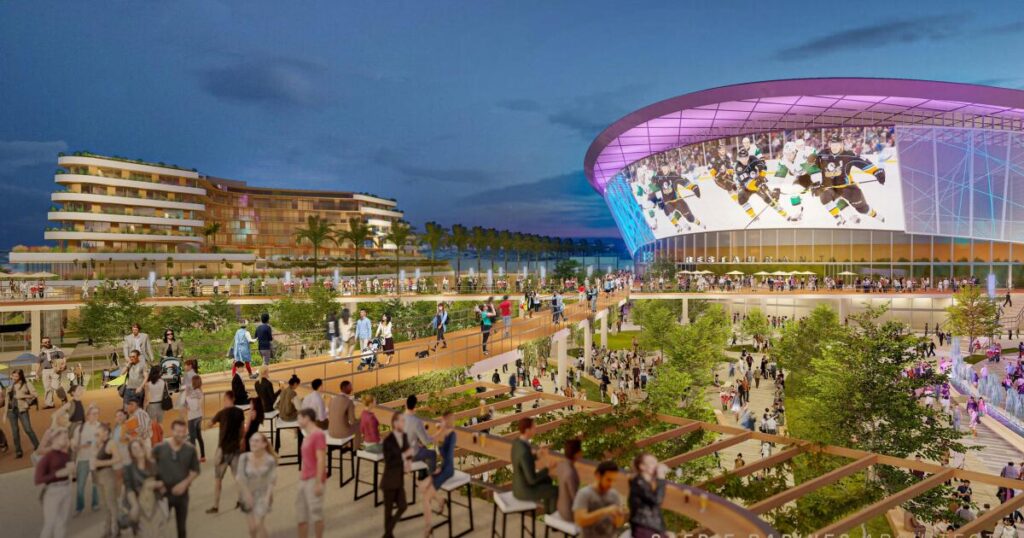
Developers are seeking to replace the decades-old Pechanga Arena, and build a new 16,000-seat facility, 4,254 homes, including up to 2,000 affordable units, and commercial and outdoor space. The site is south of Mission Bay.
Parts of the development could rise to a maximum height of 25 stories, according to project’s environmental impact report.
Sports teams, including minor league hockey team the San Diego Gulls, play at the Pechanga Arena. The arena is surrounded by parking lots, which are used for weekend swap meets.
The Assembly Rules Committee on Monday approved an urgency clause to Senate Bill 344, which mean it needs a 2/3 vote of both houses to pass and would go into effect immediately upon the governor’s signature.
Weber Pierson told the Times Monday that the amendments intended to help Midway Rising “haven’t crossed” the desk, meaning that the language hasn’t been inserted into Senate Bill 344. If the amendments go into the bill, “then at that point, I think we can have a conversation,” she said.
Brad Termini, the chief executive of Zephyr, one of Midway Rising’s development partners, said the proposed legislation “will help prevent frivolous lawsuits from causing unnecessary delays and keep the project on track to break ground next year, accelerating the delivery of much-needed housing in San Diego.”
The Kroenke Group didn’t immediately provide comment. Kroenke, the owner of the Rams, was announced as the major investor in Midway Rising in 2023.
Former San Diego Assemblymember Lori Saldaña, a longtime critic of the proposal, called the proposed amendments “reckless and rushed.”
“It removes the opportunity for the public and organizations to weigh in,” said Saldaña.
State lawmakers routinely carve out environmental exemptions for proposed sports stadiums, sometime in the closing days of the legislative session. The legislature has until the end of August to pass or reject scores of bills.
Former Senate Leader Darrell Steinberg (D-Sacramento) led his colleagues in passing a bill in 2013 that helped the Sacramento Kings arena by limiting environmental lawsuits. The new arena for the Golden State Warriors basketball team in San Francisco also benefited from CEQA reforms passed by state lawmakers in 2011.
The landmark 1970 legislation is credited with helping to protect the state’s environment, but it is also criticized for blocking development.
Since it passed, the CEQA has been a consideration in how most major projects get approved in California. The law requires the disclosure of any effects a development might have on the environment, an evaluation of alternatives and, in many cases, proposed changes that would reduce those environmental effects to a level of insignificance.
Weber Pierson also previously authored Senate Bill 958, another bill that will help the arena, that is awaiting a vote in the Assembly.
That bill states that the environmental impacts of a project that are associated with increased building height, including noise, shadows, or the potential to attract wildlife, shall not be considered significant impacts on the environment.
The bill only applies to specific developments, including those that are proposed on an graded infill site and those that pay construction workers a prevailing wage.
Weber Pierson said that SB 958 “is not special-interest legislation” during a Aug. 9 public forum about the project, describing it a broad-based housing tool, according to the Peninsula Beacon.
The publication reported that the forum “got testy at several points, with some audience members openly booing” the speakers.
Eric Law, chairman of the Penisula Community Planning Board, criticized the state senator’s proposed amendments in an interview Monday.
“The continued efforts to push legislation specific to Midway is misguided and unneeded,” said Law, whose group provides input to the city on planning issues.
Law said his group isn’t opposed to development, but wants the city to stick to the current three-story limit for the area.
“We absolutely endorse the idea of redevelopment — that place is kind of an armpit,” Law said of Pechanga Arena. “They need affordable housing and better housing — you just don’t need to do it over 30 feet.”
The San Diego City Council still needs to approve the project.
Saldaña said the developers are ignoring the growing sea-level rise that is causing nearby street flooding.
Saldaña said she was out Tuesday night in the area with volunteers from community planning groups, including Law, and witnessed groundwater “literally coming up and flooding the streets.”
“Not a drop of rain had fallen,” she said. “It’s just the higher sea level pushing the groundwater to the surface.”
Weber Pierson told the Times that Saldaña should bring her concerns about flooding to the developer and city officials.
The post Last-minute state legislation could help Stan Kroenke-backed San Diego arena, prompting outcry appeared first on Los Angeles Times.