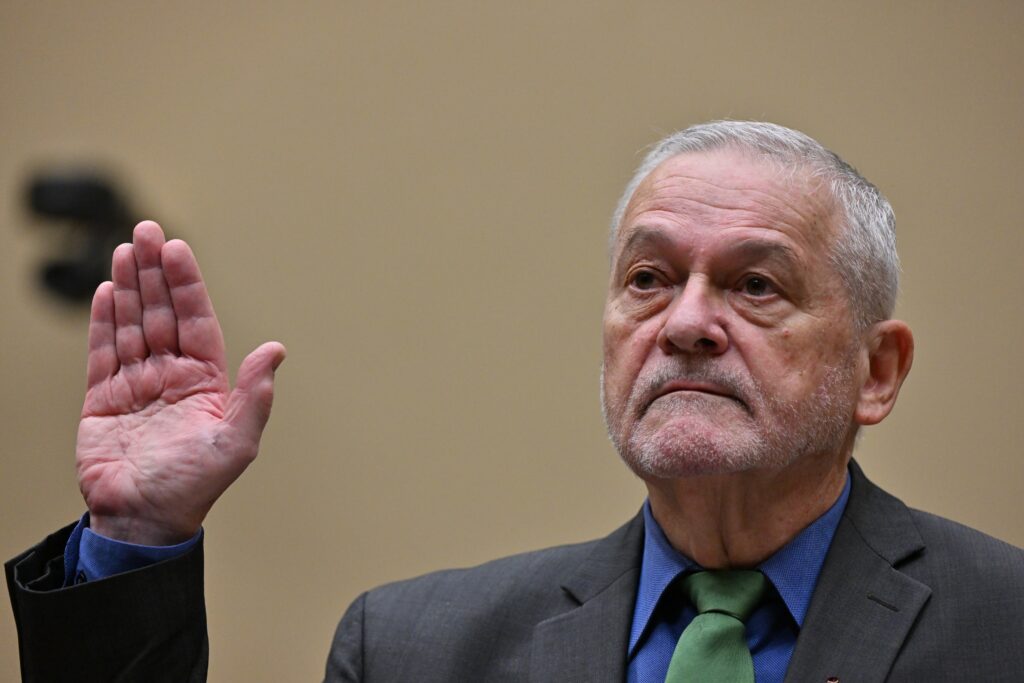
A former top adviser to Anthony S. Fauci admitted in court Tuesday he hid government communications to skirt public records laws and thwart inquiries into the origins of the coronavirus pandemic.
David M. Morens — who worked under Fauci from 2006 to 2022 — pleaded guilty to one count of conspiring to defraud the United States and could face up to five years in prison at a sentencing hearing set for November.
He told a federal judge in Maryland that he deliberately diverted emails he deemed politically controversial to a personal account to avoid the possibility they might one day be publicly released and misconstrued.
Morens, 78, previously explained his actions as a misguided attempt to protect Fauci from threats and to stop misinformation about the virus from spreading. Fauci led the government’s response to the pandemic as director of the National Institute of Allergy and Infectious Diseases.
Prosecutors did not accuse Fauci of wrongdoing in Morens’s case.
“By pleading guilty today, Dr. Morens has taken responsibility for what he did and will continue to do so,” said Tim Belevetz, Morens’s attorney.
The Justice Department announced its case against Morens earlier this year amid escalating pressure from President Donald Trump and his allies, who continue to accuse Fauci and his top aides of misleading the public on the origins of the virus and its severity.
Many scientists, though far from all, believe the coronavirus jumped naturally from bats to humans via an intermediate animal of some kind. Trump and his supporters, however, have promoted an alternate theory that the virus escaped from a Chinese government lab, which could arguably lay blame on a rival country.
Fauci has repeatedly dismissed accusations that he sought to hide information on the virus as “simply preposterous.” Still, President Joe Biden, in his final days in office, preemptively pardoned Fauci out of concern that the Justice Department under Trump could seek to indict him.
Earlier this month, Sen. Rand Paul (R-Kentucky), who chairs the Senate’s Homeland Security and Governmental Affairs Committee, urged the department officials to do just that, referring Fauci for prosecution on charges of contempt of Congress after he refused to answer lawmakers’ questions at a recent congressional hearing.
The Justice Department has said it is reviewing Paul’s request. Its case against Morens also emerged from a referral sent by Paul, who has emerged as a chief antagonist of Fauci.
Before his guilty plea Tuesday, Morens had previously acknowledged he improperly sought to keep some communications off of his government email account so they would not be accessible under public records laws.
Much of the indictment against him centered on his communications with the president of a New York-based nonprofit who received a grant from the National Institutes of Health in 2014 to study the emergence of bat coronaviruses.
Although plea documents filed in Morens’s case do not mention the executive or his organization by name, records previously released as part of a congressional investigation indicate he is Peter Daszak, former president of EcoHealth Alliance. The nonprofit worked closely with the Wuhan Institute of Virology, a Chinese lab that has faced questions over whether it played any role in the virus’s spread.
Both NIH and NIAID were bombarded during the early months of the pandemic with public records requests for internal communications about that grant and related research.
Over the course of the next several months, Morens, Daszak and another man — who previously released records indicate is Gerald Keusch, a former associate director of Boston University’s infectious disease lab — repeatedly discussed limiting their conversations to private email so they could speak freely, court filings say.
Morens several times discussed scrubbing his government accounts of communications that could stoke conspiracy theories, prosecutors said.
As part of his plea agreement, Morens also admitted Tuesday to accepting several “illegal gratuities” from Daszak, though he was not charged with any crime related to those gifts.
For example, prosecutors said the nonprofit executive sent two bottles of wine to Morens’s Maryland home with a note thanking Morens for his “advice, support, and behind-the-scenes shenanigans in [Daszak’s] battle against your bosses boss, his boss, and the ultimate boss on the hill,” an apparent reference to Trump administration officials.
“It takes courage and commitment to do what you’ve done,” Daszak wrote, according to the indictment against Morens, “given your job and the vindictive nature of the Administration.”
Neither Daszak nor Keusch has been charged with a crime. They could not be immediately reached for comment Tuesday.
The post Former Fauci aide admits hiding emails to thwart pandemic inquiry appeared first on Washington Post.