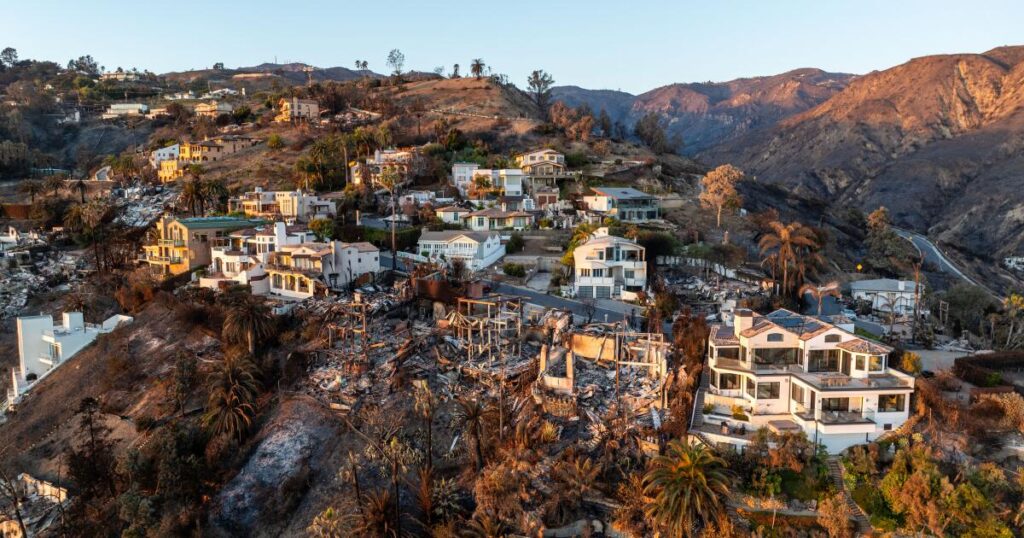
As deadly firestorms raged in Los Angeles County, carving a path of destruction that displaced families and killed 31 people, bets online were rolling in.
The wagers flowed into Polymarket, a company that bills itself as the largest platform for predicting global events, where it posed frequently asked questions about the Eaton and Palisades fires as they scorched communities. How fast would the blazes grow? How long would it take to contain them? How much would be destroyed?
According to a letter sent from nine senators this month to the U.S. Commodity Futures Trading Commission, which regulates prediction market platforms, Polymarket accepted more than $1.2 million in predictions, or bets, on the January 2025 fires.
“That was fun. Thanks everyone. Until the next time!” one Polymarket user commented on a thread where users could put money on the Palisades fire’s containment date. Others, however, expressed some concerns about the morality of cashing in on the destruction.
“This is deeply unethical,” one commented.
Prediction market platforms have exploded in popularity in recent years, facing condemnation from lawmakers and others who argue the sites commodify human suffering and, in some cases, incentivize wrongdoing. Proponents argue that the markets, their term for a question you can bet on, provide a more accurate snapshot of public opinion than traditional polls because of the financial incentives.
California Sens. Alex Padilla and Adam Schiff, along with seven other lawmakers, urged the federal government in their letter to rein in such betting and prevent people from profiting on wildfires and other disasters.
The letter comes while the platforms are under increasing scrutiny for allowing bets on ethically sensitive topics such as the outcomes of elections, military actions, clinical trials and FDA approvals on livesaving medications.
In a statement, a Polymarket spokesperson pushed back at some of the claims in the letter, saying it was part of “a misleading narrative based on markets we haven’t offered for nearly 2 years.”
Critics say the platforms are magnets for insider trading and could motivate people to engage in other illegal or unethical activity to win money. Polymarket did not immediately respond to a request for comment, but states on its website that it prohibits insider trading.
The questions, or event contracts as they’re called on the platforms, are often framed as simple yes-no scenarios, which the CFTC says allows users to “hedge economic risk or speculate on price movements and event outcomes.”
Users can buy “shares” of one answer or the other — yes or no — and the price of that “share” moves up and down as more predictions flow in. The more people who put money on “yes,” the more it will cost to buy a “yes” share, shrinking your profit margin if you’re right. In sports gambling, bettors’ winnings are determined by “odds,” which are similarly adjusted.
The things people can put money on run the gamut of public interest — from when traffic along the Strait of Hormuz will return to predicting the winner of a major league baseball game.
Even the lives of pop stars are a market. As of Friday, there were 500 ways on Polymarket to wager on various aspects of Taylor Swift’s life, including when she might become pregnant.
Traders who don’t predict correctly lose their investment.
Experts say that while some event contracts — such as the personal life of pop stars — aren’t as easy to manipulate, other scenarios could be rife with insider trading or, in the case of wildfire contracts, motivate people to commit arson.
In the letter to federal regulators, legislators said they fear that could be a temptation people face to secure a successful bet. There have not been any reported cases of event contracts motivated by arson, but it’s something Jamie Pietruska, associate professor of history at Rutgers University, said should be a concern.
“There’s a reason these are called arson markets,” she said.
Amid the scrutiny, the public’s hunger for event contracts doesn’t show signs of slowing. A new prediction market site specifically focused on California wildfires was launched early this year, according to Wired, with the tagline: “You can’t predict wildfire. But you can trade on it.” The site does not appear to be active as of this week.
The Commodity Futures Trading Commission is already considering regulations for some prediction markets, including a ban on markets that go against the public interest, which the agency described as those related to death, including war, terrorism or assassinations.
Legislators are now pushing the commission to also crack down on wildfire prediction markets.
“The CFTC must lead the charge to rein in these contracts in the U.S. and offshore and put in place common-sense guardrails to prevent people from profiting as wildfires threaten communities,” the lawmakers wrote.
The CFTC did not respond to a request for comment from The Times about whether the agency will take any action in response to the letter.
Though prediction markets are legal at the national level, several states have gone to court to argue they are nothing more than unlicensed gambling sites that violate state laws and tribal gaming compacts. In California, three Native American tribes filed a lawsuit last year against prediction market companies Kalshi and Robinhood, arguing the firms are conducting illegal gambling operations on tribal land.
“The question whether it’s gambling or speculative investment is something that’s kind of bedeviling lawmakers and regulators right now,” Pietruska said.
People have been informally betting on Mother Nature for more than 100 years, Pietruska said, dating to the 1880s when people in India would gamble on whether a rain gauge would overflow during a monsoon. By the 1930s, office workers in the United States had betting pools bolstered by the collection of weather data.
But the idea of gamifying a disaster like a wildfire for financial gain crosses a clear ethical boundary, experts say.
“It’s morally reprehensible,” said Michael Méndez, an associate professor of urban planning and public policy at UC Irvine. “You’re essentially betting on a community’s devastation and human suffering.”
The perverse incentive to create wildfires isn’t the only problem. There could also be incentives to ensure wildfires aren’t contained, further straining first responders and putting more communities at risk, Méndez said.
There have already been allegations of insider trading plaguing prediction markets.
In April, a U.S. Special Forces soldier allegedly placed a wager on Polymarket using classified information about the removal of Venezuelan leader Nicolas Maduro and won more than $400,000. He was charged with unlawful use of confidential government information for personal gain, theft of nonpublic government information, commodities fraud, wire fraud, and making an unlawful monetary transaction.
The company noted that the charges against the soldier happened because it flagged the activity and sent it to federal authorities. The company says it has referred more than 90 accounts to law enforcement, just a fraction of the number of users on the site.
Though the exact number of Polymarket users isn’t publicly disclosed, estimates indicate there are thousands of people that bet daily on the site. Monthly trading volume on Polymarket and Kalshi, the two largest prediction markets, rose from less than $5 billion in September 2025 to nearly $24 billion in April, according to Pew Research Center.
“Every trade on Polymarket is permanently recorded on-chain — visible to the world, with nowhere for misconduct to hide. And we were proactive: we built the surveillance and enforcement infrastructure to act on what the blockchain shows,” Polymarket wrote on its website.
Also this year, authorities in France began investigating whether someone tampered with a weather monitoring device at Charles de Gaulle Airport in Paris after an unusually high temperature was recorded around the same time a Polymarket trader cashed in more than $21,000 in profit.
The trader, according to a report by NPR, bet $119 that the temperature in Paris would exceed the equivalent of 64 degrees Fahrenheit on April 15. By the time meteorologists debunked the temperature spike, the user had deleted their Polymarket account.
Officials were also investigating this year whether President Trump’s teleprompter operator was using Kalshi, a competitor to Polymarket, to profit from correctly betting what words the president would say during speeches.
Amid the scrutiny, the platform removed all “mention market” options, NPR reported.
In May, Rep. James Comer (R-Ky.) launched an investigation into how users of prediction market platforms could use nonpublic information to engage in insider trading.
“It’s the Wild West,” he said during an interview on CNBC. “There are no rules.”
In January 2025, Kalshi announced that Trump’s son Donald Trump Jr. had joined the company as a “strategic advisor.”
Last week, a complaint was filed in New York federal district court against the Trump administration, accusing it of violating the 1st Amendment by offering early access to his Truth Social posts before they’re public, giving buyers access to information they could use to wager on policy decisions before they’re announced.
The post As L.A. burned, online gamblers bet on how much the fires would destroy. ‘That was fun’ appeared first on Los Angeles Times.