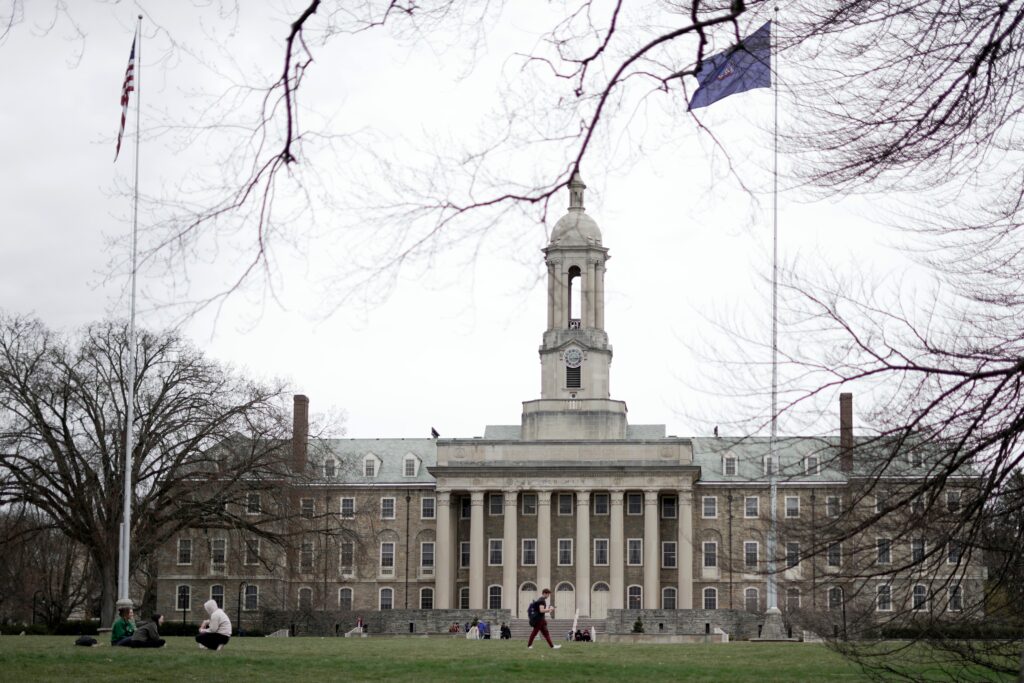
One of the alleged leaders of a drug trafficking ring involving two fraternities at Penn State University was arraigned Tuesday and denied bail.
Agostino Abbatiello, 24, was arraigned on a number of felony charges, including possession with intent to deliver cocaine and conspiracy. Authorities also charged 13 others, including former students and at least four current Penn State students.
Pennsylvania Attorney General Dave Sunday’s office alleged that Abbatiello and Thomas Robinson, 23, were the main suppliers for the operation, making regular trips to Philadelphia and New York for “large quantities of cocaine” in 2023 and 2024.
“The cocaine was then cut and packaged — primarily at the Delta Upsilon and Sigma Chi fraternity houses — and distributed mainly to Penn State University students,” according to the attorney general’s office.
Abbatiello’s attorney did not immediately respond to a request for comment.
Robinson’s father, Paul Robinson of Pittsburgh, was charged with trying to conceal evidence, including a safe containing drugs and cash. Most of the payments were made in cash or via payment apps.
“This was a coordinated and highly-profitable drug-trafficking crew revolving around two senior members of the fraternities, other fraternity brothers, and pledges,” Sunday said in a statement Monday. “In fact, according to the evidence uncovered, cutting and packaging cocaine was, for some pledges, an indoctrination into the fraternities.”
Court records show that both Robinsons posted bail. They could not immediately be reached for comment.
The executive director of Sigma Chi International Fraternity, Michael Church, said it has suspended the Penn State chapter and all three members who were charged.
“This conduct is an egregious violation of our values and has no place in our fraternity, community, or society,” Church said in a statement, adding that the organization is cooperating with authorities. “Any members involved will be held fully accountable to the extent available to our fraternity.”
Delta Upsilon International Fraternity Executive Director Justin Kirk said that the suspects associated with the organization have been expelled or suspended, or have resigned.
“We will continue to work closely with the university on any investigative efforts,” Kirk said in a statement.
Penn State did not respond to requests for comment.
The case echoes other prominent drug investigations involving college fraternities.
In 2020, federal prosecutors charged 21 people in a drug investigation involving current and former students at the University of North Carolina at Chapel Hill, Duke University and Appalachian State University. They also named three UNC frats (Phi Gamma Delta, Kappa Sigma and Beta Theta Pi) in court filings. The network allegedly sold marijuana, cocaine, Xanax and other drugs.
And in 1991, federal and local drug agents burst into three frat houses at the University of Virginia: Delta Upsilon, Tau Kappa Epsilon and Phi Epsilon. At least a dozen students were ultimately charged with crimes, including selling LSD, cocaine, marijuana and hallucinogenic mushrooms. Authorities reported finding a marijuana-growing system in a fraternity house closet.
The post Alleged leader of Penn State frat cocaine ring arraigned, denied bail appeared first on Washington Post.