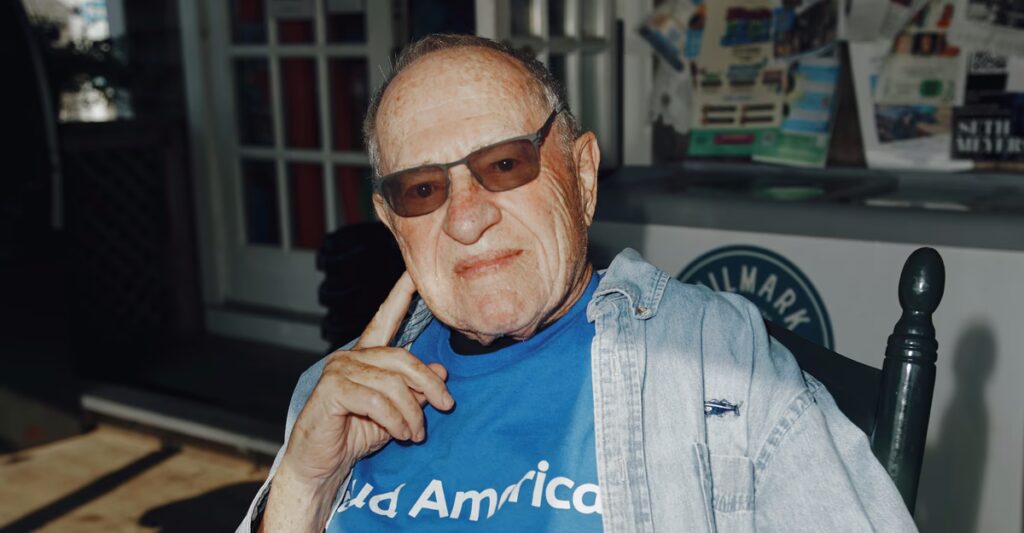
Here it is, August on Martha’s Vineyard, and Alan Dershowitz has barely been heard from.
Well, that’s not exactly true. He has been heard from on many topics—because Dershowitz is who he is, and pretty much anyone can join Substack, and TV bookers can be hard to resist. Still, he has said little publicly about the maddening injustice he’s faced in recent years: his annual summer shunning at the hands of the island’s liberal social gentry. Has this perennial comedy of ill manners—the Vineyard cancellation of Alan Dershowitz—finally run its course?
The story has become a familiar seasonal menace; as pernicious as ticks, and as hard to kill. Its particulars are known. Dershowitz, the inexhaustible Harvard Law professor who represented a gallery of notorious clients over several decades, was once a kibitzing dynamo here. But that was before the blacklists and the badgering.
In his telling (and retelling), Dershowitz became socially radioactive during Donald Trump’s first term, when he began speaking out on the president’s behalf, and then joined his first impeachment defense team. Although he did not personally support Trump—he’d been a lifelong Democrat who’d voted for Hillary Clinton in 2016 and would support Joe Biden in 2020—his stock explanation was that everyone is entitled to legal representation. It was the same basic principle he had applied when representing the likes of Mike Tyson, O. J. Simpson, Claus von Bülow, and, more recently, Jeffrey Epstein. It was no different, in fact, than the occasion of Dershowitz’s first-ever visit to Martha’s Vineyard, in 1969, when he was enlisted to help in the defense of Ted Kennedy after his late-night accident at Chappaquiddick.
Yet defending Trump was apparently too noxious for Dershowitz’s reputation. “I never thought I would see McCarthyism come to Martha’s Vineyard,” he lamented in a column in The Hill in 2018. According to Dershowitz, locals have urged his exclusion from various Vineyard businesses and institutions. Every summer, it seems, has brought a new episode in ostracism, cold shoulders in the hot sun.
[Thomas Chatterton Williams: The right is changing the rules of the culture war]
There was the Great Pierogi Incident last year at the West Tisbury farmers’ market, in which a vendor refused to sell half a dozen dumplings to Dershowitz, citing his representation of “several sexual predators and abusers, including Jeffrey Epstein.” Dershowitz claimed that he was being discriminated against over his vocal support for Israel and initiated a follow-up spectacle a week later in which the vendor, Krem Miskevich, refused to accept a signed copy of one of Dershowitz’s books (The Ten Big Anti-Israel Lies) as a peace offering.
In 2022, Dershowitz said he’d received a fan email from a reader who alleged that he’d been beaten up at the beach (he did not specify where) just for carrying a copy of a book written by Dershowitz. “Without warning, I was slugged and punched in the face,” the man wrote to Dershowitz, who reprinted the unverified email on Substack in a post titled “Email From a Man Who Got Beaten Up for Reading My Book.”
And then there was the infamous clash at the Chilmark General Store with Dershowitz’s now very-much-ex-friend Larry David. In the annals of Dershowitz’s social spiral on the Vineyard, this conflagration has taken on almost-mythic dimensions, like his own personal Stalingrad. Dershowitz was sitting on the porch of the store with another friend, “who happened to be a very kind of radical woke lefty from New York, but very tolerant,” he told me. David was not very tolerant, at least of Dershowitz. He walked onto the porch, refused to shake Dershowitz’s hand, called him “disgusting,” and stormed off. Dershowitz said at the time that David was so irate, Dershowitz worried that the comedian might suffer a stroke.
That unpleasantness on the porch, memorialized on Page Six, took place five summers ago. But Dershowitz talks about it as if it were yesterday.
On a recent Saturday, I ventured north from Washington for a little hardship duty in Chilmark, the preciously pastoral town on the western side of the island where Dershowitz has owned a home since 1991. I approached him first by email, telling Dershowitz that I was curious about his current social standing on the Vineyard and how things were going for him this summer. The subject matter could be freshly topical, I figured, because his two most prominent clients—Trump and Epstein—are more toxic than ever. To my surprise, Dershowitz agreed to speak with me.
Actually, I was not surprised.
“We can meet on the porch for a slice,” he proposed.
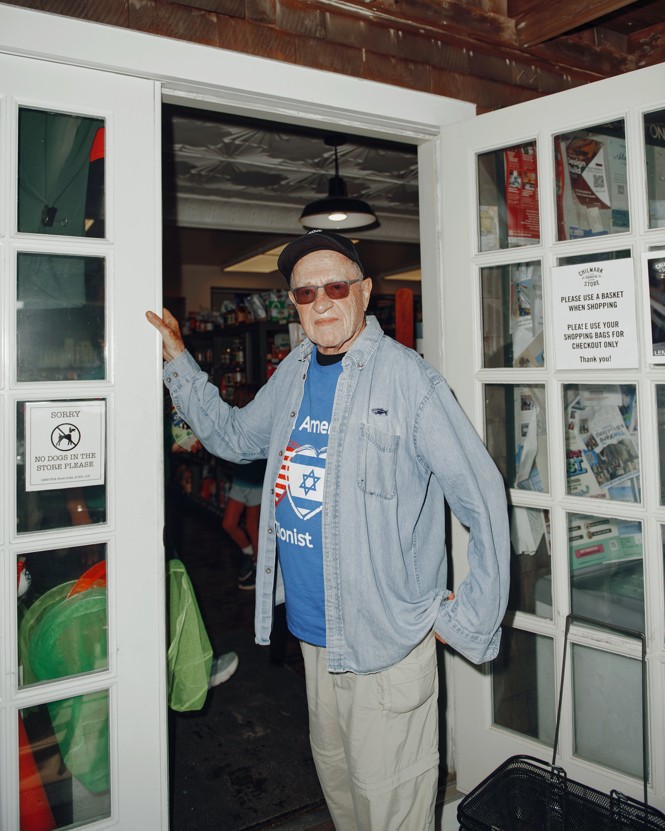
Dershowitz, who turns 88 next month, has been presiding from the rocking chairs of the Chilmark General Store for decades, juggling pizza and discourse. When I arrived, I found him wearing a bright-red T-shirt with the words Proud American over an Israeli flag and an American one, each in the shape of a heart. He told me that he’d asked his wife, Carolyn Cohen, to join us but she had no interest. “She said, ‘I’m so sick and tired of this subject,’” he told me. Dershowitz conceded that he, too, is weary of it. “But, you know, it’s important that people get the whole context,” he said.
The whole context, in 2026, is basically this: Dershowitz says he has started a new life on the Vineyard. But just because his persecution tale has become an island eye-roll does not mean that it has subsided. Especially, according to Dershowitz, in his own, bucolic neighborhood. “Here in Chilmark, it’s 90 percent negative,” Dershowitz reported to me. That reception contrasts with what he gets in Miami Beach, where he spends his winters and where, he said, he is treated “wonderfully.” He is “treated very well” even in the more heavily trafficked Vineyard towns on the other side of the island. “In Edgartown and even Oak Bluffs, the African American community, I’m treated very well,” he said. “It’s all Chilmark. And it’s all Jewish, anti-Zionist.”
I noted that he can at least still hold court at the Chilmark General Store. But he argued with my choice of the term holding court.
“I used to—not anymore,” he said.
“You don’t hold court anymore?” I asked, as he arguably held court. “What is this?”
“You’re interviewing me,” he said. In the past, it would have been a high-end conclave. “Normally, we would have this whole area,” he said, motioning to a group of rocking chairs on one side of the porch. “I would have Larry David here,” he said. “Ted Danson was here sometimes,” he added. “The guy who did Ghostbusters—he died a few years ago—he was here.” (This was Harold Ramis, who died in 2014.)
“The whole crew of Chilmark friends, I would say, 20 or so, no longer talk to me,” Dershowitz said.
He pointed next door to the Chilmark Tavern, one of his favorite restaurants on the Vineyard, where he claims that some of his vacation nemeses are trying to get him banned. “A bunch of people went to the Chilmark Tavern and said If you continue to serve Dershowitz, we’re not coming here,” he insisted.
I was skeptical of this. “Ask her; you can check with her,” he said. “Jenny.” When I contacted Jenna Petersiel, the proprietor of the Chilmark Tavern, she told me that she’d assumed that The Atlantic wanted to speak with her about the challenges of running a restaurant, or ticks. “A discussion of Alan Dershowitz had not crossed my mind,” she said, declining to comment otherwise. Dershowitz also told me of an event he had attended on the Chilmark Tavern deck not long ago. A woman got out of her car, he claimed, “saw I was up there, turned around, and went back to her car.”
He appears to have a limitless supply of such stories, in part because it seems as if Dershowitz initiates a fair number of confrontations himself. The week before our conversation, he had returned to the hallowed cultural battleground of the Pierogi Wars, the West Tisbury farmers’ market. He was wearing his U.S.-Israel shirt (or “my Zionist T-shirt,” of which he has two—one red, one blue) and saw a guy wearing a Free Palestine shirt. “I walked up to him. I said, ‘Can we take a picture together?’” The man refused. “He said, ‘No, no, no Israel,’ and he walked away.”
Dershowitz believes that many of his old Vineyard friends revile him for calling out the “anti-Zionist” and “radical” bent of the progressive left. He showed me his phone and cued up what he calls “my daily love note.” This one was an unsolicited email he’d just received, with “GENOCIDAL ZIONIST ISRAEL!” in the subject line; he kindly forwarded the note to me. “They always combine Zionism with pedophilia,” Dershowitz observed of his correspondents.
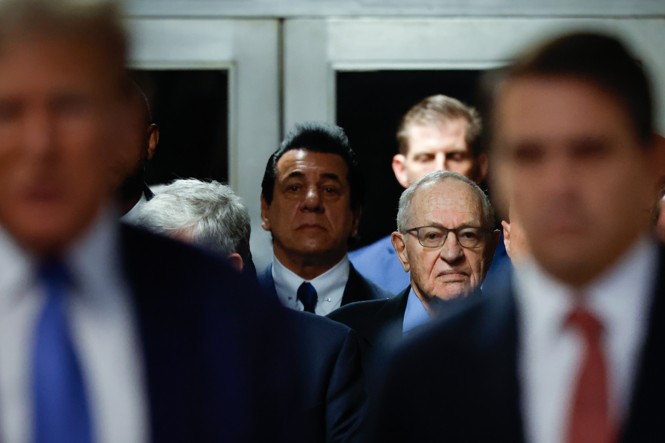
A few times during our conversation, I questioned Dershowitz about whether people really reject him because of his Zionist views or whether it might involve something more comprehensive: him being Alan Dershowitz. His position on the Middle East seems farther down the list of reasons that people might not like him than his affiliations with Trump and Epstein and his overall reputation, accrued over decades.
But Dershowitz claims, for instance, that he’s no longer asked to speak at the Martha’s Vineyard Book Festival because “they censor anybody they disagree with.” (A spokesperson for the book festival told me in an email that Dershowitz’s claim is “completely false” and that “the festival line up over the past two decades hardly reflects a narrow or excluding agenda.”)
“I personify what the woke hates,” Dershowitz said. Before I could ask him what, exactly, “the woke” is, he explained that he is now seen as a “traitor” to the Democratic Party. The enmity is mutual. In September, he has a new book coming out called Why I Quit the Dems: And So Should You! The subtitle is Confessions of a Reluctant Republican.
I asked Dershowitz directly whether he had voted for Trump in 2024.
“You’re allowed to ask it,” he said. “And my wife does not allow me to answer it.”
“Okay, so you’re going to hide behind your wife,” I said.
“I’m going to hide behind my wife,” he confirmed.
For the record, Dershowitz added that he always votes, and said that he had not voted for Kamala Harris. Also, his new book includes a blurb from President Trump (who obviously read every word).
Despite all of this, Dershowitz has arrived at a nuanced take on his snubbing. “I think it’s selective cancellation,” he told me. “We decided, basically, to change our life on the Vineyard.”
He said that he keeps busy by writing and doing regular paid appearances on Newsmax, occasional hits on Fox News, Piers Morgan’s show on YouTube, and other outlets. (He used to be on CNN all the time, but no more—“CNN has canceled me.”) He said that he does not lack social options. He has become very active in a Vineyard Chabad that he helped start. He told me at one point about all of the new friends he’s made. “Most of them are more supportive of Israel than the other group was,” he said. “And I often ask myself, How did I allow myself to become part of that other group?”
When I asked Dershowitz who his new friends are, we wound up talking about someone who is definitely in the “other group”: Larry David.
They used to speak all the time, Dershowitz told me. They would have dinner, share jokes. “I allowed him to use my gym to work out,” Dershowitz said. “I helped him on a number of occasions.”
“Larry David doesn’t talk to me anymore,” Dershowitz said at another point. “He screams and yells at me when he sees me.” He told me that he used to be a fan of Curb Your Enthusiasm but can no longer bring himself to watch it. When discussing David, Dershowitz often spoke in the present tense, describing their breach as if it were an active feud and a still-fresh wound.
Predictably, David had minimal enthusiasm for discussing any of this when I reached out to him.
“I don’t know why he’s still thinking and talking about me,” he told me by email.
As for the five-year-old confrontation at the Chilmark store, David added this: “I have lots of confrontations on my show but rarely in life,” he said. “And then only if I think I can take them in a fight. Hence the Dershowitz dust-up.”
While Dershowitz and I spoke on the porch, a woman sitting in a rocking chair next to him kept leaning in, almost certainly eavesdropping. She confirmed this about half an hour into our conversation.
“I’m sorry to interrupt,” the woman said to Dershowitz. “I was just sitting here. And I just wanted to say, you sound super fascinating. And I hope nobody’s ever mean to you. Ever.”
Dershowitz kvelled.
“Did you plant her there or something?” I joked (sort of).
“I only paid her 10 dollars,” he joked (I think).
During our conversation, Dershowitiz told me about a less cordial episode that had taken place last month in front of the Chilmark store, just a few feet from where we were sitting. The incident was not covered in the media, but Dershowitz had filmed a portion of it on his phone and shared the video with me. A guy in a Yankees cap had spotted Dershowitz at the store and promptly launched a barrage of Bronx cheers his way from the parking lot.
The man showed exemplary message discipline.
“Do you defend pedophiles? Do you defend pedophiles?” he repeated. “Yes, he does.”
Dershowitz demanded that his tormentor identify himself.
“My name is Jeffrey Epstein Jr., great friend to Alan Dershowitz,” the man replied.
Dershowitz kept demanding that the man state his name.
“What are you going to do?” the man asked.
“I’m going to sue you if you give your name,” Dershowitz said. (Surprisingly, the man continued to withhold his name.)
“Why? What are you going to sue me for?” he asked.
“For defamation.”
The heckler also mocked Dershowitz for, among other things, claiming to a TV reporter that, although he’d once received a massage from an adult woman at Epstein’s house, he’d kept his underwear on during the experience.
“He was on the plane, and he kept his underwear on,” the man taunted, while retreating across the street. There was some more hollering back and forth.
“You’re still a schmuck,” Dershowitz shouted.
In the pantheon of rogues and sleazeballs that Dershowitz has represented, Epstein stands out. Dershowitz helped orchestrate the late sex offender’s controversial plea deal in 2008; Epstein was allowed to plead guilty to state prostitution crimes in Florida, but he avoided federal trafficking charges and wound up serving just 13 months in jail. (At the time of his death, in 2019, he was awaiting trial on federal charges of child sex trafficking, by which point Dershowitz had fallen out with him and was no longer representing him.) Earlier in their relationship, they were frequent companions. Dershowitz was a visitor to Epstein’s homes in Palm Beach and New York, and went once with his wife and daughter to Epstein’s infamous island. (“No young women there,” Dershowitz wrote to me by email. “No one there except staff and ghislaine Maxwell.”)
I asked Dershowitz whether he’d ever been a passenger on Epstein’s plane.
“Oh, 20 times,” he said. As Epstein’s attorney, he explained, when he had to travel to Florida, his client would fly him down. However, the heckler’s claim that Dershowitz had received a massage on the plane was incorrect. That had taken place at Epstein’s home in Palm Beach. “This was a shoulder-and-neck massage, from an older woman,” Dershowitz told me. He said that this was “the only massage I’ve ever had in Epstein’s situation.”
“I’ve never in my life had an erotic massage. Not even from my wife,” he added, excruciatingly.
Dershowitz has said repeatedly that he never witnessed or participated in any unlawful sexual impropriety related to Epstein. In 2014, the Epstein survivor Virginia Giuffre alleged in court documents that the financier had trafficked her to multiple men while she was a minor. This included Dershowitz, who vehemently denied the charges. Giuffre sued Dershowitz for defamation, and Dershowitz countersued, claiming that she had made up the accusations. Giuffre withdrew her suit against Dershowitz in 2022, acknowledging that she might have made a mistake in identifying him. She died by suicide last year.
[Gilad Edelman: What everyone assumes about Jeffrey Epstein]
“I wish I never met him,” Dershowitz told me, speaking of Epstein. “But I don’t regret my representation of him.” This struck me as a classic bit of Dershowitz hairsplitting, and I was not quite sure what to make of it. Regardless, Dershowitz conveyed far more remorse over representing Epstein than I heard him express about any of his other clients. And he told me that he is resigned to Epstein being a lasting stain on his reputation and legacy.
“I’ve been already told I will have a bad obituary in The New York Times,” he volunteered.
“Who told you that?” I asked. “Do they work at The New York Times?”
“No,” Dershowitz said. He claimed to have heard it “from a guy who does obituaries for another newspaper.” (Apparently, all obit writers swap notes.) He added that an obituary writer for the Times did call him.
“With his deep obituary voice,” he noted, affecting a stentorian baritone. “I have to tell you that your obituary will include the allegations against you from Jeffrey Epstein,” the Times reporter said, according to the deep-voiced Dershowitz. He said that he’d urged the obit guy to “put it in perspective.” (Danielle Rhoades Ha, a New York Times spokesperson, declined to comment on any specific obituaries but told me by email, “We don’t write ‘negative’ or ‘positive’ obituaries, but strive for fair, comprehensive and accurate accounts of a person’s full life.”)
Dershowitz wanted to make clear to me how unfair he believes the Epstein-related allegations against him are. He and his wife have been married for 40 years, he said: “I have never cheated. I have never hugged—I don’t hug people. I don’t like hugging.” He also told me that he is “not a big massage person.”
“And by the way, nobody on the Vineyard believed this, even the people who hated me,” Dershowitz added. “Because they all see me with my wife.”
He went further. “In fact, the lawyer for Virginia Giuffre, he came over to me one day”—it was during a deposition—“and said, ‘Alan, I’ve seen you with your wife. I can’t believe you would ever have done anything.’”
I said I was dubious that the opposing lawyer would say something like this.
“I’ll give you his name—his name is Chuck Cooper.”
Reached by phone for comment, Charles Cooper, Giuffre’s lawyer, told me the exchange that Dershowitz had described had never taken place.
“This event that he’s reporting and this comment that he’s attributing to me are both categorically untrue,” Cooper said. He added that he remembers seeing Dershowitz with his wife on only one occasion, and that it was enough for him to make only a “fleeting observation.” Either way, “I did not say and I would never have said what he’s attributed to me,” Cooper said. “Give me a break.”
In the course of my discussion with Dershowitz, I learned of another fundamental change to his life, one that filled me with something I did not expect to feel: pathos.
Last year, Dershowitz’s son Elon died at 64, after suffering a stroke. He had been diagnosed with a malignant brain tumor when he was 10 and had been told that he’d be lucky to make it to his bar mitzvah. “We took extraordinary steps,” Dershowitz said, “all over the world.”
Elon had been his father’s sidekick. A film producer, he was the prime mover behind Reversal of Fortune, the 1990 legal thriller based on Dershowitz’s book about his successful defense of the British socialite Claus von Bülow in his trial for the attempted murder of his wife. The film solidified the status of Dershowitz (played by Ron Silver) as one of the “super lawyers” of his generation. “We went to the Oscars together,” Dershowitz said of him and Elon. Jeremy Irons won Best Actor for his portrayal of von Bülow. They went to an after-party. “I sat next to Gregory Peck, and it was a great moment,” Dershowitz said.
When Dershowitz spoke about Elon, I detected a note of anguish in his voice. On the Vineyard, they’d been pretty much inseparable. Dershowitz’s son used to join him at the Chilmark store, when he still held court. “He would come to the porch with me every day,” Dershowitz said. If anyone came up and started giving him trouble, Elon would get after them. “He was my guy.”
[Read: Nantucket doesn’t belong to the preppies]
Everybody on the Vineyard liked Elon, Dershowitz said: “Even when they turned against me, they generally didn’t turn against Elon.”
“Although Larry David did.”
“Even when my son died—and Larry knew him very well—he never sent me a card,” Dershowitz said. “Never called me, never did anything to acknowledge it.”
After I returned from the Vineyard, I spoke with Dershowitz by phone. Since my visit, he’d suffered a fractured rib. When I asked how it had happened, he lamented that the cause was nothing dramatic. “I mean, I’d love to have a great story,” he said. “Passionate lovemaking, you know?” (Although definitely not an erotic massage.)
Alas. “I sneezed too hard,” he said. “My doctor told me at my age, a sneeze or a hard cough can fracture a rib.”
Despite being in pain, Dershowitz said that he was planning to go that night to a Chabad event at the home of the billionaire hedge-fund manager Paul Singer, a big Republican donor and supporter of Israel. In a few days, Dershowitz was scheduled to be honored at the Chabad to mark the 75th anniversary of his bar mitzvah. We briefly revisited the Pierogi Incident; he sent me a link to a Facebook post from someone marking “the anniversary of Pierogigate” and vowing to “have a potato pierogi later today in honor of Dershowitz.”
When I mentioned Larry David’s name again, Dershowitz sounded freshly pained—as if I’d elbowed him in his bad rib. They had been really good friends, he reiterated. I asked whether he’d had any interaction with David since the Chilmark-store episode in 2021. Not really, Dershowitz said, except for one chance meeting at a restaurant, in which David had again blown him off. Later, Dershowitz wanted to know whether I’d spoken with David for this story.
After our initial email exchange, I finally did speak with David by phone late last week. He was on vacation on Martha’s Vineyard, and I expected him to be cantankerous and annoyed—which he was at first. When I brought up the matter of Elon’s death, however, David’s tone shifted. “He’s 100 percent right,” David told me, referring to Dershowitz. “I should have reached out, and I certainly regret not doing so. As I said on Curb once, ‘I think of nice things. I just don’t act on them.’”
David, who turned 79 last month, said that he has been “softening” and might be open to some kind of rapprochement with Dershowitz, if only to extinguish their one-way feud once and for all. “I’m starting to feel a little sorry for him, actually,” David told me. “Certainly because of his son.”
It was a touching moment, and seemed sincere. But something also felt off, as if the network had enlisted focus groups and then ordered up a feel-good ending.
Then David sent me an email the next morning.
“I’m loath to say anything mean because he’s been so ostracized,” he wrote of Dershowitz. A reversion to sarcasm! “But he only has himself to blame. He made a deal with the devil. Literally. And I’d bet the devil hasn’t said a word to him since the impeachment.”
The post Alan Dershowitz Won’t Forget What Larry David Did to Him appeared first on The Atlantic.